Discover the video content types attracting home health clients. Learn how testimonials and educational clips boost engagement and conversions.

Video Content Types Attracting Home Health Clients
Video content types attracting home health clients fall into three proven categories: patient testimonial videos, educational explainer videos, and short-form social media clips. Each format serves a distinct role in the client acquisition process. Testimonial videos boost landing page conversions by up to 80% and achieve 95% message retention compared to 10% for text. Educational explainers increase organic traffic by 157% when properly embedded. Short-form clips earn 1,200% more shares than text or images. Healthcare administrators and marketing professionals who understand these formats can build a video strategy that fills their client pipeline at every stage of the decision journey.
1. Why patient testimonial videos convert home health prospects
Patient testimonial videos are the single most effective format for converting home health prospects into clients. The reason is simple: families choosing home care are making a high-stakes, emotionally charged decision. A real person describing how your agency helped their parent recover at home carries more weight than any brochure.

The numbers confirm this. Testimonial videos increase landing page conversions by up to 80% and retain 95% of the message, compared to 10% for written content. That gap explains why agencies that rely solely on written reviews leave significant client volume on the table.
Effective testimonial videos share three qualities:
Authentic, unscripted storytelling. Clients should speak in their own words, not from a script. Rehearsed answers read as marketing, not truth.
HIPAA-compliant consent and framing. Every participant must provide written authorization. The video should avoid disclosing protected health information without explicit permission.
Emotional specificity. The most persuasive testimonials name a specific fear the client had before choosing your agency, then describe how that fear was resolved.
Pro Tip: Film two or three short testimonials rather than one long one. A 90-second clip focused on a single outcome outperforms a five-minute overview every time.
Place testimonial videos on your homepage, service pages, and intake landing pages. Those are the pages where families are actively deciding whether to call.
2. How educational explainer videos build SEO and inform prospects
Educational explainer videos serve a different purpose than testimonials. They attract prospects who are still researching, not yet ready to call. When someone searches “what does a home health aide do” or “how does Medicare cover home care,” a well-made explainer video positions your agency as the trusted authority answering that question.
Explainer videos embedded on websites increase organic traffic by 157%. Search engines treat video as a signal of content quality, and pages with embedded video rank higher on average. Adding video schema markup and accurate metadata amplifies that effect further.
Format detail | Best practice |
|---|---|
Optimal length | 1–3 minutes |
Language level | Plain, conversational, jargon-free |
SEO enhancement | Video schema markup and keyword-rich metadata |
Hosting approach | Embed on owned pages; use YouTube as secondary |
Topic focus | One question answered per video |
Keep each video focused on a single topic. A video titled “How to Choose a Home Health Agency” should answer exactly that question and nothing else. Trying to cover five topics in one video dilutes both the SEO signal and the viewer’s attention.
Pro Tip: Pair every explainer video with a written transcript on the same page. Transcripts give search engines additional text to index and make your content accessible to viewers who cannot use audio.
Simchon Productions builds healthcare brand films that combine this educational clarity with cinematic quality, so your agency looks authoritative from the first frame.
3. Short-form social media videos for brand awareness
Short-form videos under one minute are the top-of-funnel format for home health marketing. They do not close clients directly. They build the familiarity that makes families think of your agency first when a care need arises.
Short-form social videos achieve 1,200% more shares than text or image posts. That reach is not accidental. Platforms like TikTok and Instagram Reels are built to distribute short video to audiences who have never heard of your brand.
Effective short-form content for home health agencies includes:
Caregiver day-in-the-life clips. Show what a typical shift looks like. Families want to see who will be in their home.
Quick care tips. A 45-second video on fall prevention or medication management provides real value and positions your agency as a knowledgeable resource.
Behind-the-scenes moments. Staff celebrating a client milestone or a team training session builds culture and trust simultaneously.
Localized content. Tag your city, county, or neighborhood. Families searching for home care in your area are more likely to find you when your content is geographically specific.
The audience for this format skews toward adult children making care decisions for aging parents. Younger caregivers and family decision-makers spend significant time on Instagram and TikTok. Meeting them on those platforms before a crisis creates a relationship that pays off when the call finally comes. See how healthcare awareness videos can anchor this kind of top-of-funnel strategy.
4. Virtual tours and facility walkthroughs
Virtual tour videos reduce one of the most common barriers to choosing a home health agency: anxiety about the unknown. Families want to see your office, meet your intake coordinator on screen, and understand how your agency operates before they ever walk through the door.
A well-produced virtual tour covers your intake process, your care coordination team, and any specialized equipment or training your caregivers use. It does not need to be long. Three to five minutes is enough to answer the questions families are afraid to ask directly.
The transparency a virtual tour signals is disproportionately valuable. Agencies that show their operations on camera communicate confidence. Agencies that do not leave families wondering what they are hiding.
5. Caregiver spotlight videos
Caregiver spotlight videos humanize your workforce in a way that no job description or staff bio can match. A two-minute video of a caregiver explaining why they chose this work, what they love about their clients, and how they handle difficult days tells a family everything they need to know about your agency’s culture.
These videos also serve a second purpose that most administrators overlook. Mission-driven storytelling videos warm prospects and attract purpose-driven caregivers. Video recruitment content can double caregiver interview show-up rates by drawing applicants who align with your agency’s values. One format, two audiences, two measurable outcomes.
Film caregiver spotlights in a consistent style so they feel like a series. A recognizable format builds anticipation and gives your social media calendar a reliable content pillar.
6. Live Q&A sessions and recorded webinars
Live Q&A sessions and recorded webinars position your agency as an educational resource, not just a service provider. A monthly webinar on topics like “Understanding Hospice vs. Home Health” or “How to Talk to Your Parent About Accepting Help” draws families who are months away from making a care decision.
The live format creates urgency and interaction. The recorded version becomes a long-term SEO asset on your website. One production effort generates both immediate engagement and lasting organic traffic.
Webinars also build your email list. Requiring registration to attend gives you a direct line to prospects who have self-identified as interested in home care topics. That list is more valuable than any social media following you do not own.
7. Video assessments for client intake
Video assessments shorten client intake, involve remote family members, and improve care plan accuracy. A recorded intake assessment allows your clinical team to review the client’s environment, mobility, and needs before the first shift. It also gives family members who live out of state a way to participate in the care planning process.
Agencies that use video assessments report faster first-shift scheduling and better documentation. The recorded format creates a baseline that caregivers can reference when conditions change. That accuracy reduces errors and builds family confidence in your agency’s thoroughness.
This format sits at the intersection of operations and marketing. A smooth, professional intake video process signals organizational competence before care even begins.
8. Choosing the right video formats and production standards
The best video marketing strategy fails if the files do not play correctly. The standard technical format for broad compatibility in 2026 is MP4 with H.264 video encoding and AAC audio. Avoid legacy formats like WMV or AVI. They cause playback failures on mobile devices and modern browsers, which is where most of your audience will watch.
Beyond file format, production quality directly affects trust. 87% of viewers say video quality directly impacts their trust in a brand. Poor audio is the fastest way to lose a viewer. Shaky footage is the second fastest.
Key production standards to maintain across all video types:
Closed captions on every video. Captions serve viewers with hearing loss and increase watch time for everyone watching without sound.
Written transcripts on web pages. Transcripts support SEO and accessibility simultaneously.
Consistent branding. Use the same color palette, lower-third style, and intro sequence across all videos so your content is immediately recognizable.
Owned hosting for SEO-critical videos. Embed explainer and testimonial videos directly on your website pages, not just on YouTube, so the traffic benefit stays with your domain.
For a deeper look at video encoding and compatibility, the technical decisions that seem minor at production time have a significant impact on how many people actually watch your content.
Key takeaways
The most effective video strategy for home health client acquisition combines testimonial videos for conversion, explainer videos for SEO, and short-form clips for awareness, each serving a distinct stage of the client decision process.
Point | Details |
|---|---|
Testimonials convert best | Patient testimonial videos increase landing page conversions by up to 80% and retain 95% of the message. |
Explainers drive organic traffic | Educational videos embedded on your website increase organic search traffic by 157% when paired with schema markup. |
Short-form videos earn shares | Clips under one minute generate 1,200% more shares than text or image posts on social platforms. |
Production quality builds trust | 87% of viewers say video quality directly affects how much they trust a brand. |
Video serves recruitment too | Mission-driven caregiver spotlight videos attract purpose-aligned applicants and can double interview show-up rates. |
What I’ve learned from producing health videos that actually move people
I see a pattern with home health agencies that invest in video but do not get results. They produce one polished brand overview video, post it on their homepage, and wait. Nothing happens. The problem is not the video. The problem is treating video as a single asset instead of a system.
The agencies that consistently grow their client base through video think in terms of the full decision timeline. A family does not go from “we’ve never heard of you” to “we’re signing a care agreement” in one step. They research, they compare, they worry, and they finally call. Your video content needs to show up at every one of those stages.
Prioritizing audience and goals over format is what separates effective video briefs from wasted production budgets. I have watched organizations spend significant money on a beautifully produced video that answered a question nobody was asking. A focused brief that starts with “what does this specific viewer need to feel or know?” produces better results than one that starts with “we want something cinematic.”
The other thing most agencies miss is the recruitment angle. Video is a growth multiplier in home care, improving referral marketing, client loyalty, and caregiver recruitment simultaneously. A caregiver spotlight video that attracts one excellent long-term caregiver pays for itself many times over. That is a return most administrators never calculate because they are only measuring client inquiries.
Authenticity is not the opposite of quality. Balancing professional production with candid storytelling is what connects emotionally and establishes authority at the same time. The goal is not to look like a pharmaceutical commercial. The goal is to look like an organization that genuinely cares and is also serious about what it does.
— Tzvi
How Simchon Productions helps home health agencies tell their story on screen
Home health marketing requires video that earns trust fast. Families making care decisions are skeptical, emotional, and short on time. Generic video content does not move them.
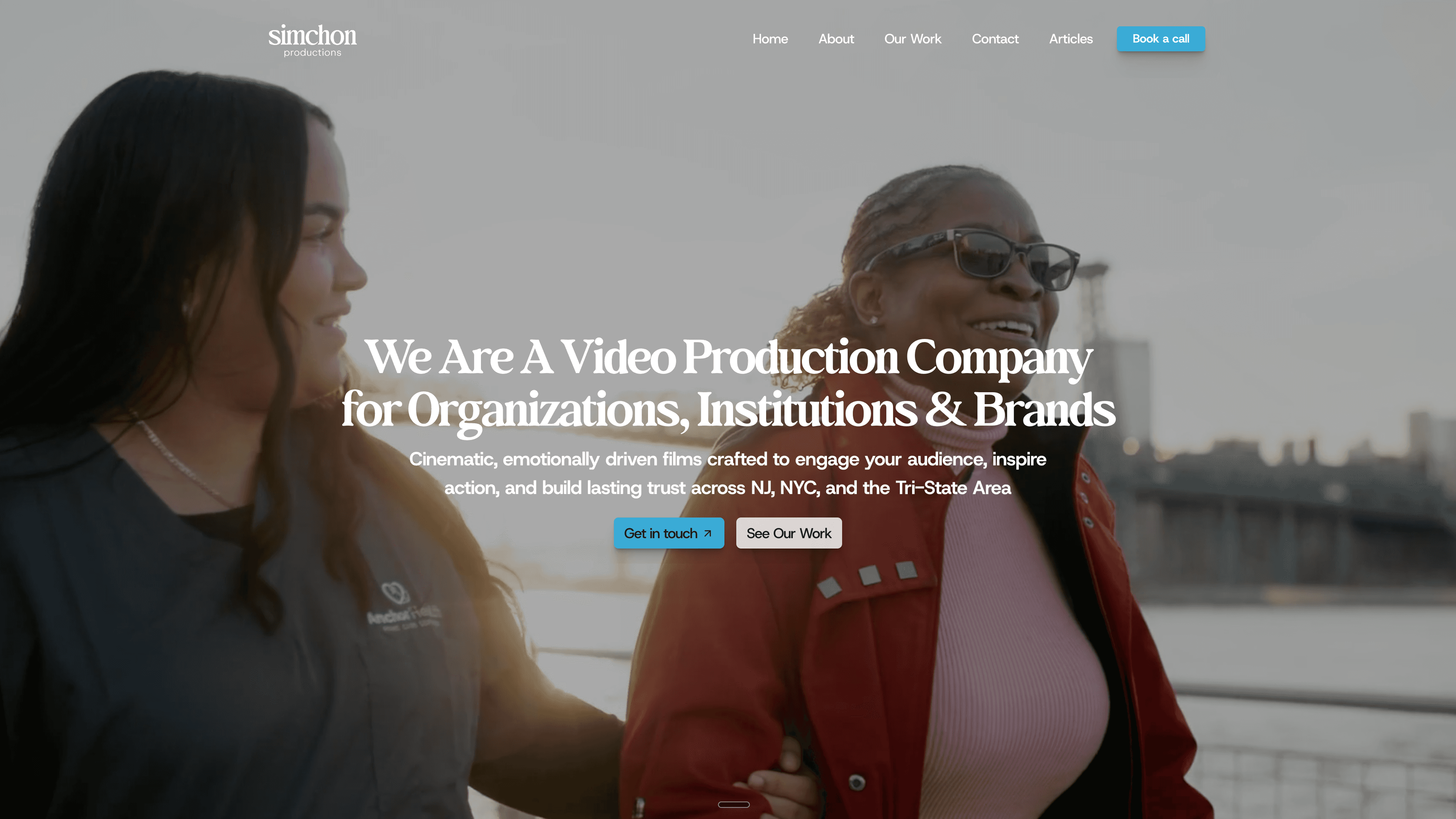
Simchon Productions specializes in documentary-style brand films, caregiver spotlights, and testimonial videos built for healthcare organizations in New Jersey and the tri-state area. Every project starts with a clear brief that identifies the audience, the message, and the outcome. The result is video content that works across your website, social channels, and intake process. Browse real examples of this work to see how cinematic storytelling translates into client inquiries for home health agencies. When you are ready to build a video strategy that covers every stage of the client decision process, Simchon Productions is the place to start.
FAQ
What video type converts the most home health leads?
Patient testimonial videos convert the most leads. They increase landing page conversions by up to 80% and retain 95% of the message, compared to 10% for written content.
How long should home health explainer videos be?
The optimal length for educational explainer videos is 1–3 minutes. Longer videos lose viewer attention before the key message lands.
Do short-form videos actually bring in home health clients?
Short-form videos build awareness rather than close clients directly. They generate 1,200% more shares than text posts, which expands your reach to families who are not yet actively searching.
What video format should home health agencies use for uploads?
MP4 with H.264 video encoding and AAC audio is the standard for broad compatibility in 2026. Avoid legacy formats like WMV or AVI, which cause playback failures on mobile devices.
Can video content help with caregiver recruitment as well as client acquisition?
Yes. Mission-driven caregiver spotlight videos attract purpose-aligned applicants and can double interview show-up rates, making them one of the highest-return video investments for home health agencies.