Discover the role of cinematic video in event marketing. Learn how it boosts engagement and drives ticket sales like never before.

Cinematic Video’s Role in Event Marketing Success
Cinematic video in event marketing is defined as the use of film-grade storytelling, narrative structure, and intentional post-production to promote events and drive audience engagement. This is not a nice extra. It is the central tool that separates events that sell out from events that struggle to fill seats. Video campaigns show a 7.79% engagement rate compared to 4.51% without video. That gap is the difference between a campaign that builds momentum and one that goes unnoticed. The IAEE has documented a clear shift toward video-first strategies, and platforms like YouTube, with over 2.5 billion users, have made cinematic event content more accessible and measurable than ever before.
What measurable impact does cinematic video have on event marketing outcomes?
The numbers behind video-driven event campaigns are hard to argue with. Video campaigns reduce cost per ticket buyer by 28.4% compared to non-video campaigns. That means you are spending less to acquire each attendee while reaching more people organically through shares and social proof.
Engagement rate is the metric that matters most early in a campaign. Engagement rate outperforms return on ad spend as a momentum indicator for live event ticket sales. When people share, comment on, and save your event video, they are doing your marketing for you.

YouTube’s scale makes it the most powerful platform for event promotion. YouTube reaches 40% of Shorts viewers who are not active on TikTok. That is a distinct audience segment you cannot reach through any other single platform. Festival aftermovies, speaker highlight reels, and behind-the-scenes series all perform well here because they give potential attendees a real preview of the experience.
Connected TV adds another layer of reach. Connected TV accounts for 20–30% of YouTube ad spend in some markets. Cinematic event ads shown on a large screen in a living room create a very different impression than a phone-sized clip. That immersive, lean-back viewing environment is where emotional storytelling lands hardest.
“The biggest mistake organizations make is not adopting a video-first mindset that treats events as year-round content engines fostering long-term sponsor and attendee engagement.” — IAEE
The IAEE’s position is clear. Video is no longer a post-event deliverable. It is the engine that drives ticket sales, sponsor value, and attendee loyalty across the entire event calendar.
How does cinematic video storytelling differ from standard event coverage?
Standard event coverage captures what happened. Cinematic storytelling makes you feel like you were there, and makes you wish you had been. That distinction drives every production decision.
Narrative arc and emotional pacing
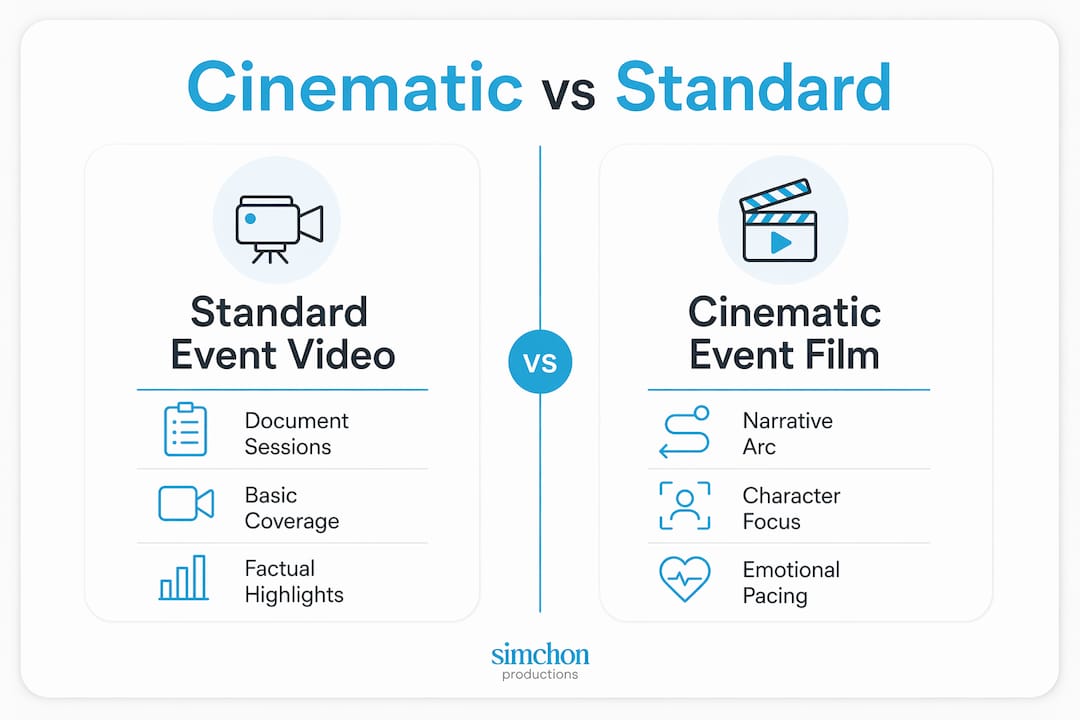
Cinematic event films emphasize rhythmic editing, color grading, and narrative arcs that reflect the emotional texture of the event. A standard highlight reel cuts from speaker to speaker. A cinematic film builds tension, releases it, and leaves the viewer with a feeling. That feeling is what motivates someone to buy a ticket next year.
The technical elements serve the story. Color grading sets the mood before a single word is spoken. Lighting choices signal whether the event is intimate or electric. Pacing controls how the viewer’s energy rises and falls throughout the film. None of these are decorative. They are deliberate choices that shape the viewer’s emotional response.
Cinematic vs. standard event video: what actually changes
Feature | Standard event video | Cinematic event film |
|---|---|---|
Primary goal | Document sessions and highlights | Create emotional connection |
Editing approach | Chronological cuts | Narrative arc with pacing |
Color and lighting | Corrected for accuracy | Graded for mood and tone |
Character focus | General crowd and speakers | Specific attendee journeys |
Post-production depth | Basic assembly | Intentional sound design and color work |
Marketing shelf life | Short, event-specific | Long, reusable across campaigns |
High production value alone does not guarantee storytelling success. An effective cinematic event video requires clear character development and an emotional narrative arc. Without those elements, even a technically perfect film fails to move the viewer.
Pro Tip: Follow one or two specific attendees through your event film. Their personal journey gives the viewer a character to root for, which is far more compelling than a montage of crowd shots.
What practical strategies integrate cinematic video into year-round campaigns?
The IAEE frames video as a year-round attendee acquisition tool rather than a post-event recap. That reframe changes everything about how you plan, shoot, and distribute your content. Here is how to build that into your marketing calendar.
Build a pre-event series. Start publishing cinematic content six to eight weeks before the event. Speaker profiles, venue walkthroughs, and sponsor spotlights give potential attendees a reason to follow along before they commit to a ticket.
Run a daily highlight studio on-site. Capture and publish short cinematic clips each day of the event. These clips serve two purposes: they reward current attendees with shareable content, and they create urgency for anyone who is still on the fence about attending future editions.
Integrate sponsor branding into the narrative. Sponsor logos on a banner are forgettable. A cinematic segment that shows a sponsor’s product solving a real attendee problem is memorable. This approach increases sponsor satisfaction and makes your event more attractive to future partners.
Distribute across platforms with format variations. A three-minute cinematic aftermovie works on YouTube and your event website. A 30-second vertical cut works on Instagram and YouTube Shorts. A 15-second teaser works as a paid ad. One shoot can produce all three if you plan for it in advance.
Feed video into email nurturing sequences. Embed short clips into your post-event email series. Video in email consistently outperforms static images for click-through rates, and it keeps your event top of mind during the registration window for next year.
Pro Tip: Plan your distribution strategy before the shoot, not after. Knowing you need a 9:16 vertical cut changes how your camera operators frame shots on the day.
Event video works best as a living content ecosystem integrated across email, social, sales enablement, and web rather than as a standalone clip. Marketers who treat each video as a one-off asset leave most of its value on the table.
What are best practices for producing cinematic event videos?
Production quality starts with the right partner. Choosing a boutique film production partner improves communication, reliability, and artistic alignment. Boutique teams are typically more invested in your specific event’s aesthetic than large generalist crews. They also move faster during editing, which matters when you need clips published the same day.
Here is what to prioritize when planning your production:
Capture authentic B-roll first. Authentic, non-staged interactions drive the strongest social media engagement compared to formal or posed footage. Brief your crew to observe and capture rather than direct.
Plan your lighting before the event. Venue lighting is rarely cinematic. Bring portable LED panels for interview setups and key moments. Good lighting in post-production is expensive. Good lighting on the day is cheap.
Shoot for the edit. Capture cutaways, reaction shots, and environmental details that give your editor options. A skilled editor cannot build a narrative arc without raw material to work with.
Organize your file delivery system. Label footage by location, time of day, and content type before it goes to the editor. Disorganized files add hours to the editing process and increase the chance of missing key moments.
Request multi-format outputs from your editor. Specify the aspect ratios, lengths, and platform destinations you need before editing begins. Changing formats after the edit is complete costs time and money.
The digital legacy of an event depends on cinematic production quality, which conveys the event’s scale and atmosphere and extends its marketing value indefinitely. A well-produced event film from this year will still be driving registrations three years from now.
Pro Tip: Ask your production partner to deliver a “social cut” within 24 hours of the event’s final day. Publishing while the event is still trending maximizes organic reach and attendee sharing.
If you are evaluating production partners, the guide on how to hire a video production company covers the key questions to ask before signing any contract.
Key Takeaways
Cinematic video is the most cost-effective tool in event marketing because it reduces acquisition costs, extends content shelf life, and builds the emotional connection that turns viewers into ticket buyers.
Point | Details |
|---|---|
Video drives measurable results | Video campaigns achieve 7.79% engagement and cut cost per ticket buyer by 28.4%. |
Storytelling separates cinematic from standard | Narrative arc, color grading, and character focus create emotional impact that highlight reels cannot. |
Year-round strategy multiplies ROI | Treat event video as a content ecosystem across email, social, and connected TV, not a one-time asset. |
Authentic B-roll outperforms staged content | Non-staged attendee moments consistently generate stronger social engagement than formal footage. |
Partner selection determines quality | Boutique production teams deliver better artistic alignment and faster turnaround for event-specific work. |
What I have learned after years of filming events
I have filmed enough events to know that most organizations are still treating video as a deliverable rather than a strategy. They hire a crew, get a recap video, post it once, and move on. That approach wastes most of the value sitting in the footage.
The shift I have seen work is treating the event as a content production day. Every session, every hallway conversation, every sponsor activation is a potential scene in a larger story. When you walk in with that mindset, you walk out with material that can fuel your marketing for the next 12 months.
The other thing I would push back on is the idea that production value is the main variable. I have seen beautifully shot videos that nobody watched because they had no story. And I have seen modest productions that went viral because they captured something real. Character and emotional arc matter more than camera specs. Quality is the floor, not the deciding factor.
My honest advice: stop budgeting for video at the end of your event planning process. Put it at the top. The marketers who do that consistently outperform the ones who treat video as an afterthought. The footage you capture on event day cannot be recreated. Plan for it, or lose it.
— Tzvi Simchon
Simchon Productions’ cinematic event video services
Simchon Productions specializes in cinematic event films that go well beyond standard coverage. Based in New Jersey and serving the tri-state area, the team builds narrative-driven films that capture the atmosphere, energy, and emotional core of your event.
Every project starts with a clear understanding of your audience and your marketing goals. The result is a film that works as a promotional asset long after the event ends. You can see the full range of event and brand film work in the production portfolio, which includes examples across nonprofit, corporate, and institutional events. If you want a production partner who treats your event as a story worth telling, Simchon Productions is the right conversation to start.
FAQ
What is cinematic video in event marketing?
Cinematic video in event marketing uses film-grade production techniques, including narrative arc, color grading, and intentional editing, to promote events and drive audience engagement beyond standard highlight coverage.
How does video improve event ticket sales?
Video campaigns achieve a 7.79% engagement rate compared to 4.51% without video and reduce cost per ticket buyer by 28.4%, making video the most cost-effective channel for live event promotion.
What makes cinematic event video different from a highlight reel?
A highlight reel documents what happened. A cinematic event film follows a narrative arc with character focus, pacing, and emotional design that motivates viewers to attend future editions.
How should marketers distribute cinematic event videos?
Distribute across YouTube, Instagram, email sequences, and connected TV using platform-specific format variations. Treating event video as a content ecosystem rather than a single clip significantly extends its marketing reach and ROI.
When should event video production be planned?
Production planning should begin at the same time as event planning, not after. Knowing your distribution needs before the shoot determines how your crew captures footage and what formats your editor delivers.