Discover why cinematic video builds patient trust. Learn how healthcare videos create emotional connections and alleviate anxiety before appointments.
Why Cinematic Video Builds Patient Trust That Lasts
Cinematic video is the most effective medium healthcare organizations have to build patient trust before a single appointment is scheduled. It works because it does something text and static images cannot: it shows real faces, real environments, and real emotion. A patient watching a well-crafted healthcare video sees the doctor’s tone, the front desk staff’s warmth, and the facility’s atmosphere. That visual and emotional information reduces anxiety and creates familiarity. This is why cinematic video builds patient trust at a level no brochure or website copy can match. Simchon Productions has built its entire practice around this principle, producing documentary-style films and brand videos that give healthcare organizations a credible, human presence before patients ever walk through the door.
Why cinematic video builds patient trust in healthcare
Cinematic video acts as a digital handshake, humanizing providers and reducing patient anxiety before the first visit. That is not a metaphor. It is a measurable behavioral shift. When patients see a physician’s facial expressions, hear their tone, and observe the physical environment on screen, they arrive at appointments with lower anxiety and higher confidence.
Healthcare is a trust-sensitive industry. Patients are not shopping for a product. They are making decisions about their health, their family members’ care, and their personal safety. A text-heavy website does not answer the question patients are really asking: “Can I trust these people?” Video answers that question directly and visually.
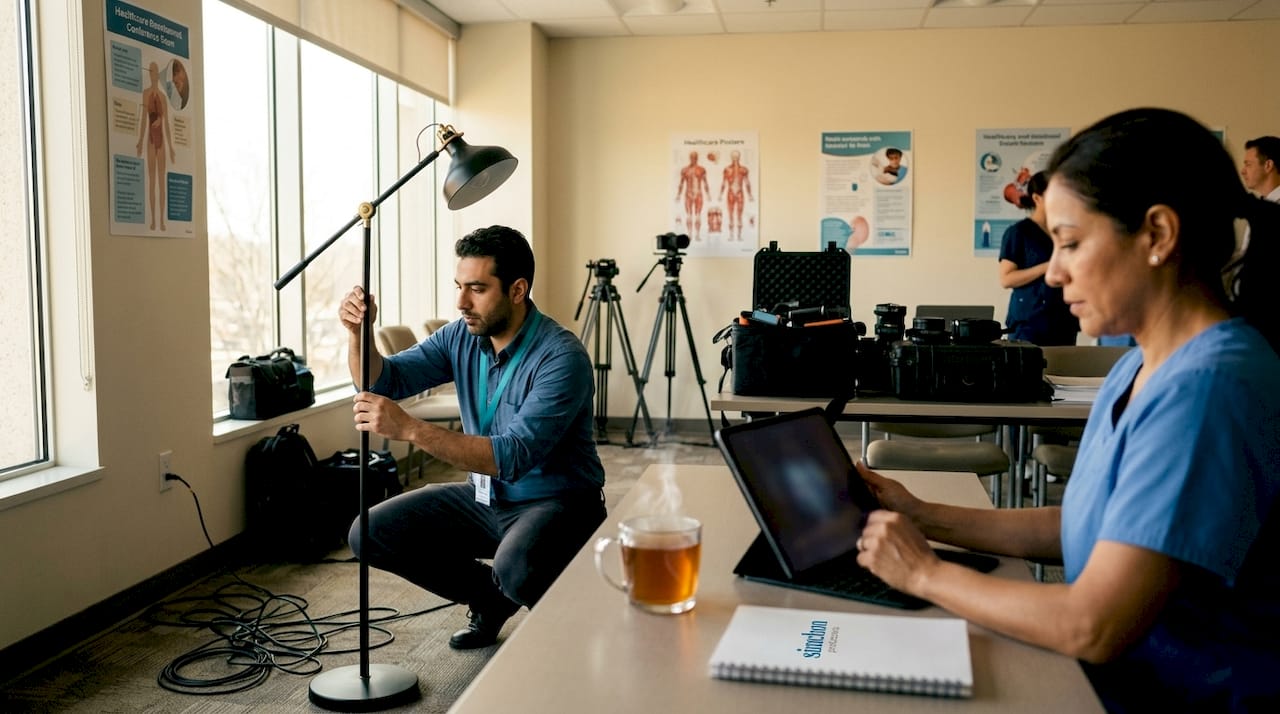
The industry term for this category of content is “healthcare brand film,” though the broader concept covers educational clips, caregiver profiles, facility walkthroughs, and documentary-style storytelling. The phrase “cinematic video” signals production quality and intentional visual storytelling, which distinguishes this content from a smartphone recording or a generic stock footage reel. Both the quality and the authenticity matter. One without the other produces content that either looks polished but feels fake, or feels real but looks unprofessional.
How authentic storytelling creates lasting patient trust
Long-form, unscripted storytelling is the foundation of effective healthcare video. Healthcare marketing campaigns that use curiosity-driven authentic content achieve viewer retention rates of 60–70%. That retention rate matters because it means patients are watching long enough to form a genuine impression of the provider.
The key word is “unscripted.” Scripted testimonials and staged interactions read as advertising. Patients recognize them immediately, and the recognition triggers skepticism rather than trust. Authentic, vérité-style storytelling that depicts real caregiving moments increases caregiver pride and translates directly to higher patient and family trust.
“Giving frontline caregivers a platform in cinematic storytelling transforms institutional marketing into a shared community narrative that builds authentic trust. When staff feel seen and represented, that authenticity comes through on screen and patients feel it.”
Three elements define authentic healthcare storytelling:
Real staff in real situations. Show a nurse doing rounds, a physician explaining a diagnosis, or a front desk coordinator welcoming a patient. These moments are more persuasive than any scripted line.
Curiosity-driven openings. Start with a question, a patient challenge, or an unexpected moment. Institutional explanations push viewers away. Genuine human moments pull them in.
Minimal staging. The camera should follow the story, not direct it. Vérité filmmaking, which means observational documentary-style shooting, captures the texture of real care that staged content cannot replicate.
The build first, distribute second approach is the most effective production strategy. Create a long-form anchor piece first. Then extract shorter clips for social media and email campaigns. This architecture produces stronger trust and engagement than leading with influencer content or short promotional clips.
Do simple educational videos outperform high-budget ads?
The answer is yes, and the reason is counterintuitive. Simple one-minute educational clips explaining common conditions outperform high-budget promotional productions for patient engagement and trust. Patients do not want to be advertised to. They want to be helped.
An educational clip that explains what to expect during a colonoscopy, how to manage a new diabetes diagnosis, or what the intake process looks like at a new practice does three things at once:
It provides real value to the viewer before they become a patient.
It positions the provider as a helpful resource rather than a sales entity.
It reduces appointment anxiety by making the unknown familiar.
Presence, tone, and clarity matter more than production budget in this format. A physician speaking calmly and directly to the camera, explaining a procedure in plain language, builds more credibility than a glossy promotional video with drone shots and background music. Overproduced video content can trigger patient skepticism because it feels like advertising. Authenticity and simplicity are what patients actually respond to.
Pro Tip: Film your educational clips in the actual clinical environment, not a studio. The familiar setting, exam tables, equipment, and real lighting, signals authenticity and helps patients visualize their own visit.
Healthcare awareness videos, which explain conditions, procedures, and what patients can expect, are one of the most underleveraged formats in healthcare marketing. They are relatively low cost to produce and deliver consistent trust-building value over months or years after publication.
How brand films build institutional credibility and patient confidence
Medical brand films reduce uncertainty by showing real environments and workflows. When a patient watches a facility walkthrough, sees the waiting room, meets the front desk team, and hears from the medical director, they arrive with a mental map of the experience. That familiarity lowers anxiety and increases the likelihood they will follow through on scheduling.
Consistency in visual tone and messaging across all healthcare video content creates a perception of organizational stability. A practice that looks and sounds the same across its website, social media, and waiting room screens signals that it is organized, professional, and reliable. Inconsistency in visual style, on the other hand, creates subtle doubt.
A strong brand film includes three layers of voice:
Leadership. A physician or administrator speaking to mission and values establishes authority and direction.
Frontline caregivers. Nurses, medical assistants, and support staff humanize the organization and show patients who they will actually interact with.
Patient voices. Real patient testimonials, filmed without heavy scripting, provide social proof that the care experience matches the promise.
Medical brand films that show real facilities, staff, and workflows build institutional credibility by creating familiarity and setting realistic patient expectations. This is not a short-term campaign asset. A well-produced brand film delivers value for two to three years, making it one of the highest-return investments in a healthcare marketing budget.
Best practices for producing cinematic healthcare videos
Effective healthcare video production follows a clear set of principles. The most important one is this: authenticity is not an accident. It requires deliberate choices at every stage of production.
Follow the 80/20 rule. Focus 80% of content on unscripted staff performing actual tasks and authentic leadership conversations. Reserve the remaining 20% for intentional framing and context-setting.
Cut the filler shots. Drone footage of the building exterior, stock footage of hands shaking, and generic B-roll of waiting rooms add nothing. They signal that the production team ran out of real content.
Use vérité-style filming. Let the camera follow real moments rather than directing them. This approach captures the texture of genuine care that staged content cannot replicate.
Build long-form first. Produce a 5–10 minute anchor film before creating short clips. The long-form piece gives you the raw material for dozens of shorter social and email assets.
Balance authenticity with professionalism. Unscripted does not mean unplanned. Good pre-production, proper lighting, and quality audio are non-negotiable. They signal respect for the viewer’s time.
Pro Tip: Interview staff and leadership separately before filming begins. Ask them to describe a moment when they felt proud of the care their team delivered. Those answers become the emotional spine of the film.
The vérité approach works because it removes the performance layer. When staff are not reading from a script, their genuine commitment to patient care comes through. Patients recognize that commitment, and it builds the kind of trust that no amount of polished advertising can manufacture.
Key Takeaways
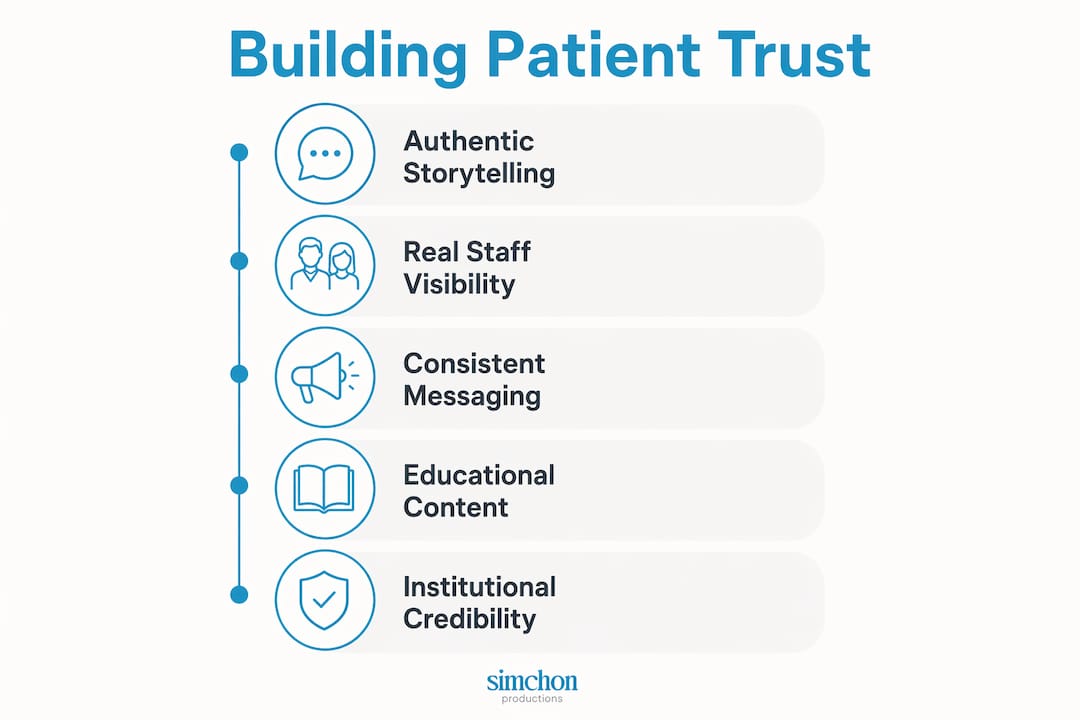
Cinematic healthcare video builds patient trust by combining authentic storytelling, real staff visibility, and consistent visual tone into a format that reduces anxiety and establishes credibility before the first visit.
Point | Details |
|---|---|
Authenticity drives retention | Unscripted, vérité-style storytelling achieves 60–70% viewer retention in healthcare campaigns. |
Educational clips outperform ads | Simple one-minute educational videos build more patient trust than high-budget promotional content. |
Brand films reduce patient anxiety | Showing real facilities and staff creates familiarity that lowers appointment anxiety and increases follow-through. |
Build long-form first | Produce a full anchor film before extracting short social clips for stronger trust and engagement. |
Consistency signals stability | Unified visual tone across all video content creates a perception of organizational reliability. |
What I’ve learned about video and patient trust after years in this work
I see a pattern repeat itself constantly in healthcare marketing. An organization invests in a polished promotional video, complete with sweeping drone shots, a professional voiceover, and stock footage of smiling patients. It looks expensive. And it performs poorly. Patients scroll past it because it feels like an ad, and they are right. It is an ad.
The organizations that see real results from video are the ones willing to show the unglamorous truth of good care. A physician who takes an extra five minutes to explain a diagnosis. A nurse who remembers a patient’s name from six months ago. A front desk coordinator who calls to check in after a difficult appointment. These are the moments that build trust. They are also the moments that most healthcare marketing teams are afraid to put on camera, because they feel too small.
They are not too small. They are the whole point.
What video does that no other medium can match is collapse the distance between a digital presence and a real-world relationship. A patient who has watched your physician explain a procedure on video does not walk into the appointment as a stranger. They walk in as someone who already has a sense of who you are. That head start is worth more than any advertising campaign.
My honest advice to healthcare marketers: stop asking “how do we look good on camera?” Start asking “what do we want patients to feel before they arrive?” Answer that question first. Then build the video around it.
— Tzvi
How Simchon Productions helps healthcare organizations build trust through film
Healthcare organizations in the tri-state area work with Simchon Productions to create cinematic films that do exactly what this article describes: show real people, real environments, and real care in a way that patients trust.
Simchon Productions produces healthcare brand films, educational clips, caregiver profiles, and documentary-style content built around authentic storytelling. Every project starts with a clear framework for identifying the audience and delivering focused messaging that connects. The result is video content that works long after the campaign ends. Browse the full production portfolio to see real examples of cinematic healthcare storytelling that builds patient confidence from the first view.
FAQ
Why does cinematic video build patient trust better than text?
Cinematic video communicates facial expressions, tone, and environment simultaneously, giving patients the emotional and visual information they need to feel safe before their first visit. Text cannot replicate that experience.
What is the most effective type of healthcare video for trust-building?
Authentic, vérité-style brand films and simple educational clips consistently outperform high-budget promotional videos because patients respond to genuine human moments rather than polished advertising.
How long should a healthcare brand film be?
A long-form anchor film of 5–10 minutes works best as the primary trust-building asset. Shorter clips of 60–90 seconds can then be extracted for social media and email distribution.
Do patient testimonials in healthcare videos actually work?
Real, lightly scripted patient testimonials build strong social proof when filmed in natural settings. Heavily scripted or staged testimonials trigger skepticism and reduce credibility.
How often should a healthcare organization produce new video content?
A core brand film every two to three years, supplemented by quarterly educational clips and caregiver profiles, maintains a consistent and credible video presence that keeps patient trust current.