Discover what a capital campaign video is and how it can boost your nonprofit's fundraising efforts. Inspire community support today!
What Is a Capital Campaign Video for Nonprofits?
A capital campaign video is a purpose-driven film that nonprofits use to communicate the vision, goals, and donor impact of a major fundraising initiative. Unlike a general fundraising video, this format serves a specific strategic role: it launches publicly only after the organization has secured the bulk of its campaign goal, and it carries the full weight of inspiring community-wide giving. If you lead a nonprofit or manage its communications, understanding this tool is the difference between a campaign that builds momentum and one that stalls before it starts.
What is a capital campaign video and how does it differ from other fundraising videos?
A capital campaign video is defined as a cinematic, mission-driven film produced specifically to support a time-limited fundraising initiative focused on major capital projects. These projects include new construction, building renovations, or endowment growth. The video’s job is not just to inform. It must inspire donors to see themselves as essential participants in a shared vision.
General fundraising videos ask for annual gifts or event support. A capital campaign video operates at a different scale. It represents years of planning, a defined financial goal, and a clear deadline. The production must reflect that weight. Donors watching it should feel the significance of the moment, not just the urgency of a donation ask.
The industry term for this format is a “campaign vision video” or “case for support video.” Both phrases describe the same function: translating a written case for support into a visual, emotional experience that donors can connect with personally.
How do capital campaign videos fit into the phases of a capital campaign?
Capital campaigns follow a structured sequence, and the video’s placement within that sequence is not optional. Getting the timing wrong is one of the most common and costly mistakes nonprofits make.
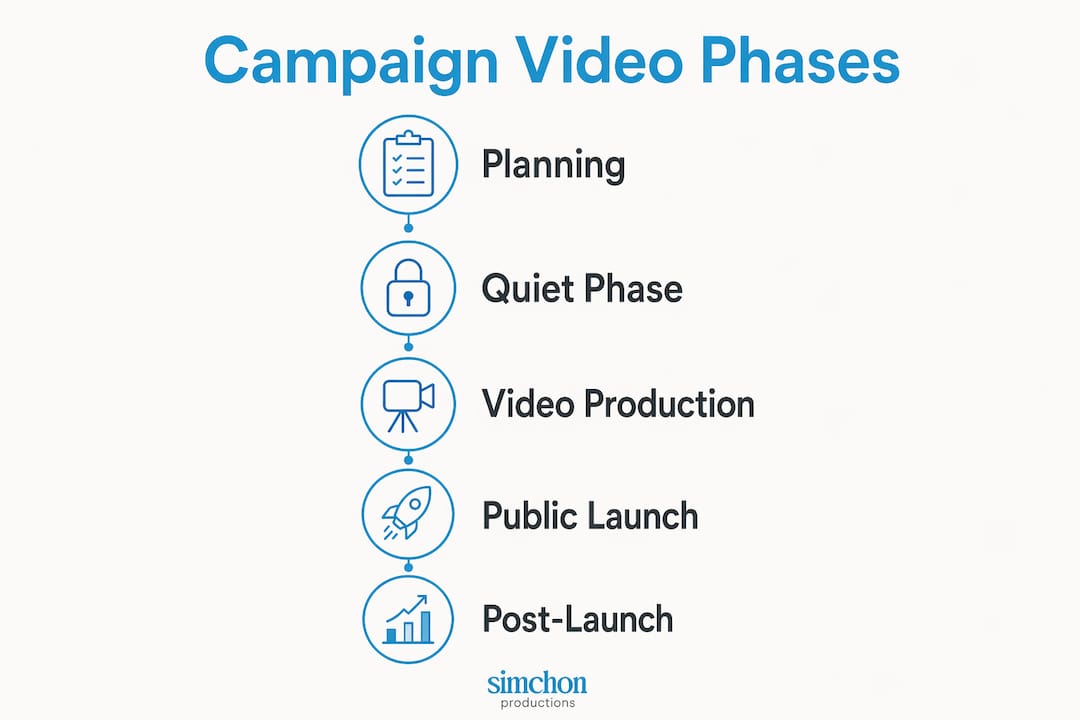
A typical capital campaign runs 3 to 7 years from planning through completion. That timeline breaks into four phases:
Planning and feasibility. The organization conducts a feasibility study to assess donor readiness, define realistic goals, and identify lead donors. No video is needed here. The work is internal.
Quiet phase. Leadership approaches major donors privately. The goal is to secure 90–95% of the campaign target before any public announcement. This phase can last one to three years.
Public launch. The campaign video premieres here. It is often shown at a gala, a giving day event, or a community gathering. The video’s job is to convert community awareness into broad donor participation.
Stewardship and closing. Shorter follow-up videos, donor testimonials, and progress updates sustain engagement through the final stretch.
Releasing a campaign video before major gifts are secured risks undermining donor confidence. When the public sees a polished video before leadership has committed, the campaign can feel premature. Major donors who have not yet given may hesitate, sensing the organization jumped ahead of its own momentum.
Pro Tip: Wait until your quiet phase is complete before producing the final campaign video. Use that time to gather real donor stories and leadership interviews that will make the public-phase video far more credible.
What messaging strategies make capital campaign videos most effective?
The biggest shift in capital campaign video strategy over the past decade is the move away from organizational needs toward donor-centric storytelling. This change is not cosmetic. It reflects a deeper understanding of why donors give.
Donors give more generously when they trust leadership, understand the mission, feel inspired, and believe their sacrifice matters. A video that focuses only on the building project or the dollar goal misses three of those four drivers. The most effective campaign videos put the donor at the center of the story.
Messaging has shifted to helping donors visualize their personal role and impact rather than focusing solely on organizational needs. That means showing the future the donor makes possible, not just the problem the organization is trying to solve. A university video that shows a first-generation student walking into a new scholarship center lands harder than one that lists square footage and construction costs.
Effective messaging in a capital campaign video typically does the following:
Leads with vision, not need. The opening frames the future, not the deficit.
Features real voices. Leadership interviews, beneficiary stories, and donor testimonials build trust faster than narration alone.
Makes the goal personal. Specific naming opportunities, impact milestones, and community outcomes give donors a concrete role.
Avoids jargon. Campaign language like “transformational gift” or “lead donor” belongs in the case document, not the video.
Closes with a clear invitation. The video ends with a specific, direct call to join the campaign, not a vague appeal to “support our mission.”
“The primary goal of a capital campaign video is alignment. Donors need to understand the vision, believe in the long-term impact, and see exactly where they fit. Production quality matters far less than clarity and trust.”
— Impact Stewardship Resources
This is why alignment over production gloss is the defining principle of effective campaign video strategy. A beautifully shot video with weak messaging will underperform a simpler video that connects emotionally and communicates clearly.
What are key elements and best practices for creating an impactful campaign video?
Creating a capital campaign video requires decisions about content, length, tone, and distribution. Each choice either strengthens or weakens the video’s ability to move donors.
Core production elements
The most effective campaign videos share several structural features. Leadership presence is non-negotiable. Donors need to see and hear the people responsible for the campaign. A pastor, university president, or executive director speaking directly to camera builds the personal trust that written materials cannot replicate.
Authentic B-roll matters as much as interviews. Footage of the actual facility, the people it serves, and the community it affects grounds the vision in reality. Renderings and architectural drawings can supplement, but they should not dominate.
Length depends on the venue. A flagship vision video shown at a public launch event typically runs 4 to 6 minutes. Shorter interview-style clips of 60 to 90 seconds work better for email campaigns, social media, and donor portals. Layered video strategies that combine a flagship video with shorter supporting clips sustain donor engagement across the full campaign timeline.
Pro Tip: Produce your flagship video and at least two or three short interview clips in the same production session. The incremental cost is low, and you will have content ready for every campaign phase.
Distribution channels that extend reach
A capital campaign video does not live in one place. Digital communication channels including email, social media, and donor portals all extend the video’s reach beyond the launch event. Each channel serves a different segment of your donor base and reinforces the campaign message at different points in the giving cycle.
Gala or giving day premiere. Maximum emotional impact in a live setting.
Email sequences. Targeted sends to donor segments with personalized messaging.
Social media clips. Short excerpts drive awareness and reach new audiences.
Donor portals and campaign websites. Permanent home for the full video and supporting content.
Board and volunteer presentations. Equips your internal champions with a consistent message.
For guidance on hiring a video production company that understands nonprofit campaign needs, look for producers with documented experience in mission-driven storytelling, not just commercial work.
What are compelling capital campaign video examples and their impact?
Different campaign phases call for different video formats. Understanding which type fits which moment helps nonprofit leaders plan production budgets and timelines more effectively.
Video type | Best use case | Primary goal |
|---|---|---|
Flagship vision video | Public launch gala or giving day | Inspire broad donor participation |
Leadership interview | Quiet phase donor meetings | Build personal trust with major donors |
Beneficiary story short | Email and social media campaigns | Connect donors emotionally to impact |
Progress update video | Mid-campaign stewardship | Sustain momentum and recognize donors |
Closing celebration film | Campaign conclusion event | Honor donors and document legacy |
Campaign videos are often launched publicly at galas or giving days, featuring donor testimonials and leadership vision casting. Franklin College’s $40 million campaign launch is a recent example of this approach, using a public premiere event to generate community excitement and broad participation.
University capital campaign videos follow the same structure but often emphasize student outcomes, faculty research, and naming opportunities for buildings or scholarships. The emotional core is the same: show the donor the future they are funding. A community impact video approach works particularly well here, grounding the campaign’s abstract goals in specific human stories.
Donor story shorts are underused and highly effective. A 90-second video featuring a donor explaining why they gave, in their own words, carries more persuasive weight than any amount of organizational messaging. These clips work at every campaign phase and cost relatively little to produce alongside the flagship video.
Key Takeaways
A capital campaign video succeeds when it launches at the right moment, centers the donor’s perspective, and layers multiple video formats across the full campaign timeline.
Point | Details |
|---|---|
Timing is everything | Launch the public video only after securing 90–95% of the campaign goal. |
Donor-centric messaging wins | Show donors their personal role and impact, not just the organization’s need. |
Alignment beats production value | Clarity and trust matter more than high-gloss visuals. |
Layer multiple video formats | Combine a flagship video with shorter clips to sustain engagement across all campaign phases. |
Distribute across every channel | Use galas, email, social media, and donor portals to maximize the video’s reach. |
What I’ve learned about campaign videos that most guides won’t tell you
I’ve worked with enough nonprofits to know that the biggest mistake is not a bad video. It’s a well-made video released at the wrong time, with the wrong message, to the wrong audience. Organizations spend months on production and then premiere the video before their board has even made their own gifts. That sequence destroys credibility with major donors faster than any production flaw ever could.
The second thing I’ve noticed is that nonprofits consistently underestimate the power of the donor voice. Leadership interviews are expected. A donor sitting on camera, unprompted, explaining why they gave their largest gift ever, is not. That kind of authenticity is what separates a video that gets polite applause from one that moves people to write checks the same night.
The shift toward donor-aligned storytelling is real, and it is accelerating. Donors, especially major donors, have seen enough institutional messaging to recognize when an organization is talking at them versus with them. The videos that perform best treat the donor as the protagonist, not the audience.
My honest advice: invest in the story before you invest in the camera. Know exactly whose voice will carry the campaign, what moment will open the video, and what specific future the donor is being invited into. Get those answers right, and the production almost takes care of itself.
— Tzvi
Simchon Productions and nonprofit capital campaign video
Nonprofits working on capital campaigns need a production partner who understands the fundraising cycle, not just the camera. Simchon Productions specializes in documentary-style nonprofit videos for organizations in New Jersey and the tri-state area, with a focus on authentic storytelling that connects donors to mission.
The team at Simchon Productions builds each campaign video around a clear framework: identify the audience, define the message, and capture the moments that carry emotional weight. The result is a film that works in a gala ballroom, an email inbox, and a board presentation. You can review past nonprofit projects to see how this approach translates across different campaign types and organizational sizes. When you are ready to talk through your campaign’s video needs, Simchon Productions is a direct next step.
FAQ
What is a capital campaign video?
A capital campaign video is a purpose-built film that nonprofits use to communicate the vision, goals, and donor impact of a major fundraising initiative. It is typically premiered publicly once the organization has secured 90–95% of its campaign goal.
When should a nonprofit release its capital campaign video?
The video should launch during the public phase of the campaign, after major gifts are secured. Releasing it too early, before leadership commitments are in place, risks undermining donor confidence and stalling momentum.
How long should a capital campaign video be?
A flagship vision video typically runs 4 to 6 minutes for a live event premiere. Shorter clips of 60 to 90 seconds work best for email, social media, and ongoing stewardship throughout the campaign.
What makes a capital campaign video effective?
Effectiveness comes from donor-centric messaging, authentic leadership presence, and clear communication of the donor’s role in the campaign’s future. Production alignment with the campaign’s vision matters more than high production budgets.
What is a university capital campaign video?
A university capital campaign video follows the same structure as any campaign vision film but emphasizes student outcomes, faculty impact, and naming opportunities. It connects donors personally to the institution’s future, making abstract goals concrete through specific human stories.