Admissions teams: one-week plan to publish 30–90s student testimonial videos that feel real. When to keep it student shot or hire pros.

Student Testimonial Video for Admissions: A One-Week Plan
A student testimonial video is a short, first-person clip where a real student explains why they chose your program and what it did for them. The best ones run 30 to 90 seconds, use plain talk instead of a script, and sit right next to a call to action like “Request Info” or “Apply Now.” Your fastest path forward: pick one student with a good story, record one honest 30 to 90 second answer this week, and publish it on the page where prospects decide.
TL;DR:
Authentic student stories should focus on specific goals, challenges, program solutions, and current outcomes, including small, unscripted details to build trust.
Recruiting suitable students involves a targeted outreach process using open-ended questions and clear consent procedures, not just scripted prompts or polished performances.
The optimal video length is between 30 and 90 seconds, with captioning and platform-specific edits maximizing reach and effectiveness across web, email, and social media.
Placement near calls to action on program pages, inquiry forms, and paid social ads significantly increases engagement and inquiry conversions.
Most successful testimonial videos come from simple, real recordings that emphasize story over production quality, prioritizing authenticity over cinematic polish.
Table of Contents
What Is a Student Testimonial Video and When Should You Use It?
What Makes a Student Testimonial Feel Authentic Instead of Staged?
How Do You Find, Brief, and Prepare Students to Record?
What’s the Filming Checklist for DIY or Pro-Led Shoots?
How Long Should the Edit Be and How Do You Repurpose It?
Where Should Testimonial Videos Go and How Do You Measure Results?
How Does Simchon Productions Approach Student Testimonial Videos?
Your One-Week Plan to Launch a Student Testimonial Video
Why Most Testimonial Advice Gets the Priority Backward
Ready to Produce a Testimonial Video That Actually Converts?
Sources
FAQ
What Is a Student Testimonial Video and When Should You Use It?
A student testimonial video is a short-recorded interview where a current or former student describes their experience in their own words, aimed at proving fit to a prospect who is still deciding. It’s different from an alumni profile piece, which usually covers a career arc over several minutes, and different from a day-in-the-life video, which follows a student around campus without a direct sales angle.
Testimonial clips work best at two funnel stages: when a prospect is comparing programs (consideration) and when they’re filling out an application but hesitating (decision). You’ll see the clearest proof of impact in these spots:
Higher time-on-page when a testimonial sits above the fold on a program page
More clicks on the “Request Info” button placed directly under or beside the video
A measurable lift in inquiries once you add video to a previously text-only landing page
Universities that build out full testimonial galleries organized by program tend to give prospects more reasons to stay on the page longer, which is exactly the behavior admissions teams want to track.
What Makes a Student Testimonial Feel Authentic Instead of Staged?
A student testimonial feels authentic when it follows a real story shape and includes small, unscripted details that a marketing team couldn’t have written for the student. The shape that works almost every time has four beats:
The goal the student had before enrolling
The challenge they ran into, academic, financial, or personal
The program’s role in solving that challenge
Where they are now, in concrete terms
Skip any one of these four beats and the testimonial reads as a sales pitch instead of a story. Micro-details do the heavy lifting here. A student who mentions a specific professor’s name, a specific class project, or the exact moment they thought about dropping out sounds real because those details are too small to fake. A slight stumble over words or an unscripted laugh raises trust rather than hurting it.
Pro Tip: Ask the student to describe one specific moment instead of a general opinion. “Tell me about the day you almost quit” produces better footage than “How was your experience?”

Voice matching matters just as much as story structure. If your target persona is a first-generation college student, feature a first-generation student, not your top-ranked scholar. Prospects watch for someone who looks and sounds like them, and prospective students spot an overly polished, generic testimonial almost instantly.
How Do You Find, Brief, and Prepare Students to Record?
You find the right students by matching them to your actual admissions personas, then you invite them through a short, low-pressure outreach sequence instead of a cold ask. Start by pulling names from advisors, faculty, or your alumni office who already know which students have a strong, specific story tied to a persona you’re recruiting against: first-generation, transfer, career-changer, international, or scholarship recipient.
Run outreach as a three-touch sequence:
Pre-ask email explaining the project and time commitment (10 to 15 minutes)
Formal invite with a proposed date, location, and a small incentive (a gift card or campus swag works fine)
Reminder sent 48 hours before the shoot, with the questions attached so the student isn’t caught off guard
A three-question recording flow works well for both remote and in-person capture: an intro question to warm up, followed by two targeted questions tied to the four-part story shape above.
Use open-ended prompts instead of a script:
“What made you choose this program over others you considered?”
“Tell me about a moment when you almost gave up, and what changed.”
“What would you tell someone who’s on the fence right now?”
Before you press record, get consent locked in. A simple four-field release form covering name, date, scope of use, and signature protects your institution and avoids a scramble for clearance after the video is already edited and published.
What’s the Filming Checklist for DIY or Pro-Led Shoots?
Sound quality matters more than camera quality, so put your budget and attention there first. A student mumbling into a laptop mic ruins an otherwise great story, while decent audio on a mediocre camera still plays fine on a program page or social feed.
Run through this checklist before you start recording:
Use an external lav mic or a phone clipped close to the student’s collar, never the built-in laptop mic
Film near a window facing the student, not behind them, for free, even lighting
Shoot horizontal for web and program pages, vertical for social and stories
Frame the student with their eyes roughly a third of the way down the frame, not dead center
Grab 30 to 60 seconds of B-roll: the student walking on campus, in a classroom, at a lab bench, anything that visually backs up what they’re saying
Record at least two takes of every answer since the best line often comes on the second try
Pro Tip: Roll the camera for a full 60 seconds before you ask your first question. Nervous students loosen up once they forget the camera is running, and that’s often when the best answer comes out.
Know when to bring in a professional crew instead of doing it yourself. A DIY setup handles most single-student testimonials fine. Bring in a video production company when the story is complex enough to need multiple locations, when you need cinematic B-roll for a flagship campaign, or when the video will run as paid media and needs to hold up against a much bigger production budget.
How Long Should the Edit Be and How Do You Repurpose It?
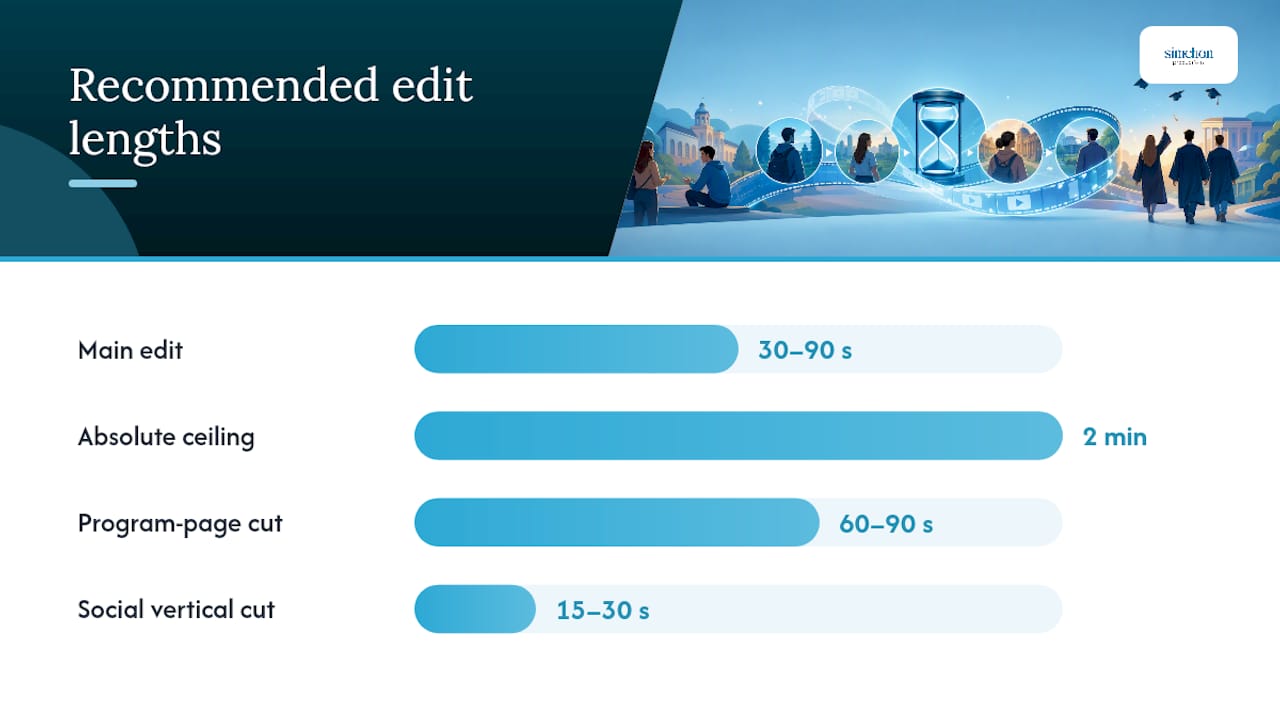
The finished video should run 30 to 90 seconds, with two minutes as an absolute ceiling. That range keeps a prospect’s attention while still fitting comfortably on a program page, in an email, or as a social ad.
Statistic Callout: Student testimonial videos perform best between 30 and 90 seconds, capped at two minutes maximum, a length recommendation that holds across web placement, email, and social distribution.
Caption every video, no exceptions. Auto-captions from your editing software are a fine starting point, but always review and correct them before publishing, since program names, professor names, and technical terms are the words auto-caption tools get wrong most often.
Get more value from a single shoot by planning your cuts before you even edit the first version:
A 60 to 90 second cut for the program page
A 15 to 30 second vertical cut for Instagram, TikTok, or paid social
A written transcript turned into a blog post or admissions page quote
Repurposing footage into shorter, platform-specific versions increases total reach without another shoot day, which matters when your production budget is fixed but your distribution needs keep growing.
Where Should Testimonial Videos Go and How Do You Measure Results?
Testimonial videos belong wherever a prospect is actively deciding, which means directly on program pages, inside your inquiry or application flow, and as short creative in paid social campaigns. A video buried on a general “About Us” page rarely gets watched because nobody visits that page while actively comparing programs.
Placement near a call to action does the real work. Positioning a testimonial next to an application button or a request-for-information form increases its persuasive effect, because a prospect at that stage wants reassurance, not more information.
Test your placement instead of guessing:
A/B test the video above the fold against the video below the fold on the same program page
Try two different thumbnail images, a smiling headshot versus a candid campus shot, and compare click rates
Track click-through rate to your inquiry form, average time on page, and any lift in completed applications after the video goes live
Give a test at least two to four weeks before you draw conclusions, since inquiry and application volume naturally moves in cycles tied to your admissions calendar.
How Does Simchon Productions Approach Student Testimonial Videos?
Simchon Productions builds student testimonial videos around a four-step framework: audience, story, capture, finish. Every project starts by identifying exactly which prospect persona the video needs to reach, then finding the student whose real story matches that persona, before a single camera setting gets discussed.
Not every testimonial needs a full cinematic shoot. A single strong student telling a specific, honest story on a phone camera with good light and good audio can outperform an over-produced video that feels like an ad. A cinematic crew earns its cost when the story spans multiple locations, when the footage needs to carry a flagship recruitment campaign, or when the video will run as paid media against professionally produced competitor content.
If you’re evaluating a vendor for a testimonial project, put these items in the contract before work starts:
Final deliverables in both horizontal and vertical aspect ratios
Burned-in captions included, not billed as a separate add-on
Signed release forms collected and stored before the shoot wraps
A clear timeline from shoot day to final delivery
Ownership and usage rights for the footage spelled out in writing
Simchon Productions’ portfolio of testimonial and recruitment work shows how this framework plays out across different institutions and story types.
Your One-Week Plan to Launch a Student Testimonial Video
Run this as a three-step plan: recruit, record, publish. Recruit your student and lock the shoot date within two days. Record the interview and B-roll in a single session, roughly 60 to 90 minutes total including setup. Publish the finished 30 to 90 second cut on one program page within a week of the shoot.
Before you hit publish, confirm:
The release form is signed and filed
Captions are reviewed and corrected, not just auto-generated
The video sits within 30 to 90 seconds
It’s placed near a request-info or apply button
You’ve set a date to check inquiry numbers against the page’s baseline
Test one video on one program page this month before you plan a bigger campaign.
Why Most Testimonial Advice Gets the Priority Backward
The conventional advice treats production polish as the goal and authenticity as a nice bonus. That’s backward. A shaky phone video of a student describing the exact moment they almost transferred schools will outperform a beautifully lit interview full of generic praise, every time, because prospects are looking for proof of fit, not proof of your production budget.
Where I think most admissions teams go wrong is skipping the outreach and prep work because it feels like the boring part. The four-touch email sequence, the open-ended prompts, the consent form, none of that is glamorous, but it’s what actually produces a usable, honest fifteen minutes of footage. Skip it and you end up with a stiff, over-rehearsed student reading from notes, which is the exact thing prospects tune out.
My take: spend 80 percent of your effort on finding the right student and asking the right questions, and only reach for a cinematic crew once you know the story is strong enough to deserve one. Production value should amplify a good story, not disguise a weak one.
— Tzvi Simchon
Ready to Produce a Testimonial Video That Actually Converts?
Simchon Productions is the option for admissions and marketing teams who want a testimonial video that looks and sounds like real proof, not a scripted ad, without having to figure out lighting, audio gear, or editing workflow on your own. Where a DIY shoot works fine for a single quick clip, Simchon Productions handles the parts that get complicated fast: multi-location capture, cinematic B-roll, vertical and horizontal deliverables, and captioning, all built around the same audience-story-capture-finish framework covered above.
That fits any school, college, or program planning a flagship recruitment push where the story deserves more than a phone camera can deliver. The company serves institutions across various states and works from brand films to full school video campaigns. If you have one student with a strong story and a program page that needs a stronger voice, get in touch with Simchon Productions to scope out a shoot date and deliverables list before your next admissions cycle picks up.
Sources
Your program page is missing its most convincing voice | FIU Core Resource Hub
Template and example questions for student testimonials. | VocalVideo
FAQ
What Is a Student Testimonial Video?
A student testimonial video is a short, first-person recording of a current or former student describing their experience with a program, typically running 30 to 90 seconds and placed near a call to action on a program page.
How Do You Make a Student Testimonial Video?
Recruit a student who matches a target persona, send a short three-touch email invite, record their answers to two or three open-ended questions instead of a script, then edit the footage down to a 30 to 90 second cut with corrected captions.
Can You Give an Example of a Good Testimonial?
A strong example follows the four-part shape: a student states their original goal, describes a specific challenge like almost dropping out for financial reasons, explains how the program or a specific advisor helped, then names where they are now, such as a job offer or graduation date.
What Does “Testimonial Video” Mean in Admissions Marketing?
In admissions marketing, a testimonial video means a recorded, authentic student account used to reassure prospects at the consideration or decision stage, distinct from a scripted ad or a general campus tour video.
How Long Should a Student Testimonial Video Be?
Keep it between 30 and 90 seconds, with two minutes as the absolute maximum, since that range holds attention on program pages, in email, and in social feeds.
Where Should You Post a Student Testimonial Video?
Post it directly on the relevant program page near the request-info or apply button, inside your inquiry email flow, and as a short vertical cut in paid social campaigns targeting prospective students.