A filmmaker forward plan for marketers to pick, film, and edit client testimonial videos. Includes the 3-part interview arc, a production checklist, and...

Client Testimonial Video Strategy: A Filmmaker’s Guide for Marketers
A client testimonial video strategy is a plan for finding, filming, and distributing customer stories that remove a buyer’s biggest doubt. The first move is simple: pick the one client story that answers your toughest sales objection head on. From there, the work follows a clear sequence: plan the interview, produce the footage, edit for the channel, and distribute with a purpose.
TL;DR:
Authentic testimonial videos are most effective when they feature clients with measurable results, relatable problems, and clear timelines, especially when filmed right after a win.
Proper interview structure, focusing on the challenge, solution, and outcomes, helps craft a compelling story that resonates across different channels and audience needs.
Lighting and sound quality are more important than high-end equipment, with simple setups like natural light and clip-on mics sufficing for most budgets.
Editing should be tailored to each platform, with shorter versions for social media and full-length master clips for landing pages or email campaigns, all with captions for sound-off viewing.
Legal compliance requires signed releases with clear usage rights and disclosures, especially when material connections or non-typical results are involved.
Simchon ProductionsMake Client Stories ResonateSimchon Productions creates cinematic testimonial films with authentic storytelling and focused messaging for organizations, institutions, and brands.Explore Simchon Productions
Table of Contents
Why do client testimonial videos work?
How do you pick the right customers for a testimonial?
How do you structure a testimonial interview?
What production setup do testimonial videos need?
How should you edit a testimonial video for each channel?
Where should you publish testimonial videos, and what should you measure?
What do you need for consent and FTC compliance?
How does Simchon Productions approach testimonial shoots?
When should you film it yourself, and when should you hire a cinematic producer?
How can Simchon Productions help you produce testimonial videos?
Where can you learn more about testimonial rules and research?
Sources
FAQ
Why do client testimonial videos work?
Client testimonial videos work because people trust other people more than they trust brands. This isn’t a guess. Research from the American Marketing Association found that 92% of consumers prefer authentic, user-generated content over polished advertising, and campaigns using this kind of content saw a 29% boost in web conversions.
A strong majority of consumers prefer authentic content to polished ads, and user-generated content (UGC) campaigns tend to see a meaningful lift in conversions. (American Marketing Association) That statistic tells you something important: a slightly rough, honest testimonial often beats a slick commercial.
The same research found that Most consumers trust personal recommendations nearly as much as advice from friends and family. A testimonial video works the same way. It’s a recommendation with a face and a voice attached.
Testimonials outperform other marketing assets in specific situations:
Landing pages, where a skeptical visitor needs proof before filling out a form.
Sales enablement, where a rep needs a quick video to send after a tough call.
Paid social ads, where a scrolling viewer needs a reason to stop and watch.
I’ve watched a single 90-second testimonial change how a sales team closes deals. It’s not magic. It’s proof, delivered by someone the buyer can relate to.
How do you pick the right customers for a testimonial?
You pick the right customer by finding someone with a clear result, a relatable starting problem, and the willingness to speak on camera. Not every happy client makes a good subject. Some are camera shy. Some have great results but can’t explain them clearly.
Look for these traits before you reach out:
A measurable outcome. A client who saw a real number change, more patients, more revenue, faster turnaround, gives you something concrete to point to.
A relatable starting point. The client’s original problem should sound familiar to your next buyer.
Comfort on camera. A nervous, one-word answerer will fight you in the edit room.
A clear timeline. Someone who can say “before” and “after” in specific terms makes your job easier.
Once you’ve identified a few candidates, timing matters. The best moment to ask is right after a win, when the client’s enthusiasm is fresh. According to the Content Marketing Institute, offering mutual value increases participation. That means:
Give the client a copy of the finished video for their own marketing.
Offer B-roll footage they can reuse on their own channels.
Link back to their website or social profiles in your published version.
Approvals can slow things down, especially with larger companies. Build in time for review rounds and keep your file names and versions clear so nobody is confused about which cut is final.
How do you structure a testimonial interview?
You structure a testimonial interview around three parts: the challenge, the solution, and the measurable result. This arc gives the viewer a story instead of a list of compliments.
Start with questions that surface the original pain point:
“What problem were you facing before we started working together?”
“What had you already tried that didn’t work?”
Move into the solution phase:
“What changed once you started using our service?”
“Was there a specific moment when you felt confident this was working?”
Close with results and emotion:
“What number or outcome are you proudest of?”
“How would you describe the experience to a friend in your position?”
Prep your interviewee before the camera rolls. Tell them to answer in full sentences, since you can’t use “yes” as a testimonial. Ask them to restate the question in their answer. If they ramble, gently ask them to say the same thing in one sentence.
Pro Tip: Ask every question twice, once early and once near the end. People often give a sharper, more quotable answer the second time, once they’ve relaxed.
What production setup do testimonial videos need?
Testimonial videos need clean audio and good lighting far more than they need a high-end camera. A blurry frame is forgivable. Bad sound is not.
Here’s how gear choices break down by budget:
Tier | Camera | Audio | Lighting |
|---|---|---|---|
Basic | Smartphone with a tripod | Clip-on lavalier mic | Natural window light |
Hybrid | Mirrorless camera with a kit lens | Wireless lav or shotgun mic | One softbox plus window light |
Professional | Cinema camera with prime lenses | Dual wireless lavs with a boom backup | Three-point lighting setup |
Framing and setting matter as much as gear. A few rules that hold up on every shoot:
Keep the client’s eyes at the upper third of the frame, not dead center.
Choose a background that hints at their business without cluttering the shot, an office, a storefront, a workspace in use.
Ask the client to wear solid colors and avoid busy patterns or logos that compete with yours.
Let them look slightly off camera at an interviewer instead of straight into the lens, which reads as more natural.
Directing an amateur speaker takes patience. Give short, specific notes between takes, like “say that again, but slower” instead of vague feedback like “be more energetic.”
For low-budget shoots, a bedsheet over a window makes a passable diffuser, and a quiet closet full of clothes works as a makeshift sound booth. For hired crews on a bigger shoot day, run through a checklist before the client arrives: batteries charged, memory cards formatted, mic levels tested, backup audio recorder running, and a shot list printed on paper in case a device dies.

How should you edit a testimonial video for each channel?

You should edit a testimonial video differently depending on where it will run, since a viewer’s patience changes by platform. A LinkedIn post might hold attention for 60-second. A landing page video can run two to three minutes if the story earns it.
Editing rules that apply almost everywhere:
Open with the problem statement, not a slow introduction.
Cut to the specific metric or result within the first 30 seconds.
Use b-roll of the product, service, or workplace to show rather than just tell.
Add captions on every version, since most viewers watch social video with the sound off.
A practical repurposing workflow looks like this:
Cut a master version first, usually two to four minutes, with the full story intact.
Trim a 60 second cut for landing pages and email campaigns.
Cut a 30 second version for LinkedIn or paid social.
Create a 15 second vertical clip for Instagram Reels or TikTok, built around the single strongest quote.
Quote overlays help viewers who skim without sound. Pull the most quotable line and place it as bold text over the relevant b-roll. For longer-form B2B sales cycles, Klyr Media’s guide on video length points out that complex purchases often need a longer format to address multiple stakeholder concerns, while simpler products do better with shorter cuts.
Where should you publish testimonial videos, and what should you measure?
You should publish testimonial videos where the buyer is already making a decision, then measure whether the video moved them closer to saying yes. Different placements serve different jobs.
Landing pages work best for driving conversion, since the viewer is already close to a decision.
LinkedIn builds B2B credibility, especially when the testimonial comes from a recognizable company or title.
Email nurture sequences work well for warming up a slow-moving lead.
Paid social ads extend reach to people who don’t know your brand yet.
Basic optimization steps that most teams skip:
Write a descriptive video title instead of a generic file name.
Add a full transcript below the embedded video for search engines and accessibility.
Use video schema markup where your website platform supports it.
Many marketers report a positive return on investment from using video in their marketing. (American Marketing Association) That figure includes testimonials alongside demos and how-to videos, which suggests the format earns its place in a broader plan rather than standing alone.
Track a few core numbers: watch time, click-through rate from the video to a contact form, and conversion rate on pages with the video compared to pages without it. A simple A/B test, the same landing page with and without the testimonial embedded, will tell you more than any industry benchmark.
What do you need for consent and FTC compliance?
You need a signed release and a clear, visible disclosure whenever a testimonial has a material connection to your business, such as free service, payment, or a discount. Skipping this step creates legal risk, even for a small business.
A written release should include:
The exact usage rights granted, including whether the footage can run on social media, paid ads, or a website.
How long the company can use the footage, ideally stated as perpetual unless the client requests otherwise.
Which channels the footage may appear on, named specifically rather than left vague.
An approval window, so the client has a defined number of days to review before the video goes live.
The FTC’s Guides Concerning the Use of Endorsements and Testimonials state that a testimonial should never imply typical results unless you can back that claim with evidence. If one client’s results are unusual, say so on screen.
When a material connection exists, FTC guidance on disclosures requires that the disclosure be clear and conspicuous in both the visual and audible parts of the video. A caption alone, buried in a video description, is not enough.
How does Simchon Productions approach testimonial shoots?
Simchon Productions builds every testimonial shoot around a simple framework: define the audience, set the objective, choose the narrative focus, then plan distribution before a single frame is shot. That order avoids wasted footage.
A typical shoot day includes a pre-interview call, a two to three hour filming block, and b-roll capture of the client’s workspace or product in use. Standard deliverables include a master cut, three to four social edits sized for different platforms, and a folder of usable b-roll for future projects.
Clear planning up front cuts down on approval rounds later, since the client already knows what story the footage will tell.
When should you film it yourself, and when should you hire a cinematic producer?
DIY testimonial videos make sense for small budgets, quick turnarounds, and moments you need to capture right now, like a client’s reaction on the spot. Accept that the footage will look serviceable, not cinematic, and that lighting and audio will take real effort to get right on your own.
Hiring a professional makes more sense when the stakes are higher: a flagship brand story, a complex client journey, or footage you plan to reuse across a year of marketing. A working filmmaker brings lighting knowledge, sound design, and editing pace that most in-house teams don’t have time to master.
A rough heuristic that holds up: if the video will run for more than three months or across more than one paid channel, the production quality needs to match that investment.
— Tzvi Simchon
How can Simchon Productions help you produce testimonial videos?
A video production company may produce brand films, testimonial shoots, and documentary-style videos for organizations, often focusing on cinematic quality and honest storytelling. Every project starts with the same question this article walks through: which client story removes your buyer’s biggest doubt?
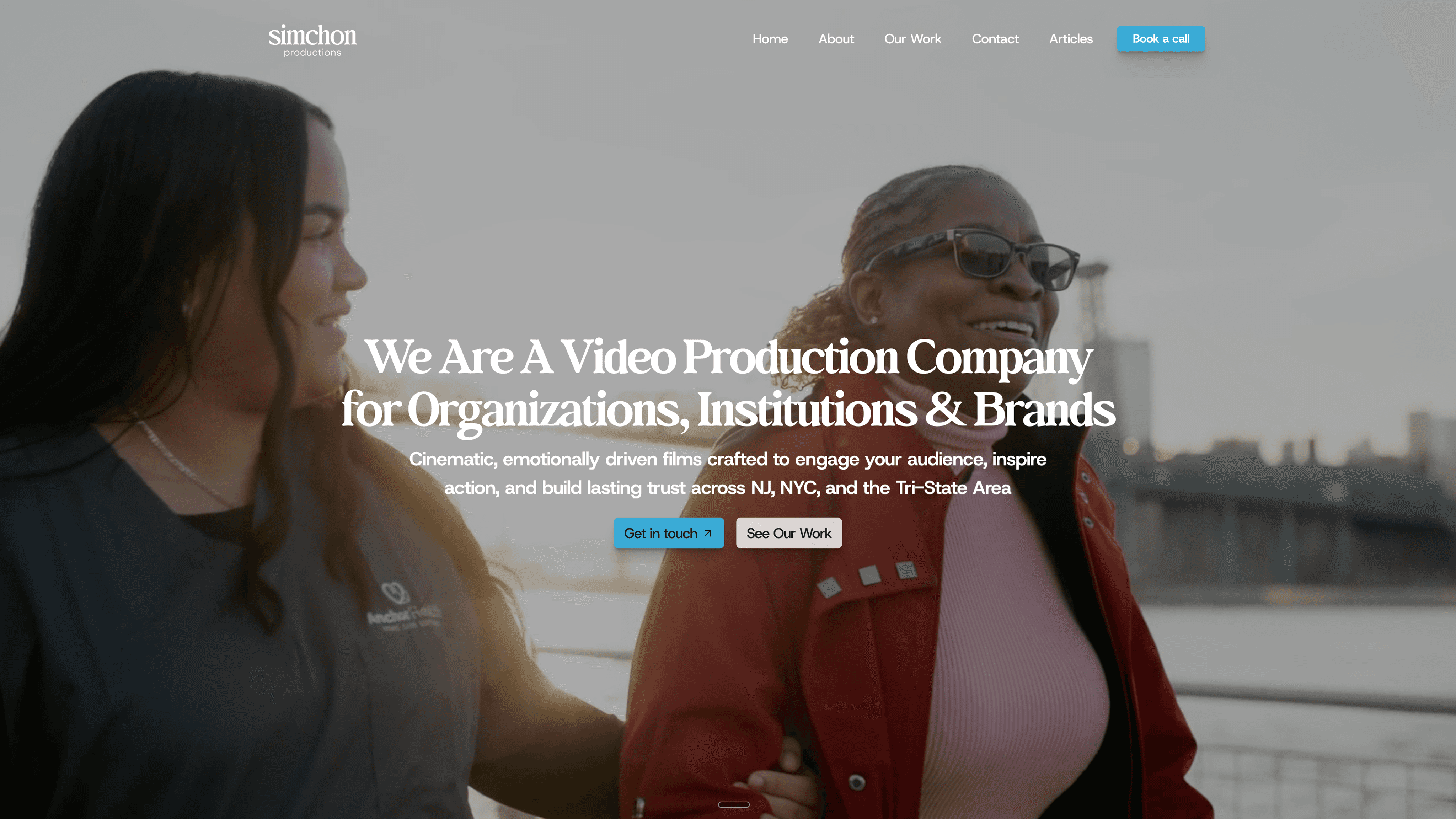
Typical video production services often include brand films and commercial videos that combine testimonial interviews with b-roll and narrative structure, documentary style and ‘About Us’ films for organizations needing longer stories, nonprofit and donor videos built around supporter and beneficiary testimonials, and healthcare, school, and event videos for institutions with specific approval and compliance requirements.
To start a project, visit the Simchon Productions site and share your goals and timeline. Every engagement is quoted based on scope, so the first conversation is about your story, not a fixed package.
Where can you learn more about testimonial rules and research?
The FTC’s endorsement guides and its disclosure guidance for video content cover the legal side in detail. For research on why user-generated content converts, the American Marketing Association publishes ongoing studies. The Content Marketing Institute offers practical guidance on building a full video distribution plan.
Sources
User-generated content is king for authenticity and conversions — American Marketing Association
16 CFR Part 255: Guides Concerning the Use of Endorsements and Testimonials in Advertising — FTC
FAQ
Can you provide some examples of client testimonial videos?
Strong examples usually follow the challenge, solution, result structure covered above, often paired with b-roll of the client’s actual workplace or product. Simchon Productions has published patient testimonial examples for hospitals and clinics that show how this structure plays out in a healthcare setting.
How can I create an effective testimonial video?
An effective testimonial video starts with picking a client whose story answers a real buyer objection, then structuring the interview around a clear before-and-after arc. Good lighting and clean audio matter more than expensive camera gear, and every version should include captions since most viewers watch without sound.
Are fake testimonials illegal?
Fake or misleading testimonials violate FTC rules, since the FTC’s endorsement guides require that endorsements reflect honest opinions and not imply results that aren’t typical or substantiated. Businesses that use fabricated reviews or testimonials risk enforcement action and reputational damage.
What kind of videos attract viewers?
Videos that open with a clear problem and show a specific, believable result tend to hold attention longest, which is why testimonials paired with b-roll perform well. Research from the American Marketing Association found that authentic, less polished content often outperforms heavily produced ads because viewers trust it more.