Discover the essentials of a K-12 video production strategy explained. Create impactful videos that boost admissions and strengthen community trust.

K-12 Video Production Strategy Explained for School Marketers
A strong K-12 video production strategy centers on one interview-driven hero film, a schedule of short social edits, and mobile-first delivery. Plan a single shoot day, pull 4–8 short clips from that footage, and you have a multi-year asset that serves admissions, fundraising, and community trust simultaneously. Entry-level projects typically deliver final files in a matter of weeks and start at a modest budget suitable for foundational needs.
First three steps to take today:
Choose one compelling subject for a 60–90 second hero interview
Plan a single shoot day covering the interview plus B-roll
Schedule three short social edits (15–30 seconds each) from that same footage
Interview-driven films, when framed around evergreen values rather than specific dates, can remain mission-useful over an extended period. That longevity is the real ROI argument for any director managing a tight budget.
Table of Contents
What is a K-12 video production strategy, and why does your school need one?
Who should K-12 videos be made for, and how do you map audience to message?
Which video formats and lengths work best for K-12 admissions and development?
How should production be planned in terms of phases, roles, and timelines?
What budget bands produce professional K-12 video results?
Which technical standards and deliverables should you require from a vendor?
How do you make K-12 videos grab attention on mobile in the first 3–5 seconds?
Where should you host, publish, and measure K-12 video performance?
How long will a professional interview-driven K-12 video stay useful?
What questions and contract items should you use when hiring a K-12 video production company?
How do you meet accessibility and inclusivity standards in K-12 video?
How do you integrate instructional goals into school marketing videos?
How do you involve students and staff in video production?
What post-production editing choices strengthen K-12 storytelling?
What legal and privacy rules apply to K-12 video content?
Key Takeaways
Why interview-driven films are the right default for school video
Simchon Productions works with schools that are ready to build a real video strategy
Useful sources and further reading
What is a K-12 video production strategy, and why does your school need one?
A K-12 video production strategy is a planned system for creating, distributing, and reusing video content to move specific audiences toward specific actions, whether that is submitting an application, making a gift, or accepting a job offer.

Without a strategy, schools produce one-off videos that age quickly and serve no clear goal. With one, every shoot feeds multiple channels and multiple audiences.
The Hero, Hub, Help framework organizes this well. Hero films are flagship emotional pieces. Hub content builds community on a regular cadence. Help videos answer the practical questions prospects ask before they ever contact admissions.
Who should K-12 videos be made for, and how do you map audience to message?
The four primary audiences for K-12 video are prospective families, current parents, donors and alumni, and staff candidates. Each group needs a different hook and a different format.
Audience | Best Format | Example Hook |
|---|---|---|
Prospective families | Hero film, campus tour | “What does a day here actually feel like?” |
Current parents | Hub update, event recap | “Here is what your student accomplished this semester.” |
Donors and alumni | Interview testimonial, impact story | “Here is where your gift went.” |
Staff candidates | Culture film, faculty interview | “Why teachers choose to stay here.” |
Approval workflow checklist:
Identify the internal stakeholder who approves messaging for each audience
Get script or outline sign-off before shoot day
Build one revision round into the post-production schedule
Confirm final approval authority before delivery
Which video formats and lengths work best for K-12 admissions and development?
The five formats that consistently perform for K-12 schools include hero films, interview testimonials, short social edits, explainers, and event recaps, each tailored to different stages of the decision funnel with varied lengths and platform uses.
For higher education recruitment video, a single interview day can yield one hero film plus four to eight repurposed social edits, which maximizes the return on a single production investment.
How should production be planned in terms of phases, roles, and timelines?
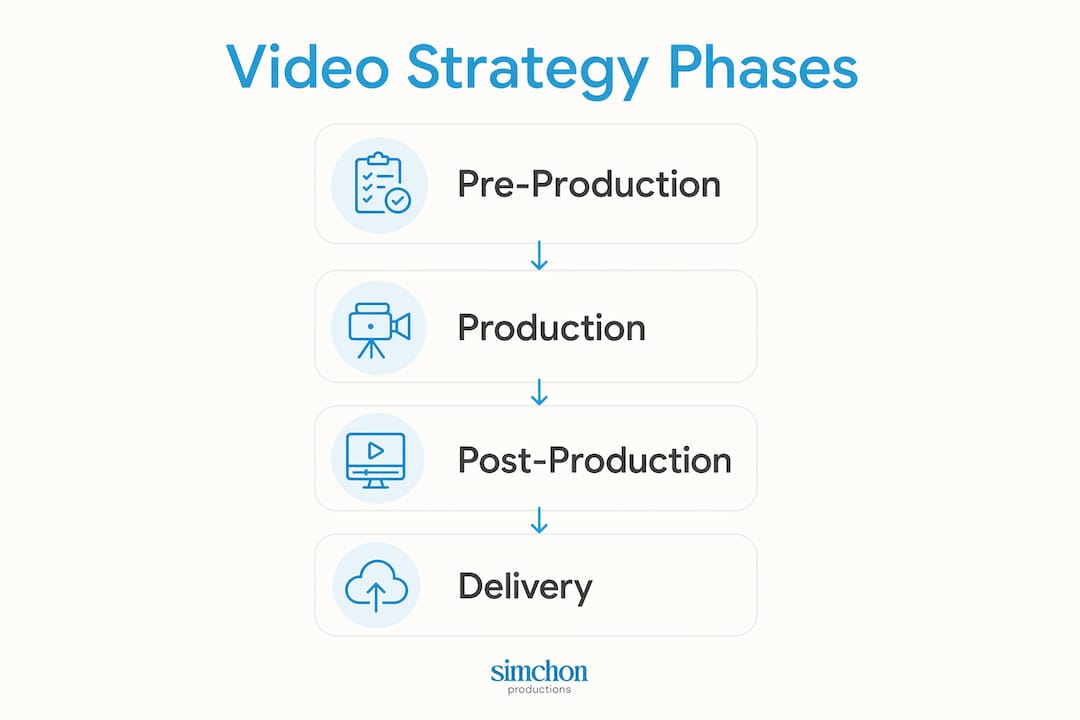
A professional K-12 video project moves through four phases: pre-production, production, post-production, and delivery. Skipping pre-production is the most common reason projects run over budget and over schedule.
Typical phases of a professional video project include pre-production activities like briefing and scripting, a production phase encompassing the shoot day, post-production involving editing and revisions, and final delivery of files and captions over varying durations depending on project complexity.
Roles and responsibilities:
Internal lead: owns approvals, coordinates talent and locations
Vendor director/DP: leads shoot, manages crew
Editor: cuts hero film and social edits
Caption specialist: delivers SRT files with final cut
Pro Tip: Lock your interview subject and location at least one week before shoot day. Last-minute changes are the single biggest cause of budget overruns on school video projects.
What budget bands produce professional K-12 video results?
Three tiers cover most K-12 video needs. The right tier depends on how many deliverables you need and how widely the video will be distributed.
Video production projects generally fall into budget tiers corresponding to scope and deliverables, from foundational single shoot day projects with small crews, up to flagship multi-day shoots with cinematic equipment and comprehensive deliverables.
Professional-looking video is achievable at the foundational tier when technical standards are followed consistently.
Scope-control tips:
Limit interview subjects to two or three per shoot day
Approve the script outline before production begins
Negotiate a fixed revision round, not open-ended changes
Pro Tip: Ask your vendor to price the hero film and social edits as a package. Bundling almost always costs less than ordering edits separately after delivery.
Which technical standards and deliverables should you require from a vendor?
Require a minimum of 1080p resolution, with 4K as the future-proof standard, H.264/MP4 web deliverables, closed captions in SRT format, and both a master file and compressed web proxies.
Deliverable | Spec |
|---|---|
Editable master | ProRes or DNxHD |
Web proxy | MP4, 1080p |
Social edit | MP4, vertical and square formats |
Captions | SRT file or burned-in |
High-res stills | 8–12 JPEGs from shoot |
Technical checklist for your RFP:
4K acquisition, 1080p minimum delivery
H.264 codec, MP4 container for all web files
Closed captions (SRT) included in base scope
Color-corrected master before delivery
Written quality-control sign-off from vendor
How do you make K-12 videos grab attention on mobile in the first 3–5 seconds?
Mobile devices now account for the majority of education-related video consumption, so the first three seconds must show a human face, state an emotional or practical promise, and work without sound.
Hook examples:
Admissions: Open on a student mid-sentence: “I almost didn’t apply.” Cut to campus. No title card.
Fundraising: Open on a teacher looking directly at camera: “One classroom. Forty kids. Zero supplies.” Cut to the solution.
Recruitment: Open on a faculty member: “I turned down two other offers to come here.”
Pro Tip: Export a silent version of every social edit and watch it without audio before you approve it. If the story is unclear without sound, the edit needs a text overlay or a tighter opening cut.
Where should you host, publish, and measure K-12 video performance?
Use YouTube for discovery and SEO, and use Vimeo or Wistia for premium embeds on your school website and donor pages. The two approaches serve different goals and should run in parallel.
Platform comparison:
YouTube: Free, high discoverability, strong SEO signal, public by default, limited brand control
Vimeo: Clean embeds, password protection, good analytics, modest monthly cost
Wistia: Best-in-class analytics, email capture, CRM integrations, higher cost, built for conversion
KPI checklist:
Views and unique viewers (reach)
Average watch time and completion rate (engagement)
Click-throughs to application or donation pages (conversion)
Embed performance on key landing pages (page speed, play rate)
How long will a professional interview-driven K-12 video stay useful?
Interview-driven videos are typically useful for 5–10 years when they focus on values, culture, and mission rather than specific dates, statistics, or faces that may leave the school. That longevity is what separates a strategic asset from a one-season marketing piece.
Refresh triggers to watch for:
A featured person leaves the school
A major policy or program changes
A visual rebrand updates logos or colors
A key statistic in the video becomes outdated
Old interview footage can often be recut into new short edits without a reshoot. Pull a different 20-second clip, add a new title card, and you have a fresh social post from a two-year-old interview. For more on why independent schools invest in video, the reuse argument is usually the strongest one in the budget conversation.
What questions and contract items should you use when hiring a K-12 video production company?
The most important question to ask any vendor is: “Can you show me an interview-driven K-12 portfolio and provide two client references?” If the answer is no, keep looking.
Hiring checklist:
Request a portfolio with at least two school or nonprofit projects
Ask for a sample timeline and deliverable list before signing
Confirm the vendor handles captions in the base scope
Verify intellectual property ownership transfers to the school on final payment
Confirm parental consent workflow is part of pre-production
Contract clauses to include:
Delivery schedule with milestone dates
Revision rounds (specify number)
IP and usage rights transfer
Caption and accessibility deliverables
Liability and parental consent obligations
Red flags:
No references or portfolio
Vague deliverable list (“a video” with no specs)
Captions listed as an add-on, not included
Rush-only schedules with no pre-production phase
Pro Tip: Ask to see a sample deliverable list before you sign. A professional vendor can hand you one in 24 hours. If they cannot, that tells you something about how organized the project will be.
How do you meet accessibility and inclusivity standards in K-12 video?
Closed captions are the baseline requirement for every K-12 video. They serve students and families with hearing differences, non-native English speakers, and anyone watching on a mobile device in a quiet space.
Beyond captions, audio descriptions narrate key visual information for viewers with visual impairments. For any video embedded on a school website, the Web Content Accessibility Guidelines (WCAG) 2.1 Level AA standard is the practical benchmark to meet. Require SRT caption files as a contract deliverable, not an afterthought. Inclusive video also means representing the actual diversity of your school community on screen, not a curated version of it.
How do you integrate instructional goals into school marketing videos?
The most effective approach pairs a clear learning or communication objective with the video format before production begins. A video that tries to do everything, inform, inspire, and convert, usually does none of those things well.
For instructional content, story-first, role-based production reduces complexity and keeps the message focused. Assign one goal per video: a how-to explainer answers one question, a testimonial makes one emotional argument, a campus tour shows one experience. When students are involved in production, the process itself becomes a learning activity that builds communication, collaboration, and critical thinking skills.
How do you involve students and staff in video production?
Students and staff are your most credible on-screen talent and, when given structured roles, capable production contributors. Station-based approaches work well for limited hardware: one group handles camera, another manages audio, a third handles scripting or interviewing.
For marketing videos, involve students as interview subjects, not crew, unless the project is explicitly educational. Staff involvement works best when faculty or administrators speak to their own experience in their own words. Coached answers rarely survive editing. Genuine ones do.
What post-production editing choices strengthen K-12 storytelling?
The edit is where a K-12 story either lands or falls apart. The most common mistake is cutting around the emotion instead of into it. Let a pause breathe. Let a subject’s face hold for two seconds after they finish speaking.
For social edits, open on the strongest line from the interview, not a title card or a logo. Use B-roll to support what the subject is saying, not to fill time. Color grading should feel warm and natural for school content. Overly cinematic grades can feel out of place and reduce trust. Captions should be styled consistently and reviewed for accuracy before delivery.
What legal and privacy rules apply to K-12 video content?
Every K-12 video that features a student requires written parental consent before filming. This is not optional, and it is not covered by a general media release signed at enrollment unless that release explicitly covers video production for external marketing use.
FERPA (the Family Educational Rights and Privacy Act) governs how student information, including images and video, can be used and shared. Schools must review their FERPA policies with legal counsel before distributing any video that identifies a student. Build a consent workflow into pre-production: collect signed forms, log them by student name, and include copies in the final delivery package. Vendors should confirm in writing that consent documentation is part of their pre-production checklist.
This article is general information, not legal advice. Confirm your school’s specific consent and FERPA obligations with qualified legal counsel.
Key Takeaways
A K-12 video production strategy built on interview-driven hero films, mobile-first edits, and proper technical standards produces assets that serve admissions, fundraising, and community trust for 5–10 years.
Point | Details |
|---|---|
Interview-driven hero film | One shoot day yields a hero film plus four to eight social edits, maximizing ROI. |
Mobile-first hook | The first 3–5 seconds must work without sound and show a human face. |
Budget reality | Foundational projects start at $3,000–$6,000; professional tier runs $7,000–$15,000. |
Technical requirements | Require 1080p/4K, MP4 deliverables, SRT captions, and a ProRes master. |
Simchon Productions | Simchon Productions produces interview-driven school films in NJ/NYC with full deliverable packages including captions, social edits, and masters. |
Why interview-driven films are the right default for school video
Most school videos fail not because of poor production quality but because they try to show everything instead of making one person feel something. A campus tour that runs three minutes and covers twelve talking points will lose a prospective parent by the forty-second mark. An interview with a student saying one honest, specific thing about why they chose the school will hold attention to the end.
The interview-first approach also reduces reshoot risk. When the story lives in a person’s words rather than in a scripted sequence of shots, you are not dependent on weather, logistics, or a perfectly staged moment. You capture what is real, and real content ages better. A 2022 interview with a faculty member who is still at the school is still usable in 2026. A 2022 event recap is not.
The reuse argument is the one I come back to most often with directors who are skeptical about the budget. One well-produced interview can be cut into a hero film and four to eight social clips, donor appeal, and recruitment pieces. This yields five to nine deliverables from a single shoot day, maximizing your return.
Simchon Productions works with schools that are ready to build a real video strategy
Simchon Productions produces interview-driven films for private schools, universities, and nonprofits across the NJ/NYC tri-state area. The work covers the full scope this guide describes: strategy, production, editing, captions, social edits, and master file delivery.
Every project includes a hero film, B-roll, closed captions in SRT format, and a set of short social edits cut from the same footage. Directors get a sample timeline and deliverable list before any contract is signed. Browse the school and nonprofit portfolio to see the work, or reach out directly to request a project estimate and timeline for your next video.
Useful sources and further reading
Hero, Hub, Help Video Marketing for Private Schools — Cube Creative: Covers the Hero/Hub/Help framework, mobile-first viewing behavior, and budget guidance for school video.
Video Production in Schools Guide — S3 Technologies: Technical standards (1080p/4K), equipment options, and station-based production approaches for school programs.
Nonprofit Video Storytelling — Anedot: Why conversational, interview-driven content outperforms scripted video for donor engagement and long-term asset value.
Strategies for Teaching Media Production — TeacherStrategies.org: Story-first instruction, role-based collaboration, and low-cost production approaches for student involvement.
Why Independent Schools Invest in Video Production — Simchon Productions: ROI framing, asset reuse, and admissions and fundraising applications for school video.
How to Hire a Video Production Company — Simchon Productions: Deliverable specs, contract clauses, and hiring checklist for organizations evaluating vendors.