Discover what a legal brand identity video is and how it can elevate your law firm’s presence, enhancing trust and engagement.

Legal Brand Identity Videos for Law Firms: A Practical Guide
A legal brand identity video is a cinematic film that captures a law firm’s or legal organization’s unique value proposition, mission, and culture in a single flagship asset. It is not a practice area explainer or a case results reel. It is the film you put on your homepage, loop at a conference, or share with lateral recruits to answer the question: Who are you, and why should I trust you? The guidance below draws on Simchon Productions’ production methodology and legal-branding best practices to walk you through every decision you will need to make.
Table of Contents
Why do law firms commission brand identity videos?
What makes a legal brand identity video actually work?
Legal, ethical, and compliance risks you need to manage
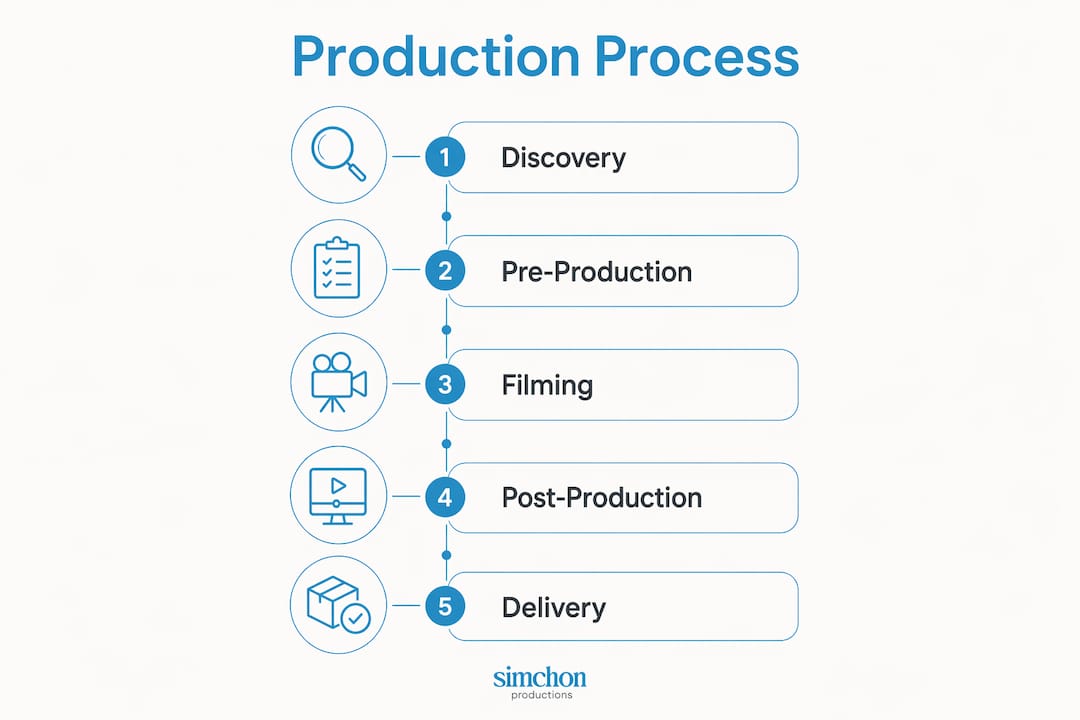
What does the production process look like, and what will it cost?
How do you keep the video consistent with your firm’s brand?
When should you hire a professional production company?
How Simchon Productions approaches a legal brand film
Key Takeaways
What actually makes legal brand films succeed
Useful resources for further reading
Simchon Productions produces legal brand films for tri-state organizations
Why do law firms commission brand identity videos?
The short answer: differentiation is hard in a crowded market, and video is the fastest way to close that gap. Law firms with inconsistent visuals and unclear messaging blend into the local competitive set. A brand film fixes that by putting a face, a voice, and a visual identity in front of the right audience in under three minutes.
Primary business objectives:
Client trust and differentiation — prospective clients decide on counsel before they ever call. A film that shows your people, your values, and your environment does more than a bio page.
Recruitment and internal culture — brand films function as both external marketing assets and internal cultural tools that align staff around a shared identity.
Event and conference showcase — a looped brand film at a trade show or bar association event runs while your partners are in sessions.
Business development and thought leadership — embedded in pitch decks and partner microsites, the film signals that your firm invests in its own brand.
Common placements: website hero, conference loop, LinkedIn organic, lateral-hire packets, alumni engagement emails, and RFP appendices.

What makes a legal brand identity video actually work?
Production quality is the floor. What separates a forgettable corporate video from a film that earns trust is the combination of narrative precision and technical discipline.
Narrative and messaging:
Lead with your unique value proposition — the one thing your firm does that no one else can claim in exactly the same way.
Keep the primary cut to a short version suitable for web; a slightly longer version works for events.
Write the script around your client promise, not your practice list.
Cinematography and production values:
Frame principals in real firm environments, not generic conference rooms.
Use a color grade that matches your brand palette so the film reads as part of your visual system.
Controlled lighting and deliberate camera movement signal premium production without requiring a massive crew.
Audio and music:
Commission bespoke score cues or license music with perpetual, commercial rights — never use royalty-free tracks that appear in competitor videos.
Voiceover style should match your firm’s tone: measured and authoritative, not broadcast-announcer.
Talent and B-roll:
Use your actual principals on camera. Scripted scenes with actors undermine credibility for legal audiences.
Documentary-style B-roll of real work environments preserves authenticity.
Deliverables to request: web-ready master, social edits (60s, 30s, 15s), event loop, captioned version for accessibility.
Pro Tip: A branded location plate (your firm’s name and city, typeset in your brand font, held for three seconds at the open) costs almost nothing in post but immediately anchors the film to your identity and prevents it from reading as generic.
Legal, ethical, and compliance risks you need to manage
This is where most firms get into trouble, and it is almost always because legal review happens after production, not before.
Key risk areas:
Copyright and licensing: music, stock footage, fonts, and archival materials all require perpetual, commercial licenses. Retain documentation in a centralized folder.
Talent releases: obtain written releases for every person on camera, including partners, staff, and any third parties. Handle minor appearances with extra care.
Confidentiality: run scripts by counsel before the shoot. Avoid any language that could disclose privileged matters or imply specific case results.
Attorney advertising rules: most U.S. jurisdictions regulate testimonials, results language, and comparative claims in legal marketing. Engage compliance counsel before scripting.
Usage rights: confirm territorial and channel permissions — web, paid media, event, and partner sites may each require separate clearances.
Before you approve a final cut, confirm these five items in writing: music license scope, talent release signatures, script counsel sign-off, usage territory, and storage location for all clearance documents. Missing any one of them can pull the film from distribution after launch.
Pro Tip: Build a legal clearance sign-off step directly into your postproduction timeline. Store all releases and license documents in a single shared folder with version control. Auditing this later is far easier than reconstructing it.
Involving legal counsel early in brand development reduces IP and ethics risk and prevents costly post-launch corrections.
What does the production process look like, and what will it cost?
Phase | Typical Duration | Client Responsibility |
|---|---|---|
Strategy & discovery | several weeks | Brief, brand guidelines, stakeholder interviews |
Scripting & approvals | several weeks | Script review, legal/compliance sign-off |
Preproduction | several weeks | Talent scheduling, location access, wardrobe |
Principal photography | a few shoot days | On-site availability, space access |
Postproduction | several weeks | Rough-cut review, revision rounds |
Delivery & asset variants | short period | Final approval, asset distribution |
A short event loop production can move through this process in about a month or more. A full brand film with multiple interview subjects and location days typically requires multiple weeks from kickoff to delivery.
Budget bands:
Entry: one shoot day, small crew, basic post. Suitable for internal use or limited social distribution.
Standard: multi-day shoot, professional crew, licensed music, full post with color grade and motion graphics.
Premium: cinematic production, bespoke score, multiple locations, full deliverable suite including accessibility edits.
Costs concentrate in crew day rates, location fees, music licensing, and postproduction hours. Cutting corners on any of these three shows on screen.
Delivery checklist: web master (H.264 and ProRes), social cuts, captioned version, event loop, archival project files.
How do you keep the video consistent with your firm’s brand?
A brand film that looks different from your website confuses the people you are trying to reach. Videos that match a firm’s visual identity perform better as marketing touchpoints because they maintain user immersion, as explained in the Best Branding Agencies in Kansas City guide.
Before the shoot:
Supply your brand guidelines to the production team at kickoff: colors, typography, logo usage rules, and tone of voice.
Confirm color accents, lower-third typographic scales, logo safe areas, and palette-driven color grading targets.
During production:
Run pre-shoot style tests and capture reference frames that match your website and print assets.
Use keyed overlays in rough cuts to verify that lower thirds and logo placements sit within brand safe zones.
Stakeholder sign-off: marketing, managing partners, and compliance should each review the rough cut against brand guidelines before picture lock. Build this review into the timeline, not as an afterthought.
Pro Tip: Deliver color-graded reference stills and lower-third templates to your internal team alongside the final film. Future social edits and event cuts will stay on-brand without requiring a full production review.
When should you hire a professional production company?
Hire a professional when:
The film will appear in front of external audiences (clients, recruits, conference attendees).
The messaging involves complex legal positioning or compliance-sensitive claims.
You need a reusable asset suite across multiple channels and formats.
Your firm’s reputation is directly on the line.
DIY or in-house makes sense for:
Internal training videos with no external distribution.
Rapid social proof clips shot on a phone for organic LinkedIn.
Low-stakes proof-of-concept tests before committing to a full production.
Vendor evaluation criteria:
Criterion | What to look for | Red flag |
|---|---|---|
Legal/institutional experience | Sample reels from law firms or similar organizations | Only commercial or consumer brand work |
Releases and clearance process | Documented workflow, standard release templates | “We handle it informally” |
IP and usage contract terms | Clear ownership language, usage territory defined | Vague or absent IP clause |
Local tri-state familiarity | Knowledge of NJ/NY/CT locations, permitting, logistics | No regional production history |
Insurance | General liability and E&O coverage | No certificate available |
How Simchon Productions approaches a legal brand film
A regional legal association in the tri-state area came to Simchon Productions needing a brand film for their annual conference and website. Their goals: communicate member value, attract new institutional members, and give leadership a flagship asset for partnership outreach.
The approach:
Discovery session with leadership to surface the organization’s core language and differentiators, then translate those directly into script beats.
Two shoot days across two locations: the organization’s primary meeting space and an exterior that reinforced their regional identity.
All talent releases and music licenses cleared before the shoot date, with documents stored in a shared project folder.
Deliverables: 90-second web master, 60-second conference loop, 30-second social cut, captioned version.
The production process itself became a brand-clarification exercise. By the time we reached picture lock, the leadership team had language they could use across every channel — not just the film.
The film ran as the conference opening loop, was embedded on the homepage, and was included in new-member welcome packets. Qualitative feedback from leadership pointed to stronger first impressions at partnership meetings.
Pro Tip: Use the discovery session as a formal brand-codification workshop. The specific phrases partners use to describe their work are often the strongest script lines — and they are free.
Key Takeaways
A legal brand identity video works when narrative precision, production quality, and legal clearance are treated as equally non-negotiable from day one.
Point | Details |
|---|---|
Define the objective first | Decide whether the film serves client acquisition, recruitment, or events before scripting begins. |
Align brand guidelines early | Supply colors, typography, and tone of voice to the production team at kickoff, not during post. |
Engage legal counsel before the shoot | Script review, talent releases, and music licensing must be cleared before cameras roll. |
Match budget to stakes | External-audience films warrant standard-to-premium production; internal-only use can go entry-level. |
Simchon Productions | Specializes in cinematic brand films for tri-state legal organizations, with documented clearance workflows and full deliverable suites. |
What actually makes legal brand films succeed
Most legal organizations approach a brand film the same way they approach a brochure: they list what they do and hope that is enough. It is not. The firms whose films actually move the needle are the ones that made a decision before the shoot about what they stand for, not just what they offer. That distinction drives every creative choice downstream — the locations, the music, the faces on camera, the first line of the script.
The other thing I see consistently: organizations that involve their compliance and marketing leads in the same room during discovery produce better films faster. Not because they agree on everything, but because the tension between “what we want to say” and “what we are allowed to say” produces sharper, more defensible messaging. That is a feature, not a friction point.
Working in the tri-state area also matters more than people expect. Permitting in Manhattan, location logistics in New Jersey, and the specific visual vocabulary that reads as credible to a New York legal audience — these are not things you figure out on the day of the shoot.
Useful resources for further reading
Law firm brand identity fundamentals (LISI) — a clear breakdown of what a law firm brand actually encompasses beyond logo and color.
Law firm branding guide (Clio) — practical guidance on building a cohesive visual identity for solo and small firms.
Early legal review in brand development (Stoel Rives LLP) — why involving counsel at the start of brand development prevents costly downstream problems.
Law Firm Brand Video Production Guide (Simchon Productions) — detailed production guidance covering IP, releases, and messaging approvals specific to law firms.
Why brand identity films support growth (Simchon Productions) — how brand films function as recruitment and culture tools, with parallels to legal organizations.
How to hire a video production company (Simchon Productions) — vendor evaluation checklist and procurement steps for organizations commissioning video for the first time.
Simchon Productions produces legal brand films for tri-state organizations
If you have read this far, you already know what a strong legal brand identity video requires. Simchon Productions delivers exactly that for law firms and legal organizations across New Jersey, New York, and Connecticut: cinematic production, documented clearance workflows, and a full deliverable suite built for multi-channel use.
The difference from a generic video vendor is straightforward. Simchon Productions brings a structured discovery process that codifies your brand language before a single frame is shot, a compliance-aware production workflow that keeps your legal and marketing teams aligned, and regional familiarity that removes the logistical friction that derails tri-state productions.
Contact Simchon Productions to schedule a discovery call. Come prepared with your brand guidelines, your primary audience, and the one thing you want viewers to feel when the film ends. That is the conversation worth having.