Learn key marketing strategies for assisted living facilities. Boost your tour bookings with speed-to-lead tactics and targeted paid search.
Marketing for Assisted Living Facilities: What to Fix First
Speed-to-lead is the single most important lever. Communities that answer new inquiries within 30 minutes see far higher tour booking rates than those that wait even an hour. Fix that first, then layer in care-type paid search and CRM nurture sequences.
Three tactics matter more than everything else combined:
Speed-to-lead systems that get a human or automated reply to every inquiry in under 30 minutes
Care-type paid search paired with landing pages built for one care level and one conversion goal
CRM and nurture automation that keeps families engaged across an 87 to 112 day decision cycle
Get these three running and you should see more booked tours within 60 days, plus a shorter, more visible sales pipeline. Two things to do this week: turn on SMS auto-reply for every inquiry channel, and build one landing page for your highest-margin care type.
Key Takeaways
Occupancy growth in assisted living depends most on responding to new leads within 30 minutes and pairing care-type paid search with disciplined CRM nurture through an 87 to 112 day decision cycle.
Point | Details |
|---|---|
Fix speed-to-lead first | Respond within 30 minutes to convert leads to tours at far higher rates than delayed responses. |
Match tactics to occupancy tier | Prioritize paid search below 80% occupancy, then shift toward referral and content as census grows. |
Build care-specific landing pages | Use one conversion goal, published pricing, and testimonials to avoid wasting paid search spend. |
Track five core KPIs weekly | Monitor lead-to-tour, tour-to-move-in, cost per move-in, pipeline coverage, and speed-to-lead. |
Use cinematic video for trust | Simchon Productions builds community overview, testimonial, and staff films that shorten the decision cycle. |
Table of Contents
Which Assisted Living Marketing Ideas Work Best at Each Occupancy Level?
How Fast Should You Respond to a New Assisted Living Lead?
How Do You Structure Paid Search for Assisted Living Facilities?
Which Referral Partners Actually Fill Beds?
What Should Your CRM and Nurture Sequence Look Like?
What Makes a Tour Convert Into a Move-In?
What KPIs Actually Show Where Your Pipeline Is Leaking?
What Video Content Actually Moves Families Toward a Tour?
Where Do Families Check Reviews Before They Tour?
What Content Should You Publish and How Often?
What Does a 90-Day Marketing Launch Plan Look Like?
How Should You Segment Marketing by Occupancy Level?
How Do You Position Against Other Assisted Living Options?
How Do You Train Admissions Staff to Convert More Leads?
What Outreach and Events Actually Build Local Trust?
Why Cinematic Storytelling Shortens the Decision Cycle
How Simchon Productions Helps Communities Tell This Story
Primary Sources Behind This Playbook
Sources
FAQ
Which Assisted Living Marketing Ideas Work Best at Each Occupancy Level?
The right tactic depends entirely on your current occupancy. A community at 68% needs different marketing than one at 91%, and running the wrong playbook wastes budget you don’t have.
Crisis tier (under 80% occupancy). The goal is fast census recovery. Prioritize high-velocity paid search, aggressive speed-to-lead fixes, and referral outreach to discharge planners. Time to impact: 2 to 6 weeks. When occupancy sits below 80%, dedicate 40 to 50% of marketing spend to paid search because it’s the fastest reliable channel for filling beds.

Growth tier (80 to 92% occupancy). The goal shifts to building a durable pipeline. Invest in CRM nurture, referral partnerships, and content that supports a 3-month decision cycle. Time to impact: 6 to 12 weeks.
Optimization tier (92%+ occupancy). The goal is protecting margin and building a waitlist. Focus on reputation management, referral cultivation, and brand video that reduces cost per move-in over time. Time to impact: ongoing.
Occupancy tier | Budget split (paid vs. organic/referral) | Expected CPL range | Time to impact |
|---|---|---|---|
Crisis (under 80%) | 40-50% paid search | Higher, urgency-driven | 2-6 weeks |
Growth (80-92%) | 30% paid, 40% referral, 30% content | Moderate | 6-12 weeks |
Optimization (92%+) | 15% paid, 50% referral, — | Lower, owned-channel driven | Ongoing |
How Fast Should You Respond to a New Assisted Living Lead?
Under 30 minutes, every time. Families calling about assisted living are usually in crisis mode, comparing three or four communities in the same afternoon, and the first one to call back wins the tour.
Operators who fixed their response time saw 30 to 50% more tours booked within 60 days, and leads contacted in under 30 minutes convert to tours at 300 to 400% higher rates than leads contacted after one or two hours. Wait past four hours and most leads are unlikely to convert.
Build this with four pieces:
Instant SMS and email auto-confirmation the moment a form or call comes in, so the family knows someone is coming.
Prioritized call routing that rings admissions staff first, then a backup, then a manager, never a voicemail box.
Aggregator lead routing set to immediate, since third-party lead sites often route the same inquiry to five competitors at once.
Dynamic follow-up templates that reference the specific care type and community the family inquired about, not a generic “thanks for your interest.”
Week 1 checklist: assign a response owner for every shift, set a 30-minute SLA with a written escalation path, and script the first callback so staff aren’t improvising with a grieving adult child on the line.
Pro Tip: Test your own system. Call your main line at 6 p.m. on a Friday and see what actually happens. Most directors are shocked at what their leads experience after hours.
How Do You Structure Paid Search for Assisted Living Facilities?
Build separate campaigns for each care type, never one blended campaign for the whole community. A family searching “memory care near me” wants a completely different answer than one searching “independent living with meals.”
Segment by care type and use long-tail keywords like “assisted living cost [city]” or “memory care for parent with dementia” instead of broad terms like “senior living.” Add negative keywords early: “jobs,” “careers,” “Medicaid,” and “free” all pull in traffic that never converts.
Every landing page needs:
One single conversion goal (schedule a tour, not five competing buttons)
A starting price range displayed clearly, not hidden behind a form
At least one testimonial or short video near the top
Sub-two-second mobile load time
A click-to-call button visible without scrolling
Statistic Callout: Sending paid traffic to a generic homepage instead of a care-specific landing page wastes budget. Branded and care-type-specific campaigns produce lower cost per lead and higher conversion than blended campaigns pointing to a homepage.
Budget guidance varies by market, but expect wide swings in CPC and cost per lead depending on your metro’s competition. Track cost per move-in, not just cost per click, or you’ll optimize for the wrong number.
Which Referral Partners Actually Fill Beds?
Discharge planners and geriatric care managers convert better than almost any digital channel, because they’re recommending you to a family that already trusts them.
Rank your outreach effort this way:
Hospital discharge planners, who place families under time pressure and need a trusted, fast option
Geriatric care managers, who guide families through the entire decision and often tour with them
Elder law attorneys, who see families early, often before a crisis forces a decision
Financial planners, who discuss long-term care costs before a move is imminent
Cultivate these relationships with quarterly lunch-and-learns, a one-page fact sheet with pricing and care levels, and a simple referral process where a partner can call one number and get a same-day response.
Shifting your lead mix toward these higher-quality sources can cut cost per move-in by 30 to 50% compared to relying mainly on paid aggregator leads. Track referral ROI by source every quarter, and scale back paid referral agencies once your professional network produces steady volume on its own.
What Should Your CRM and Nurture Sequence Look Like?
Your CRM needs stages that match how families actually decide, not a generic sales funnel borrowed from another industry. Assisted living decisions average 87 days, and memory care decisions average 112 days, so your nurture sequence has to sustain contact for months, not days.
New inquiry — tagged by care type and urgency level
Contacted — first callback logged, urgency scored (crisis, active search, or early research)
Tour scheduled — automated reminders trigger
Toured — follow-up sequence begins
Decision pending — long-cycle nurture activates
Move-in or closed
Sample 90-day sequence for warm leads:
Week 1: personalized video from the admissions director, referencing their specific care needs
Week 2 to 4: email with pricing transparency, a virtual tour link, and a testimonial video
Month 2: SMS check-in plus an invite to a community event
Month 3: direct call from admissions, timed near typical decision windows
Cold leads over 90 days move into a lighter monthly reactivation drip. Score leads hot, warm, or cold based on tour attendance and email engagement, then route hot leads straight to a human, not another automated email. A family-decision video guide can help shape messaging for adult children managing this process for a parent.
What Makes a Tour Convert Into a Move-In?
A tour converts when the family leaves with a clear next step, not just a good impression. Standardizing your tour script and follow-up matters more than the building itself.
During the tour, build in real resident interactions, not just staged hallway walks. Let a nurse or care coordinator answer a clinical question directly, since that builds more trust than a sales pitch ever will. End every tour with a specific next step written down on paper, not a vague “let us know.”
Same-day follow-up call or email within 3 hours of the tour ending
A short testimonial video sent that evening, matched to the family’s stated concerns
A calendar invite for a follow-up call or second visit
Digital, e-signable admission paperwork sent within 48 hours
Assign one move-in coordinator to handle every administrative step after a family says yes. Operators who standardize tour elements and immediate follow-up see tour-to-move-in rates improve by 15 to 25 percentage points compared to communities that leave follow-up to chance.
Pro Tip: Ask every family what almost stopped them from touring. That one question surfaces objections your marketing isn’t addressing yet.
What KPIs Actually Show Where Your Pipeline Is Leaking?
Five numbers tell you almost everything: lead-to-tour rate, tour-to-move-in rate, cost per move-in, pipeline coverage, and speed-to-lead. Track them weekly, not quarterly, or problems go undetected for months.
KPI | What it reveals |
|---|---|
Lead-to-tour rate | Whether your intake and follow-up process is working |
Tour-to-move-in rate | Whether the tour experience closes the deal |
Cost per move-in | Whether your channel mix is efficient |
Pipeline coverage | Whether you have enough leads in motion to hit occupancy goals |
Speed-to-lead | Whether staff are responding fast enough to win the tour |
Cost per move-in for private-pay communities typically runs between $3,200 and $4,500, with owned channels like referrals and content pulling that number down over time compared to paid aggregator leads.
Review this dashboard every Monday. If lead-to-tour rate drops two weeks running, check speed-to-lead first. If tour-to-move-in drops, review your tour script before you touch the ad budget.
What Video Content Actually Moves Families Toward a Tour?
A cinematic community film shot with real residents and staff builds more trust in 90 seconds than a brochure builds in ten pages. Families researching assisted living are scared and skeptical, and video is the fastest way to show them what a brochure can only describe.
Three formats do the heaviest lifting:
Community overview film (90 to 150 seconds): dining, activities, common spaces, and a warm sense of daily life
Resident testimonial video (60 to 90 seconds): a real resident or family member speaking in their own words, not a scripted read
Staff introduction video (45 to 60 seconds): the nurse or director families will actually meet
Shoot list essentials include genuine resident interactions, natural light in common areas, and close-up moments of care staff at work, not posed handshakes. Always add captions, since most families watch on mobile with sound off, and captions help search engines index the content too.
The families who move fastest from tour to move-in are usually the ones who watched a testimonial video before they ever set foot on campus. Seeing a resident like their parent, speaking honestly about the decision, does more to reduce fear than any brochure or spec sheet.
Place these films on care-type landing pages, inside nurture emails, and as the creative for paid social ads. Track view-through rate against tour bookings to see which film actually moves families to schedule.
Where Do Families Check Reviews Before They Tour?
Google is where nearly every family starts, followed closely by Facebook and senior-living-specific directories. A thin or outdated review profile makes a family skeptical before they’ve even called.
Prioritize Google Reviews first, since it shows directly in search and map results
Set a simple cadence: ask every family within one week of a positive move-in experience
Respond to every negative review within 24 hours, calmly and specifically, without getting defensive
Pull your strongest quotes onto landing pages and into paid ad creative, with permission
A negative review handled well, with a clear response and a real resolution, often builds more trust than five generic five-star reviews with no detail.
What Content Should You Publish and How Often?
Content should match how families actually search, moving from general worry to specific comparison over weeks or months. Building this library once saves you from scrambling every time admissions asks for something new.
Care-type landing pages for each level you offer, updated quarterly
A pricing guide that answers the cost question honestly instead of hiding it behind a form
An “is it time” self-assessment that helps adult children recognize the signs
Family-decision videos addressing guilt, cost, and timing directly
A downsizing checklist for the practical side of a move
Communities in crisis tier should publish monthly at minimum, prioritizing pricing and care-type content. Growth-tier communities can slow to quarterly, focusing on nurture-stage content. Repurpose your existing videos into short clips for social posts and email nurture instead of shooting new footage every time, which stretches your production budget further.
What Does a 90-Day Marketing Launch Plan Look Like?
The first 90 days should fix your biggest leak first, then build sustainable systems around it. Trying to launch everything at once guarantees nothing gets done well.
Weeks 1 to 2: Fix speed-to-lead. Marketing owns SMS and email auto-reply setup; admissions owns call routing and the response SLA.
Weeks 3 to 6: Launch one care-type landing page and its paid search campaign. Marketing owns build and launch; admissions reviews messaging for accuracy.
Weeks 7 to 10: Build the CRM nurture sequence and lead scoring. Marketing and admissions co-own the content calendar.
Weeks 11 to 13: Standardize the tour script and post-tour follow-up. Operations and admissions co-own training.
Milestone checks: speed-to-lead under 30 minutes by week 2, one live landing page by week 6, nurture sequence fully automated by week 10, tour-to-move-in rate tracked weekly by week 13.
Common pitfall: launching paid search before the landing page is ready, which wastes spend
Common pitfall: skipping staff training on the new response SLA, so old habits creep back within weeks
How Should You Segment Marketing by Occupancy Level?
Segmenting your marketing budget and messaging by occupancy tier keeps you from spending like a community that’s full when you’re actually at 72%, or spending like you’re in crisis when you’re already thriving.
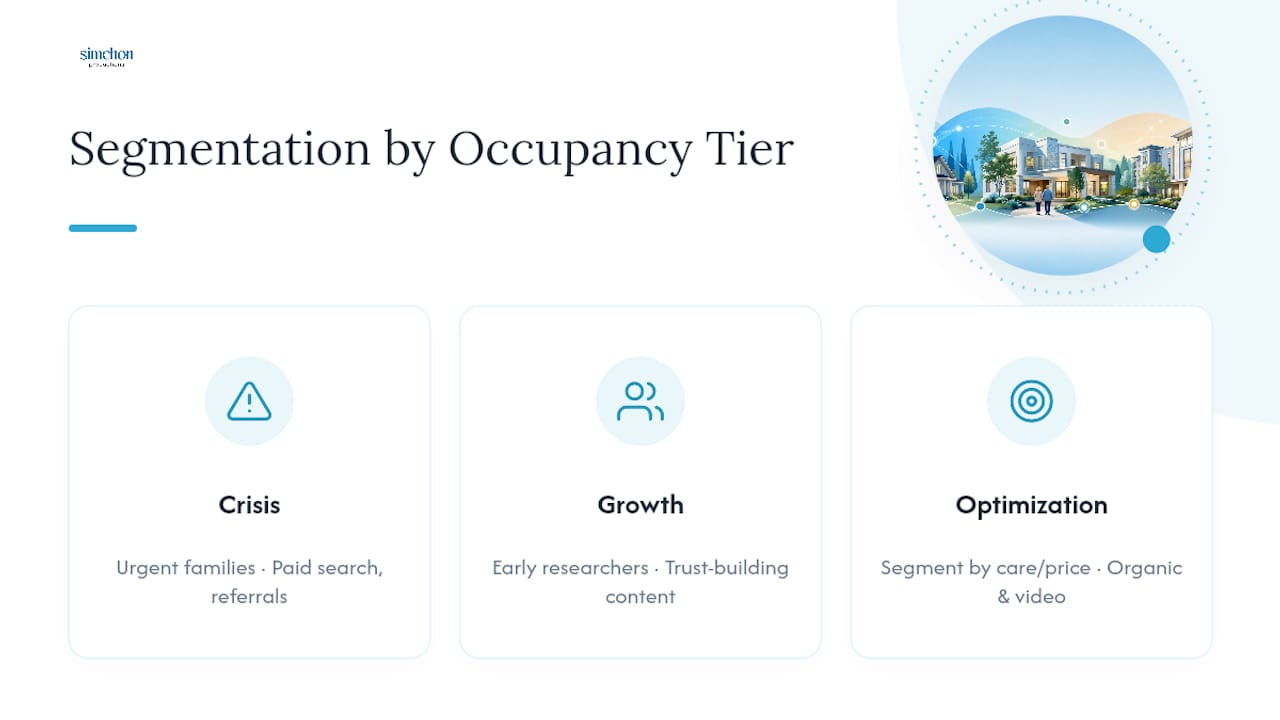
At crisis-tier occupancy, segment your audience narrowly: families with an urgent need, usually triggered by a hospital discharge or a fall. Your messaging should lead with availability and speed, not lifestyle amenities. Paid search dominates here because it captures people actively searching right now.
At growth-tier occupancy, broaden your targeting to include earlier-stage researchers, adult children just starting to explore options for a parent who isn’t in crisis yet. Messaging shifts toward trust-building content, like a family-decision video or a downsizing checklist, since these families have more time to compare.
At optimization-tier occupancy, segment by care type and price point to attract the specific resident profile that fits your remaining openings. If you have three memory care beds left and a full assisted living wing, your entire marketing spend should point at memory care, not a blended community message.
Segmentation also applies to channel choice. Crisis-tier communities should weight spend toward paid search and referral because both produce fast results. Optimization-tier communities can afford to invest more in organic content and video, since the payoff plays out over months rather than days. Reassess your tier and segmentation every quarter, because occupancy shifts and last quarter’s plan may already be outdated.
How Do You Position Against Other Assisted Living Options?
Positioning starts with naming exactly what makes your community different, not a list of amenities every competitor also offers. A pool and a chef aren’t differentiators anymore. Most communities have them.
Start with a competitive audit. Visit or call three competing communities in your market and note their pricing transparency, their tour experience, and how fast they respond to an inquiry. Most communities respond slowly and hide pricing, which means transparent pricing and fast response time can become your actual differentiator, not just a nice-to-have.
Look at your clinical staffing ratios, specialized programming, and any unique partnerships with local hospitals or physicians. If your nurse-to-resident ratio beats the market average, say so specifically on your landing pages instead of using a vague phrase like “exceptional care.”
Your video content is also a positioning tool. A cinematic film showing real residents and real staff sets you apart from communities using stock photography or outdated brochures, and it signals a level of investment and confidence that families notice immediately.
Price positioning matters too. If you’re priced above the market, your messaging needs to justify it with specifics: staff ratios, activity programming, or a shorter wait for memory care placement. If you’re priced below, transparency becomes even more important, since families searching for lower-cost options are often the most price-sensitive and skeptical of hidden fees.
How Do You Train Admissions Staff to Convert More Leads?
Admissions staff need a script, not a sales pitch, because families calling about assisted living respond better to empathy and clarity than to persuasion tactics.

Train staff to open every call by acknowledging the emotional weight of the decision before asking a single qualifying question. A line as simple as “This is a big decision, and I want to help you feel confident about it” changes the entire tone of the call.
Build a simple qualifying script: care needs, timeline, budget range, and decision-maker involved. Skipping the decision-maker question wastes time, since many calls come from an adult child who isn’t the one paying or making the final call.
Role-play objection handling regularly. The three most common objections are price, timing (“we’re not ready yet”), and guilt (“I feel like I’m giving up on Mom”). Give staff a specific, practiced response to each, not an improvised one.
Track individual admissions staff performance against lead-to-tour and tour-to-move-in rates. If one staff member consistently converts better, record their calls (with consent) and use them as training material for the rest of the team. Retrain quarterly, since scripts go stale and staff drift back into old habits without reinforcement.
What Outreach and Events Actually Build Local Trust?
Local outreach works best when it positions your staff as the trusted resource before a family even needs a bed, not as a sales booth trying to close a lead on the spot.
Host educational workshops on topics families actually worry about: “Signs It Might Be Time for Assisted Living,” “Understanding Memory Care,” or “Paying for Senior Living Without Losing Your Home.” Partner with a local elder law attorney or financial planner to co-host, since it lends credibility and expands your reach to their client list.
Sponsor or attend community events where caregivers already gather: caregiver support groups, senior center programs, and local health fairs. A booth alone rarely converts, but a genuine conversation and a follow-up call afterward often does.
Build relationships with local senior discovery resources so families searching nearby can find you accurately. Tools like Local AI Page help confirm your business listings are accurate and discoverable by ZIP code, which matters since many families search hyper-locally when a decision becomes urgent.
Film your events. A short video from a workshop or health fair, with real questions and real answers, makes excellent nurture content and shows prospective families what your team is actually like in person, not just what your brochure claims.
Why Cinematic Storytelling Shortens the Decision Cycle
Families spend months comparing communities partly because most marketing gives them nothing real to hold onto. A cinematic film changes that. When a family sees an actual resident laughing at dinner or a nurse explaining her approach to care, the decision starts to feel less abstract and less frightening.
That shift is why video consistently correlates with faster tours and stronger follow-through in the data reviewed here. It replaces guesswork with a real look at daily life.
— Tzvi Simchon
How Simchon Productions Helps Communities Tell This Story
Simchon Productions is the direct answer to the video gap most of the tactics above depend on. We produce the exact films this article recommends: community overview films, resident testimonial videos, and staff introduction pieces, shot cinematically and built specifically for assisted living and senior living marketing.
A discovery call with our team starts with your occupancy goals and your current landing pages, not a generic sales pitch. We ask which care types need the most support, review your existing footage if you have any, and map out a shot list built around real residents and staff. You can view sample community and testimonial films through our video production process before committing to a project.
If your tour-to-move-in rate is stalling because families arrive skeptical, a cinematic film built for your community is one of the fastest ways to change that. Request a quote from Simchon Productions and get a project timeline based on your specific care types and launch deadline.
Primary Sources Behind This Playbook
8 Tactics to Increase Assisted Living Occupancy for Operators in 2026: supports speed-to-lead conversion data and tour-to-move-in improvement figures.
The Ultimate 2026 Digital Marketing Guide for Senior Living Communities: supports the 87 to 112 day decision cycle and landing page requirements.
Senior Living Census Building Playbook: supports occupancy-tier budget allocation and cost per move-in benchmarks.
Assisted Living & Senior Housing Lead Generation guide: supports lead qualification and pricing transparency guidance.
Sources
8 Tactics to Increase Assisted Living Occupancy for Operators in 2026
The Ultimate 2026 Digital Marketing Guide for Senior Living Communities - Elderbloom Strategies
Senior Living Census Building Playbook: Strategies by Occupancy Level for 2026 | USR Engage
FAQ
How Do You Market an Assisted Living Community Effectively?
Start by fixing speed-to-lead so every inquiry gets a response within 30 minutes, then build care-type landing pages backed by paid search and a CRM nurture sequence that sustains contact across the full decision cycle.
How Do You Generate More Leads for Assisted Living?
Combine care-specific paid search campaigns, referral partnerships with discharge planners and geriatric care managers, and transparent pricing on landing pages to attract and self-qualify more leads.
How Do You Market a 55+ Community?
Use the same occupancy-tier framework: segment messaging by lifestyle and price point, publish transparent pricing, and use video content showing real residents to build trust faster than brochures or stock photography.
How Do You Increase Revenue in Assisted Living?
Increase revenue by improving tour-to-move-in conversion through standardized tour scripts and fast follow-up, and by shifting your lead mix toward higher-quality referral sources that lower cost per move-in.
What Video Length Works Best for Assisted Living Marketing?
Community overview films run 90 to 150 seconds, resident testimonials run 60 to 90 seconds, and staff introduction videos run 45 to 60 seconds, matching how families consume content on landing pages and mobile devices.