Plan multicampus video production with crew logistics, FERPA safeguards, captioning, and a 48 to 72 hour checklist to catch gaps before filming.

Multicampus Video Production: Avoid Privacy Gaps and Reshoots
Multi-campus video production means coordinating a single film or video series across more than one location for one organization, like a university system, school district, healthcare network, or nonprofit with several sites. The right move is to centralize creative control under one lead production partner instead of letting each campus hire separately. Running this model can make the difference between a cohesive film and a patchwork of mismatched clips.
TL;DR:
Lock a written brief covering audience, message, deliverables, and channels; assign local approvers and one central signoff, then secure releases before filming.
Traveling crews preserve visual consistency but add travel costs; local crews cost less per site only when they share shot lists and lighting setups.
Automated captions need human review before publication; budget early for transcripts or audio description, and review identifiable student footage case by case for privacy.
Keep master videos and caption files in one shared library, then compare view through rates, engagement, and call to action conversions across campuses.
Simchon ProductionsBring Every Campus Story TogetherSimchon Productions creates cinematic films with focused messaging and authentic storytelling for schools, universities, and other organizations.Explore video production
Table of Contents
How Do I Scope and Plan a Multi-Campus Video Project?
How Do You Coordinate Crews, Equipment, and Scheduling Across Campuses?
What Accessibility and Student-Privacy Requirements Must I Plan For?
How Should I Distribute Multi-Campus Videos and Measure Success?
How Simchon Productions Approaches Multi-Campus Films
Ready to Start a Multi-Campus Video Project?
FAQ
Sources
How Do I Scope and Plan a Multi-Campus Video Project?
Start with a one-paragraph brief that names your audience, your core message, your deliverables, and where the video will live. Without this, every campus will pull the project in a different direction.
Here’s the planning sequence we walk clients through:
Write the brief first. Name the audience (prospective students, donors, patients), the message, the deliverables (hero film, social cuts, testimonials), and the primary channels.
Map stakeholders and sign-off. Decide who approves locally at each campus and who holds final sign-off centrally, usually the marketing or communications director.
Block your shoot windows early. Academic calendars, clinical schedules, and donor events all compete for dates. Lock windows months out and build in buffer days for weather or last-minute conflicts.
Budget for the real cost drivers. Travel, per-site crew, permits, captioning, and post-production all add up faster across multiple locations than a single-site shoot.
Set stage gates before anyone shoots. Creative lock, signed location releases, a caption plan, and privacy forms should all be done before cameras roll.
Pro Tip: Run a 48 to 72 hour pre-shoot checklist at every campus. It catches missing releases, wrong contacts, and equipment gaps before they become reshoots.
A clear brief also protects your budget. We’ve seen smaller school systems get strong returns on a well-planned video investment specifically because the scope was locked before anyone traveled.
How Do You Coordinate Crews, Equipment, and Scheduling Across Campuses?
Assign one central production manager and one local site lead per campus. The central manager owns the creative vision and schedule. The local lead handles campus access, contacts, and day-of logistics.
You generally choose between two crew models:
One traveling crew: Keeps visual style consistent since the same people shoot everything, but travel days add cost and limit how many sites you can cover in a short window.
Local crews with a standardized kit: Faster and cheaper per site, but only works if you hand every crew the same shot list, lighting setup, and lens choices.
A shared shot list and a short “look bible” (consistent color grade, framing style, and interview setup) keep footage from five campuses feeling like one film instead of five different ones. Before anyone shoots, confirm permits, campus security contacts, insurance certificates, and a basic safety briefing for each location.
Pro Tip: Build your pre-flight check 48 to 72 hours before each shoot date. Confirm gear, access, weather backup, and signed releases so no crew sits idle waiting on a missing form.

If a campus needs physical upgrades before filming, like glare control or branded window treatments in a lobby you’re shooting in, a partner like TWT SoCal’s school safety film services can handle that install work ahead of your production dates.
What Accessibility and Student-Privacy Requirements Must I Plan For?
Institutions are expected to provide accurate, human-edited captions on video meant for students, employees, or the public, and automated captions alone don’t meet that standard. Purdue’s video accessibility SOP lays out a clear process: automated captions get reviewed and corrected by a human before anything publishes, with high-risk content prioritized first.
Beyond captions, decide early when you need transcripts or audio description. Both add cost and turnaround time, so budget for them during planning, not after the edit is locked.
Many institutions prioritize caption accuracy and tackle their highest-risk content first, according to Purdue’s accessibility guidance, which shapes how you sequence review across a multi-campus project.
Student privacy adds another layer. The FERPA FAQ from the U.S. Department of Education explains that photos or video “directly related” to a student can count as an education record, which means schools need to look at footage case by case rather than assume it’s automatically fine to publish.
Practical steps that protect you:
Collect signed release forms before filming any student, patient, or staff member.
Build a privacy signoff step into your stage gates, not just your legal file.
Write a short editorial policy for any content that features minors or protected health information.
Flag footage that could qualify as directory information and confirm it with campus counsel.
How Should I Distribute Multi-Campus Videos and Measure Success?
Match each deliverable to its audience. A hero film for admissions needs a different cut, length, and call to action than a piece aimed at donors or patients.
A few things make distribution across campuses run smoothly:
Host the master files in one central asset library so every campus pulls from the same source instead of re-editing on their own.
Include downloadable caption files with every asset so local teams don’t skip accessibility steps.
Track view-through rate, engagement, and call-to-action conversions, then break those numbers down by campus to see where the message lands hardest.
Plan your repurposing in advance: social cuts, testimonial clips, and reusable b-roll save you from re-shooting similar content next year.
For admissions-focused content, our guide to video in higher education recruitment covers channel strategy in more depth. For donor-facing cuts, see our notes on video content that engages college donors.
How Simchon Productions Approaches Multi-Campus Films
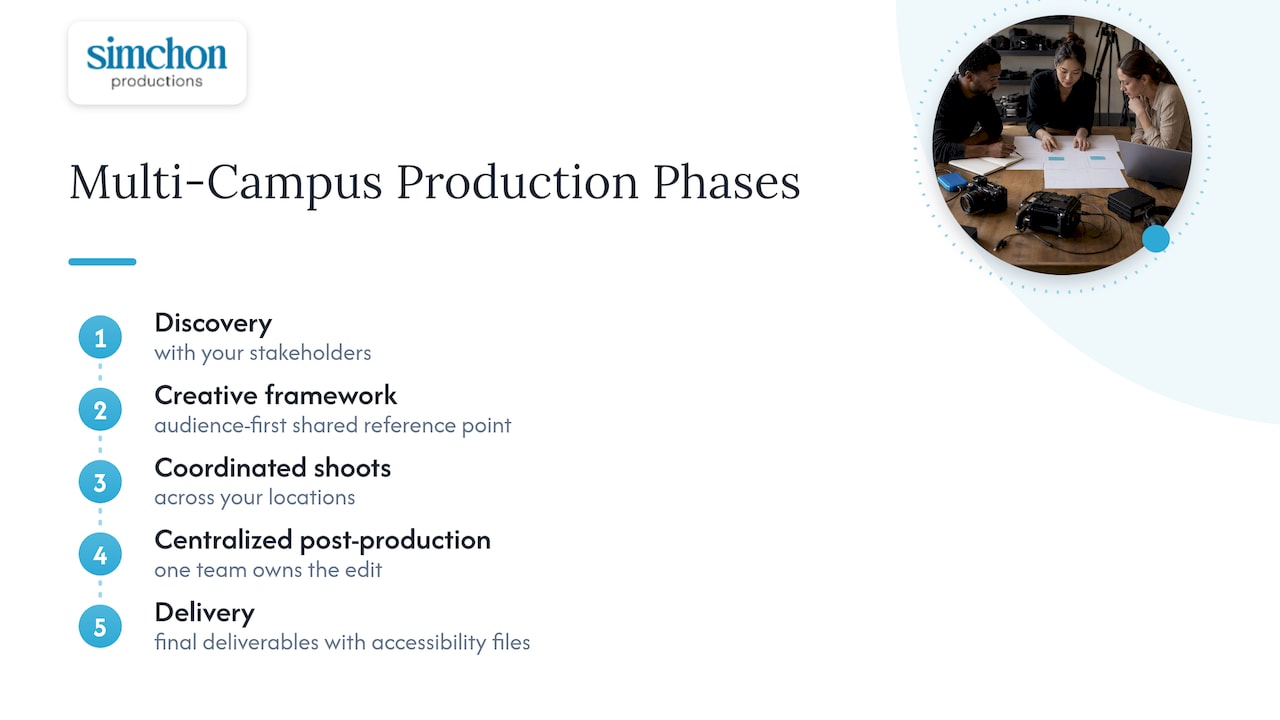
We build every multi-campus project around one audience-first creative framework before anyone picks up a camera. That framework becomes the shared reference point for every campus, so a video shot in New Jersey and one shot two states away still feel like they belong to the same story.
Our process runs through five phases: discovery with your stakeholders, a unified creative framework, coordinated shoots across your locations, centralized post-production, and delivery with all accessibility files included. Clients tell us this structure is what keeps a multi-site project from feeling disjointed, because one team owns the vision from the first call to final delivery.
— Tzvi Simchon
Ready to Start a Multi-Campus Video Project?
Coordinating several locations under one creative vision is exactly the kind of project well-suited for a streamlined video production process.
Before your first call with us, have a few things ready:
A rough project brief: audience, message, and where the video will live.
A list of the campuses or locations you want included.
Your general goals, whether that’s admissions, fundraising, or patient outreach.
A ballpark budget range so we can scope realistically.
Visit our service page to see the full range of film types we produce and request a consultation for your next multi-campus project.
This article is general information, not a substitute for advice from a qualified lawyer. Consult a qualified legal professional about your own circumstances before acting on anything here.
FAQ
What is multi-campus video production?
It’s the coordinated planning, filming, and editing of video content across more than one location for a single organization, like a university system or healthcare network. One creative team manages the whole project so the final films feel consistent no matter which campus they were shot at.
How long does a multi-campus video project usually take?
Timelines vary based on the number of locations, travel distance, and how many deliverables you need. Expect more lead time than a single-site shoot, since you’re scheduling around multiple campus calendars and building in buffer days for weather or access issues.
Do we need separate captions for each campus video?
You need accurate, human-edited captions on every video regardless of how many campuses are featured. Purdue’s accessibility SOP confirms automated captions alone don’t meet institutional standards, so plan for human review across all your footage.
When does student footage become a FERPA concern?
Footage becomes a potential education record when it’s “directly related” to an identifiable student, according to the FERPA FAQ. That means schools should review footage case by case and secure proper consent or releases rather than assuming any campus video is automatically exempt.
Does video actually help with admissions or donor engagement?
Documented case studies show that video, including welcome videos and relationship-marketing content, has influenced applicants’ impressions and decisions in specific graduate education programs. The same logic applies to donor-facing content built around a clear message and real stories.
Sources
Video-based relationship marketing in graduate education (case examples)
FERPA frequently asked questions (U.S. Department of Education)