Filmmaker led, platform first playbook for vertical video campaigns. Learn specs, modular shoot and testing workflows, plus tactics to lift Shorts...

Lift Shorts Conversions 35% with Filmmaker Vertical Video Campaigns
Vertical video campaigns use 9:16 video assets built for mobile screens, run across platforms like TikTok, Instagram, and YouTube Shorts. Full-screen vertical ads consistently earn higher engagement and stronger viewer interest than horizontal video on mobile, because they fill the screen without forcing a viewer to rotate their phone or squint at black bars.
TL;DR:
Platforms like TikTok, Instagram Reels, Snapchat, and Pinterest prioritize vertical formats, with some serving vertical only and others supporting multiple aspect ratios.
Creative hooks in the first three seconds, bold captions, and native re-framing are critical for capturing attention and avoiding lookalike, over-polished content.
Testing multiple hooks, angles, and calls to action over several days is essential to identify what resonates, with focus on watch-through rate and cost per result.
A modular shooting approach, capturing varied footage and editing for each platform, yields better results than cropping horizontal footage after the fact.
Simchon ProductionsMake Vertical Video Feel HumanSimchon Productions creates cinematic, authentic films with focused messaging for organizations, institutions, and brands across the tri-state area.Explore Simchon Productions
Table of Contents
What Platforms and Placements Support Vertical Video Ads?
What Specs Do Vertical Video Files Need?
How Should You Structure Vertical Creative for Attention?
How Do You Build a Vertical Production and Testing Workflow?
Which Metrics Actually Tell You a Vertical Campaign Is Working?
What Are Some Working Vertical Video Templates?
A Filmmaker’s Take on What Actually Moves the Needle
How Can Simchon Productions Help You Launch Vertical Campaigns?
Sources
FAQ
What Platforms and Placements Support Vertical Video Ads?
Every major ad platform now accepts vertical video, but each one treats it differently. TikTok was built for 9:16 from day one, so vertical is not optional there. Other platforms serve vertical alongside square and horizontal, sometimes with cropping or blur fills when a vertical file isn’t uploaded.
Here’s where vertical video runs and what to expect on each platform:
TikTok: Vertical only. Horizontal footage gets cropped or letterboxed automatically.
Instagram Reels and Stories: Vertical is native and prioritized in the feed algorithm.
Facebook Reels: Same vertical requirement as Instagram Reels, shared ad infrastructure.
YouTube Shorts: Google recommends vertical assets for Shorts placements, with horizontal video cropped or shown with blurred sidebars.
YouTube in-feed and in-stream: Accepts vertical, square, and horizontal; Google advises uploading multiple aspect ratios so its system picks the best fit per placement.
Snapchat: Vertical only, full-screen by default.
Pinterest: Vertical (2:3 or 9:16) performs best in the main feed.
X (formerly Twitter): Supports vertical in-feed video with growing incremental reach.
Amazon Sponsored Brands: Added vertical video creative support in 2024 for Drive Page Visits and Grow Brand Impression Share goals.
Check each platform’s ad specs page before launch. Specs change often, and an outdated file can get rejected or served at reduced quality.
What Specs Do Vertical Video Files Need?
Vertical video ads should be shot and exported at 9:16, roughly 1080x1920 pixels, in MP4 format using H.264 compression. That’s the safest default across every major platform, though 4:5 and 1:1 versions still help on mixed placements like YouTube in-feed, where Google’s system can choose whichever ratio fits the slot.
Keep text, logos, and calls to action out of the top and bottom 120 to 160 pixels of a 1080x1920 frame. That zone gets covered by platform interface elements like captions, profile icons, and comment bars. A logo sitting in that strip disappears behind the mute button on half your views.
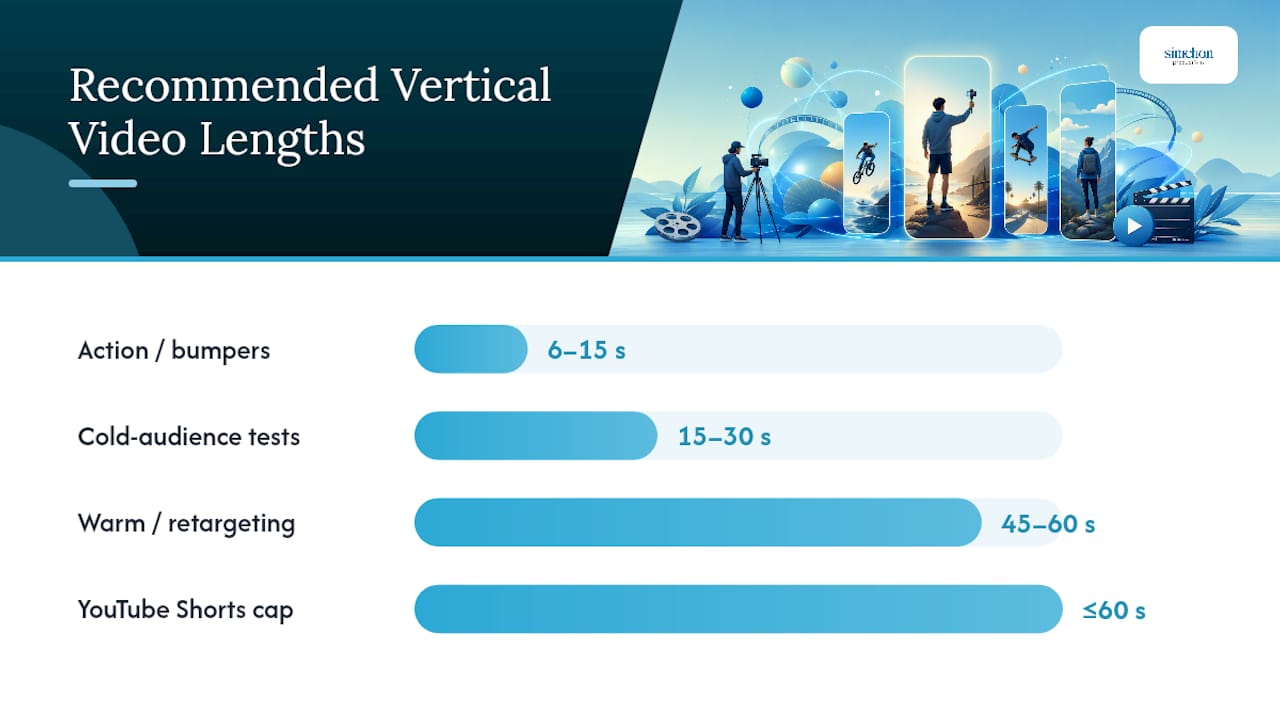
Length depends on the goal:
6 to 15 seconds: Best for action-driven ads and bumper-style awareness spots.
15 to 30 seconds: The standard test range for cold audiences who don’t know your brand yet.
45 to 60 seconds: Works for warm audiences and retargeting, where viewers already have context.
YouTube Shorts: Only the first 60 seconds play in the Shorts feed, so front-load anything essential.
Statistic Callout: Adding vertical assets to an existing YouTube campaign can lift conversions on Shorts by 35% and view-through rate by more than 40% in some campaign configurations, according to Google’s own reporting.
How Should You Structure Vertical Creative for Attention?
Vertical creative wins or loses in the first three seconds. A viewer scrolling a feed decides whether to keep watching almost instantly, so the opening frame needs to earn the next second before it earns the sale.
Follow this sequence when building the edit:
Open on motion or a face, not a logo. A static title card in second one is the fastest way to lose a scroller.
Match the platform’s visual grammar. TikTok rewards fast cuts and handheld energy. YouTube Shorts tolerates a slightly slower build. Copy the native pacing of wherever the ad will run.
Design for sound-on, but survive sound-off. Meta recommends vertical, sound-on creative with clear voiceover, but every ad still needs burned-in captions since a huge share of mobile viewers scroll with the volume down.
Bold your on-screen message. Don’t rely on subtle text. Big, high-contrast captions do the selling when audio is off.
Never crop a horizontal master and call it done. Reframe the shot, re-edit the timing, and rebuild the overlays natively for 9:16. A naive crop cuts off half the frame and looks lazy because it is.
Pro Tip: If you’re repurposing an existing horizontal video, don’t just crop the middle. Re-edit the pacing too. Horizontal cuts feel slow once you’re staring at a tall, narrow frame.
How Do You Build a Vertical Production and Testing Workflow?
A modular shoot day produces far more usable footage than a single scripted take, and it costs a lot less than shooting each variant from scratch. Plan for multiple hooks, multiple angles, and alternate voiceover lines before you ever hit record.
On set, capture:
Three to five different opening hooks for the same core message.
At least two camera heights or angles per key scene.
Two or three CTA read variations (urgency, value, curiosity).
B-roll shot specifically in vertical framing, not cropped from wide shots.
Once footage is in hand, build a simple testing matrix. Test Hook A against Hook B, a 15-second cut against a 30-second cut, and an early CTA against a late one. Run each combination for three to seven days before making a call, and read results by watch-through momentum, not just clicks.
Framing matters more on vertical shoots than horizontal ones. I always place the subject slightly higher than center in the frame. That preserves headroom and keeps a caption or CTA overlay from ever covering a face. On the back end, I export platform-specific masters with burned captions and separate SRT files for each, which speeds up both upload and A/B testing later.
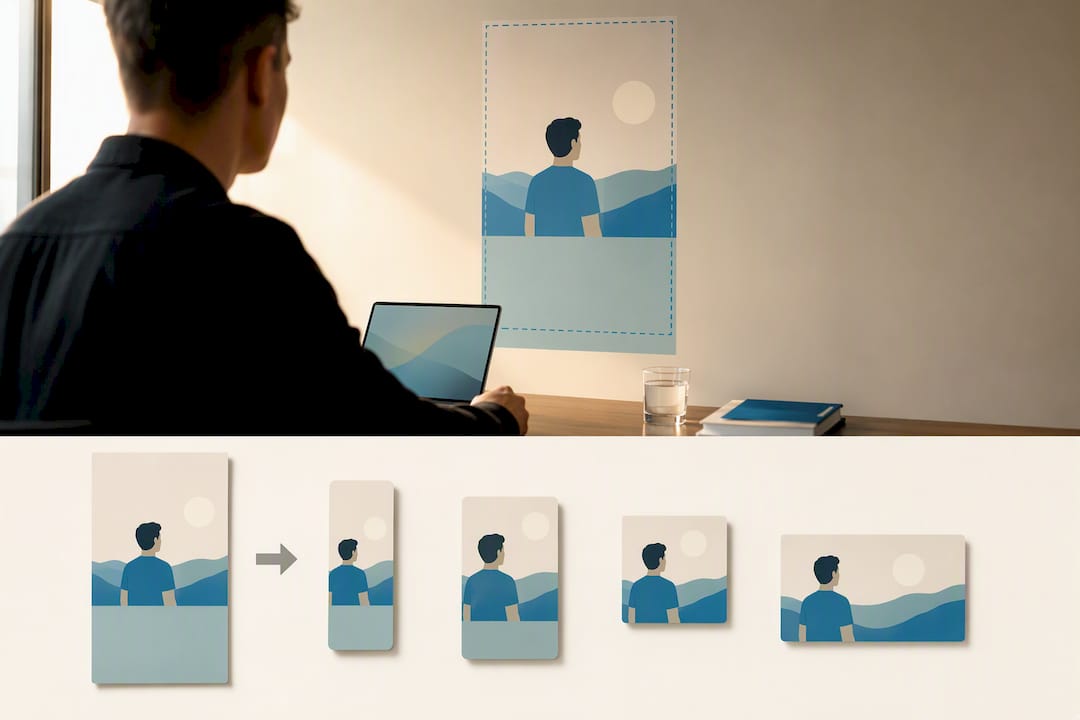
Pro Tip: Batch your exports by platform, not by video. Building all your TikTok masters first, then all your Shorts masters, keeps caption styling and safe zones consistent across a whole campaign.
Which Metrics Actually Tell You a Vertical Campaign Is Working?
View-through rate, watch-through percentage, and cost per result tell you more about a vertical campaign than clicks alone. Clicks measure interest at the very end of the funnel. Watch behavior tells you whether the creative itself is holding attention, which is the real lever in vertical video.
Track these core numbers:
View-through rate (VTR): Percentage of viewers who watch to completion or near-completion.
Watch-through at 25/50/75/100%: Shows exactly where viewers drop off, which points to a pacing or hook problem.
Click-through rate (CTR): Standard, but weaker as a standalone signal for vertical.
Cost per acquisition (CPA): The number that decides whether a creative scales or gets killed.
Engagement velocity: How fast likes, shares, and comments accumulate in the first hours after launch.
YouTube and Google’s own viewability standards differ from typical video viewability metrics elsewhere, so compare Shorts performance against Shorts benchmarks, not against in-stream numbers. Give a new creative three to seven days before judging it. Scale winners based on CPA trend and watch-through momentum together, not either one alone, and remix underperformers by swapping the hook before you scrap the whole asset.
What Are Some Working Vertical Video Templates?
Match the template to the placement, and match the placement to the KPI you actually care about.
15-second product demo for TikTok. Fast cuts, clear payoff by second five. Primary KPI: cost per acquisition.
30-second brand hook for Reels. Slower build, stronger visual identity. Primary KPI: reach and awareness.
15-second testimonial for Stories. Single subject talking directly to camera, minimal editing. Primary KPI: engagement rate.
45 to 60-second explainer for Shorts. More context, works for viewers who already know the brand. Primary KPI: watch-time and site traffic.
Schools and nonprofits often see the testimonial template outperform polished brand spots, since a donor or parent talking plainly to camera reads as more credible than a scripted voiceover. That same logic applies to donor and admissions storytelling more broadly.
A Filmmaker’s Take on What Actually Moves the Needle
Most vertical campaigns fail for one of three reasons: a weak hook, an edit that’s too polished to feel native, or no captions. I see the over-polished edit mistake constantly. Brands spend money making something look like a TV commercial, then wonder why it dies in a TikTok feed built for raw, native footage.
Planning vertical from the first shot day, instead of cropping a horizontal master later, saves money and produces better results almost every time. It’s not a bigger budget. It’s a smarter shoot day.
— Tzvi Simchon
How Can Simchon Productions Help You Launch Vertical Campaigns?
Simchon Productions is the alternative to piecing together vertical ads from repurposed horizontal footage: a modular shoot day built specifically to produce platform-ready 9:16 masters and multiple testable variants in one production.
Simchon Productions plans hooks, camera angles, and voiceover variations before the camera rolls, so a single shoot day yields creative for TikTok, Reels, and Shorts without a second production budget. Services relevant to a vertical-first campaign include Brand Films, Commercial Videos, Nonprofit Videos, and Event Films, each deliverable as platform-ready exports with burned captions and separate files per placement. For schools and universities building recruitment content specifically, the same modular approach applies to higher education video strategy. Marketing directors who need multiple testable variants without multiple shoot days can visit the Simchon Productions site to scope a project and get a quote based on the specific campaign.
Sources
YouTube Shorts ads: Asset specs and best practices - Google Ads Help
Use square and vertical video to engage mobile customers - Google Ads Help
FAQ
Can You Give an Example of a Vertical Video?
A vertical video is any clip shot or formatted at 9:16, filling a phone screen top to bottom, like a TikTok product demo or an Instagram Reel testimonial. A 15-second TikTok demo showing a product in use, shot handheld and edited with fast cuts, is a common example.
Is 1920 by 1080 Vertical?
No. 1920 by 1080 pixels is horizontal (16:9), the standard for widescreen TV and desktop video. The vertical equivalent flips those numbers to 1080 by 1920 pixels, which is the recommended resolution for Shorts and Reels.
Why Do People Prefer Vertical Videos on Their Phones?
People prefer vertical video on mobile because it fills the entire screen without requiring them to rotate their phone. Research shows vertical ads increase viewer interest and engagement partly because the full-screen format reduces the mental effort needed to process the content.
What Is Vertical Video Content?
Vertical video content is any video shot or edited in a 9:16 aspect ratio, built for how people naturally hold their phones. It covers everything from TikTok ads to Instagram Stories to YouTube Shorts, and it typically requires native framing rather than a cropped horizontal file.
Does Simchon Productions Produce Vertical Video Content?
Simchon Productions produces cinematic vertical-ready content including various types of films for organizations in the tri-state area. Pricing depends on project scope, and current details are available directly on the Simchon Productions site.