Discover why cinematic video moves donors to give. Learn the secrets of storytelling, visuals, and emotional triggers that drive donations.

Why Cinematic Video Moves Donors to Give in 2026
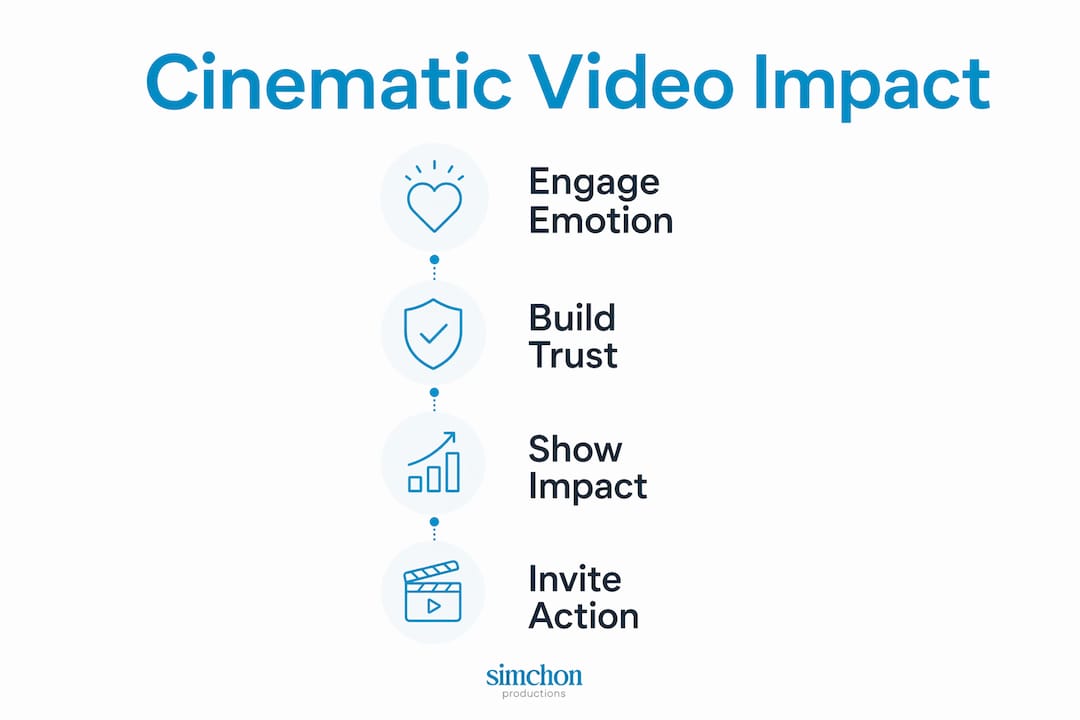
Cinematic video moves donors to give because it does something no email or brochure can: it makes people feel the mission before they’re asked to fund it. The most effective fundraising videos combine authentic storytelling, professional visuals, emotional triggers, and a clear call to action into one experience that converts viewers into givers. 57 % des personnes qui regardent une vidéo d’organisme à but non lucratif font un don, soit un résultat nettement supérieur aux appels basés sur du texte. Voici ce qui motive ce résultat :
Authentic narrative: Real people, real outcomes, no scripts that sound like press releases
Professional visuals: Lighting, camera movement, and editing that signal organizational credibility
Emotional triggers: Awe, empathy, and hope activated through deliberate storytelling choices
Identifiable subject: One person’s story, not a statistic
Clear call to action: A specific, visible ask placed at the right moment
Sound design: Music and audio that guide the viewer’s emotional state
Trust signals: Behind-the-scenes footage and beneficiary voices that prove the work is real
Each element reinforces the others. Pull one out and the video still plays. But it won’t move anyone to open their wallet.
Table of Contents
How emotional storytelling drives nonprofit donations
Strategies for producing high-impact nonprofit videos
What filmmaking elements make fundraising videos work?
Expert insights on why cinematic videos uniquely move donors
How cinematic quality builds donor trust
Real examples of fundraising videos that worked
Psychological triggers that cinematic techniques activate
How to tailor cinematic content to different donor demographics
Simchon Productions brings this to life for nonprofits
Key takeaways
How emotional storytelling drives nonprofit donations
Stories work on donors in ways that data simply cannot. When a viewer watches a single mother describe how her family got clean water, the brain processes it as a personal experience, not an abstract cause. That’s the Identifiable Victim Effect at work: people donate more when they see one relatable individual rather than aggregate numbers. Videos featuring human faces boost retention by 95% compared to text-based content.
The most effective nonprofit videos follow a clear emotional arc: establish the problem through a real person’s experience, show your organization stepping in, then reveal the transformation. This structure gives donors a satisfying resolution that only becomes possible because of their support. Authentic testimonials carry weight that polished marketing copy cannot match, and authenticity converts passive viewers into active supporters more reliably than high production value alone.
Storytelling also connects well to the role of online gift narratives in building donor relationships over time.
Focus on one beneficiary, not a crowd
Let subjects speak in their own words, unscripted
Show the problem visually before introducing your organization
Reveal the transformation with concrete, visible evidence
Balance emotion with brief data points to validate the story’s scale
Pro Tip: Structure your story as Problem, Intervention, Transformation. Introduce your beneficiary within the first ten seconds, show the turning point by the midpoint, and let the outcome land before your call to action appears.
Strategies for producing high-impact nonprofit videos
Strategy comes before the camera. The nonprofits that see the strongest returns from video are the ones that answer three questions before they shoot: Who is this for? What do we want them to do? Where will they watch it? Without those answers, even a beautifully produced video collects digital dust.
Short-form videos under 90 seconds generate 2.5 times more engagement than longer content on social platforms, so length is a real strategic decision, not a production afterthought. Keep social-first content tight. Reserve two-to-three-minute formats for landing pages and major donor presentations where viewers have already opted in.
Define your audience first: Major donors respond differently than first-time givers on Instagram
Match length to platform: Under 90 seconds for social, two minutes or more for website and email
Script the CTA specifically: “Your $50 provides clean water for one family for a year” outperforms “learn more”
Plan distribution before production: Know where the video lives before you decide how to shoot it
Use authentic footage: Real program moments outperform staged recreations every time
You can also repurpose longer videos into short clips for social platforms. Tools like ClipForge make that process faster without losing the emotional core of the original.
What filmmaking elements make fundraising videos work?
Production quality shapes how donors perceive your organization before a single word is spoken. Shaky footage, flat lighting, and muddy audio signal disorganization, even when the mission is strong. The filmmaking elements that matter most are not about looking expensive. They’re about creating an immersive experience that keeps the viewer present.

Camera movement guides attention and creates intimacy. A slow push toward a subject’s face during an emotional moment pulls the viewer in. Static wide shots create distance. Lighting separates subjects from backgrounds and communicates warmth or urgency depending on the scene. Sound design is where most nonprofit videos fall short: clean dialogue, ambient sound from the field, and a music bed that builds with the story’s emotional arc all work together to keep viewers engaged.
Narrative pacing matters just as much as any visual element. Hook the viewer immediately, establish the problem early, demonstrate impact through the middle, and deliver the call to action in the final seconds. This structure ensures the emotional arc lands before drop-off occurs.
Hook within the first three seconds
Establish the problem before the 45-second mark
Show impact and transformation through the middle section
Deliver a specific CTA in the final 15 seconds
Use music that builds with the story, not over it
Expert insights on why cinematic videos uniquely move donors
The shift from “shouting louder” to inviting the viewer in is what separates fundraising videos that convert from ones that get scrolled past. Cinematic quality signals to major donors and foundations that your organization is stable, organized, and capable of managing resources responsibly. That perception matters when a foundation is deciding between two grant applicants.
Professional-grade video enhances perceptions of stewardship and credibility in ways that text-based appeals simply cannot replicate. Emotional triggers also play a measurable role: awe accounts for 25% of the most-shared content online, and laughter for 17%, both driving more giving than neutral messaging. Donors are moved by feeling, not by facts alone.
Pro Tip: Embed a video transcript on your donation page alongside the video itself. Transcripts on donation pages drive a 560.2% lift in conversion rates. Pair that with a specific CTA in the final 15 seconds of the video and you’ve built a two-part system that works.
How cinematic quality builds donor trust
Donors, especially major ones, read production quality as a proxy for organizational health. A well-lit, well-edited video communicates that your team is competent and your resources are managed well. That’s not a superficial judgment. It’s a reasonable inference. High-quality video production signals organizational professionalism and reassures donors that their gifts will be stewarded responsibly.
Behind-the-scenes content adds a different kind of trust. Showing staff at work, program logistics, and unscripted moments makes donors feel like insiders rather than spectators. That sense of access builds loyalty. Loyalty, over time, becomes recurring giving. For a deeper look at how visual storytelling strengthens long-term donor relationships, cinematic video and trust is worth reading.
Real examples of fundraising videos that worked
The most instructive examples of impact-driven donor videos share one trait: they show a specific outcome, not a general mission.
One clean water nonprofit raised a multimillion-dollar amount using raw footage of wells being built and communities celebrating their first access to clean water. No narrator. No statistics on screen. Just the moment of transformation, captured on location. A food-focused organization boosted online donations significantly through short Instagram videos showing how small gifts feed children, making the ask feel achievable rather than abstract. A survivor-testimony campaign combined personal video stories with a matched-giving offer and increased digital donations substantially.
What these examples share is a mission-driven video approach that leads with human impact and makes the donor’s role in that impact unmistakably clear.
Psychological triggers that cinematic techniques activate
Cinematic techniques work because they activate specific psychological responses. Slow camera movements and close-up facial expressions trigger mirror neurons, creating empathy. A music swell at the moment of transformation releases dopamine, making the viewer feel the resolution emotionally before they process it rationally. These are not accidental effects. They’re the result of deliberate craft.
Scarcity and urgency, when framed around real need rather than manufactured pressure, activate loss aversion. A viewer who feels that a child’s outcome depends on their decision in the next 30 seconds is more likely to act than one who feels the cause will manage either way. Pair that with social proof, such as a donor testimonial or a milestone counter, and you’ve addressed both the emotional and rational sides of the giving decision simultaneously.
How to tailor cinematic content to different donor demographics
Not every donor responds to the same video. Major donors and foundation officers tend to respond to longer, more detailed content that demonstrates organizational depth and measurable outcomes. First-time givers on social media need a hook in the first three seconds and a frictionless path to donate. Monthly supporters want to feel connected to ongoing progress, not just a single campaign moment.
Age and platform also shape what works. Younger donors on TikTok and Instagram Reels respond to vertical, authentic, fast-paced content under 60 seconds. Older major donors reviewing a grant proposal expect a polished, two-to-three-minute piece with clear program data woven into the narrative. The best nonprofit video strategies account for these differences at the planning stage, not in post-production.
Segment your video library by donor type and match each piece to the channel where that audience already spends time. One video cannot serve every audience well.
Simchon Productions brings this to life for nonprofits
Nonprofits that understand why cinematic video moves donors to give still need a production partner who can execute it. Simchon Productions works with nonprofits across the tri-state area to produce documentary-style and cinematic brand films built around authentic storytelling, not generic marketing content.
The difference is in the approach. Simchon Productions builds a clear framework around your audience and your message before a camera is ever picked up. The result is a film that hits the emotional core of your donors, communicates your mission with credibility, and gives viewers a clear path to act. If you’re preparing for a capital campaign, an end-of-year appeal, or a major donor presentation, view the nonprofit work to see what that looks like in practice. Ready to get started? Reach out to Simchon Productions to talk through your next video.
Key takeaways
Cinematic video moves donors to give by combining emotional storytelling, professional filmmaking, and strategic calls to action into a single experience that builds trust and inspires giving.
Point | Details |
|---|---|
Emotional storytelling drives giving | The Identifiable Victim Effect shows one person’s story outperforms statistics in motivating donations. |
Video converts at a high rate | 57% of viewers donate after watching a nonprofit video, far above text-based appeals. |
Short-form video wins on social | Videos under 90 seconds generate substantially more engagement than longer content on social platforms. |
Transcripts multiply conversions | Embedding a video transcript on a donation page drives a 560.2% lift in conversion rates. |
Simchon Productions | Produces cinematic nonprofit films for the tri-state area, built around authentic storytelling and donor-focused messaging. |