Production-aware workflow for communications teams: one-page prep, two-to-three core messages, and recorded mock interviews (three recommended) to ready...

Executive On Camera Interview Workflow Communications Teams Can Reuse
Every executive on-camera interview needs three things to go well: a one-page prep note sent early, two to three plain-language messages built in the executive’s own words, and at least one recorded mock interview before the cameras roll. Skip the mock and you skip the only step that actually catches problems. Follow this order and most executives walk into the real interview calmer and sharper than they expect.
TL;DR:
Executives should run three recorded mock interviews, each with increasing difficulty, to identify and correct non-verbal cues and answer delivery issues.
Core messages must be written in the executive’s own words, supported by a brief story or example to make responses authentic and memorable.
A well-structured, one-page prep note covering purpose, main topics, core messages, logistics, and reassurance significantly reduces pre-shoot anxiety.
Using open-ended questions that prompt storytelling produces more genuine responses than yes-or-no questions and reveals valuable insights.
Technical setup, including blocking sufficient time, controlling noise, and limiting observers, is crucial to prevent a wasted shoot day and ensure video quality.
Simchon ProductionsCreate Interviews That Build TrustSimchon Productions creates cinematic films with authentic storytelling and focused messaging for organizations, institutions, and brands.Explore Simchon Productions
Table of Contents
What Goes in a One-Page Executive Prep Note?
How Do You Build Core Messages Executives Will Actually Say?
How Many Mock Interviews Should an Executive Run Before Filming?
What Questions Get Executives to Tell Real Stories Instead of Reciting Talking Points?
What Room and Technical Setup Prevents a Wasted Shoot Day?
What Should an Executive Wear and How Should They Sit?
When Should an Executive Use a Teleprompter Instead of Speaking Freely?
How Does a Production Partner Reduce Risk on Shoot Day?
How Should an Executive Handle a Difficult or Sensitive Question?
What Happens After the Interview Wraps?
How Do Voice and Body Language Affect an Executive’s Credibility on Camera?
How Does an Executive Stay On-Message Without Sounding Scripted?
Author’s Perspective: What I See on Set
Ready to Film Your Executive Interview?
Sources
FAQ
What Goes in a One-Page Executive Prep Note?
A one-page executive prep note tells the executive why the interview matters, who’s watching, and what to say, without burying them in paragraphs. Communications teams that send a short brief instead of a long packet see better executive readiness and lower pre-shoot anxiety. Length is the whole point. If it doesn’t fit on one page, it won’t get read closely.
Include these six items:
Why it matters: one sentence on the interview’s purpose and who will see it (internal audience, press, donors, prospective families).
Main topics: three to five subjects the interviewer plans to cover, not a script.
Core messages: two or three priorities, written in plain language.
Call to action: what you want the viewer to do or feel after watching.
Logistics: call time, arrival instructions, on-site contact name and phone number, expected interview length, and confirmation that answers can be repeated if needed.
A calming line: something like, “This is a conversation, not a test. If you flub an answer, we’ll stop and try again.”
That last line matters more than it looks. Executives who know retakes are normal loosen up faster on camera.
How Do You Build Core Messages Executives Will Actually Say?
You build core messages that sound real by writing them down in the executive’s own words, not marketing copy, then attaching one short story to each. A message that reads like a press release gets delivered like one, flat and forgettable. Sit with the executive for 20 minutes, ask how they’d explain the point to a colleague over coffee, and write down what they actually say.
Draft two or three messages based on the executive’s natural phrasing, then test each one out loud.
Attach a short story or example to every message. A number without a story is forgettable; a story with a number sticks.
Practice bridging back to those messages when a question drifts. Short phrases work best: “That’s a fair question, and here’s what matters most for our team,” or “I can’t speak to that specifically, but what I can tell you is…”
Flag exact-word facts in the brief itself, things like compliance language, dollar figures, or legal terms that must be stated precisely, so the executive knows exactly where phrasing flexibility ends.
Build a short reporter dossier covering the interviewer’s past coverage, tone, and likely follow-up angles. A structured preparation framework that includes this kind of research consistently produces better outcomes than a last-minute briefing the morning of the shoot.
Pro Tip: Have the executive record themselves saying each core message on their phone. If they can’t say it naturally in under 15 seconds, it’s not their voice yet, it’s still a slogan.
How Many Mock Interviews Should an Executive Run Before Filming?
Most executives need three mock interviews of increasing difficulty, each one recorded and reviewed on video. The recording is not optional. Watching yourself answer a hard question reveals problems the executive never feels in the moment, darting eyes, crossed arms, a habit of saying “um” every third sentence.
Structure the three sessions like this:
Session one (starter): friendly, easy questions to find natural phrasing and build confidence.
Session two (practice): tougher, more specific questions that push past prepared talking points.
Session three (final): a curveball question, a simulated technical glitch, or a format change to mimic real-world surprises.
Review each recording for eye contact, filler words, hand gestures, and pacing. Simulate an interrupted answer or a rapid-fire follow-up question so the executive practices staying calm mid-sentence. If the executive still seizes up after three sessions, bring in a dedicated media trainer. If the issue is mostly comfort with the camera and setting, the production team running rehearsals is usually enough.
What Questions Get Executives to Tell Real Stories Instead of Reciting Talking Points?
Open-ended questions that ask for a specific memory or moment get executives to tell real stories, while yes-or-no questions get slogans. “Walk me through the day you decided to launch this program” produces a better answer than “Why did you launch this program?”
Start with an anecdote prompt. Questions like “Tell me about a time when…” or “What did that moment feel like?” invite detail instead of summary.
Follow up for specifics. Ask who was in the room, when it happened, and what changed afterward. Vague answers get more useful once you ask for one more detail.
Let silence sit. Don’t jump in to fill a pause. Executives often need three or four extra seconds to find the better version of their answer.
Ask for a repeat when needed. If an answer rambles or misses the point, just say, “Let’s try that one again, shorter this time.”
Avoid stacked or leading questions. Asking two things at once, or phrasing a question so there’s an obvious “right” answer, produces guarded, evasive responses.
What Room and Technical Setup Prevents a Wasted Shoot Day?
The room and technical setup that prevents wasted shoot days starts with blocking real time, checking audio twice, and controlling who’s in the room. A rushed 20-minute slot rarely produces usable footage once you account for setup, warm-up, and retakes.
Block 45 to 60 minutes when possible. Twenty minutes sounds efficient but leaves no room for a flubbed answer or a second take.
Prioritize audio over visuals. Poor sound breaks viewer trust faster than an imperfect shot. Use a lavalier mic clipped away from jewelry or scarves, keep a boom mic as backup, and run a second audio recorder in case the primary fails.
Check the backdrop. Avoid pure white walls, busy patterns, or anything resembling a green screen, all of which distract from the executive’s face.
Limit observers. Extra people in the room raise pressure and invite side conversations. Set a rule: essential crew only, and no last-minute stakeholder additions without a heads-up to the director.
What Should an Executive Wear and How Should They Sit?
An executive should wear solid colors, avoid tight patterns, and sit leaning slightly forward with hands visible. Busy patterns and thin stripes create a flickering effect on camera called moiré, and it’s distracting on playback.
Wardrobe: solid colors work best; avoid tight checks, thin stripes, and busy patterns. Bring a backup outfit in case the first choice clashes with the set or lighting.
Posture: sit leaning slightly forward, not rigid, not slouched. Keep hands visible and use them naturally instead of crossing arms, which reads as closed off.
Mic considerations: avoid noisy jewelry, scarves that rub against a lav mic, and heavy fabric that muffles sound.
Glasses: ask about anti-glare coating ahead of time, since studio lighting can create harsh reflections that hide the eyes.
When Should an Executive Use a Teleprompter Instead of Speaking Freely?
An executive should use a teleprompter only for short, exact-wording moments, like a legal disclaimer, a fundraising ask, or a formal announcement, and speak freely for everything else. Mixing formats works better than picking one: interview format for authentic story, teleprompter for precision.
Write prompter lines the way people talk. Short sentences. Contractions. Natural breath marks. For direct-to-camera segments, the executive looks at the lens; for interview-style segments, they look at the interviewer, not the camera. Practice both, since switching eye lines mid-shoot trips people up. Glasses wearers should test prompter visibility beforehand, since glare and small text don’t mix well on camera.
How Does a Production Partner Reduce Risk on Shoot Day?
A production partner reduces risk on shoot day by handling audio, lighting, and pacing so the executive can focus entirely on answering questions. Simchon Productions builds this into the workflow directly: a warm-up conversation to settle nerves, a recorded mock question or two, a technical run-through, then the main interview, followed by pickup shots if any answer needs a cleaner take.
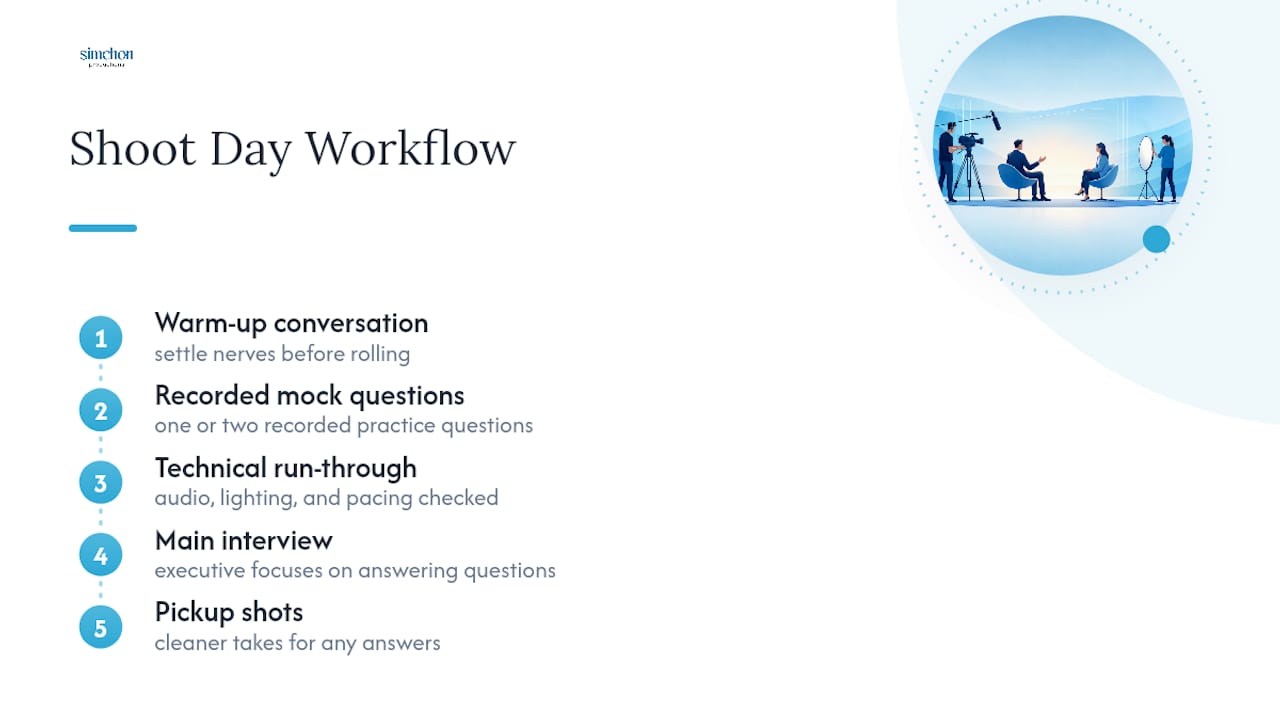
A crew with a dedicated audio technician, a lighting operator, and a director who’s watching content, not just framing, catches problems before they become wasted footage. That structure is also what keeps an executive from feeling like they’re being tested. They’re being supported. Deliverables from an engagement like this typically include the raw interview footage, a polished edit, and shorter clips built for social use, all captured in a single, well-run session.
How Should an Executive Handle a Difficult or Sensitive Question?
An executive should handle a difficult question by acknowledging it directly, answering what they honestly can, and bridging to what matters most, never by dodging or getting defensive. Viewers spot evasiveness fast, and a visibly dodged question often does more reputational damage than an honest, limited answer.
Start with acknowledgment: “That’s a fair question” or “I understand why people are asking about this.” Dismissing the question or looking annoyed reads badly on camera, even if the executive says all the right words afterward.
Answer what can honestly be answered, even briefly. If certain details are confidential, legally restricted, or simply unresolved, say so plainly: “I can’t share specifics on that right now, but here’s what I can tell you.” Vague non-answers frustrate viewers more than an honest boundary.
Bridge back to a core message once the direct answer is given, not before. Bridging too early, before acknowledging the question, reads as deflection. Bridging after a real answer reads as focus.
Prepare for the two or three toughest questions a reporter might realistically ask, not the worst-case scenario nobody would actually raise. This is where the reporter dossier pays off. If the interviewer has covered layoffs, controversies, or financial troubles at other companies, expect a version of that question here too. Rehearsing the actual hard question, out loud, on camera, beats hoping it doesn’t come up.

What Happens After the Interview Wraps?
What happens after the interview wraps matters almost as much as the interview itself. A quick debrief, a thank-you to the crew and interviewer, and a plan for reviewing footage all protect the relationship and the final product.
Send a short thank-you to the interviewer or media outlet within a day, especially if this is a press interview rather than an internal shoot. It’s a small gesture that keeps the door open for future coverage.
Review the raw footage with the communications team before it goes into editing. Flag any answer that felt off, whether it strayed from the core message, ran too long, or included information that shouldn’t air. Catching this before the edit is far easier than fixing it after.
Track how the interview performs once it’s published or aired: views, shares, press pickup, or audience feedback. That performance data shapes how the next executive interview gets planned, from which messages resonated to which questions caused hesitation.
Keep a running file of questions asked across interviews. Patterns emerge fast. If the same tough question comes up three interviews in a row, that’s a sign to build a stronger, more rehearsed answer before the next one.
How Do Voice and Body Language Affect an Executive’s Credibility on Camera?
Voice and body language affect credibility because viewers judge tone and posture before they process the actual words. A flat, monotone voice reads as disengaged even when the content is strong, and crossed arms or a rigid posture reads as defensive even when the executive feels calm.
Vary vocal pace and pitch deliberately. Slowing down on a key message and speeding up slightly on background details helps viewers know what to remember. A voice that never changes speed or tone starts to sound like it’s reading, even when it isn’t.
Watch the hands. Controlled, natural gestures at chest height add emphasis without distracting. Hands hidden under a table or clenched in a lap read as nervous, while wild, unrestrained gestures pull focus from the words.
Maintain steady but not frozen eye contact with the interviewer, and blink and shift naturally the way anyone does in conversation. Staring fixedly at one point looks robotic on playback.
Smile when it’s genuine, particularly during the warm-up or a lighter story. A forced smile is easy to spot, but no smile at all across an entire interview makes an executive seem cold, even discussing good news.
How Does an Executive Stay On-Message Without Sounding Scripted?
An executive stays on message without sounding scripted by returning to the same two or three core ideas through different words and stories, not the same sentence repeated. Repetition of a message’s substance builds recall. Repetition of exact phrasing sounds like a talking point, and viewers notice the difference immediately.
Use the story attached to each core message as the anchor, then let the wording shift naturally depending on the question. If a message is “we invested in staff training this year,” one answer might lead with the story of a specific employee, while another leads with a numbers-based example. Same message, different entry point.
Before the interview, agree with the executive on which one or two messages absolutely must land, even if every other exchange gets fuzzy. Trying to hit five messages in a ten-minute interview usually means none of them land clearly.
Watch for drift during the mock interviews. If the executive starts wandering into unrelated territory or adding new claims that weren’t part of the brief, that’s the moment to tighten the message list, not add to it. A reporter-ready executive who provides context and useful anecdotes earns more trust and more follow-up coverage than one who recites the same line every time.
Author’s Perspective: What I See on Set
The most common problem I see on set isn’t nerves. It’s over-scripting. An executive walks in having memorized paragraphs, and the second a question comes at a slight angle, they freeze because the exact words aren’t there anymore. The fix is always the same: fewer scripted lines, more rehearsed stories. A slightly imperfect, honest answer beats a polished one that sounds read. If you only have time for one prep step, skip the script and run the mock interview instead.
— Tzvi Simchon
Ready to Film Your Executive Interview?
A professional production company gives communications teams something a script and a webcam never can: a crew that handles the technical pressure so the executive only has to focus on the conversation. That’s the real advantage over a rushed DIY setup or an internal team juggling cameras and lighting on top of coaching the executive through content.
A typical production engagement starts with a planning call to align on messages and logistics, followed by shoot day itself, where the crew runs a warm-up conversation, a recorded mock question, and a technical check before the main interview begins. After filming, the production team handles the edit and delivers a polished final video along with shorter clips built for social use. You can review examples of executive and cinematic interview work in the video production portfolio, and if you’re comparing outside help against handling it in-house, this breakdown of what to expect from a production partner is worth a look first. When you’re ready to talk through your project, reach out through Simchon Productions to schedule a planning call and get a quote.
Sources
For deeper reading on executive media preparation, see Harvard Business Review, 5WPR, Griffith Media, and 10Fold. For hands-on technical checklists, Filmijob’s interview prep guide is a solid companion resource.
Prepare Leaders for High-Stakes Media Interviews: A Framework for Message Discipline Under Pressure
Media Training for Executives: How to Become a Reporter-Ready Expert
FAQ
How Do You Prepare for an On-Camera Interview?
Send a one-page prep note with the purpose, topics, and logistics, develop two or three core messages in the executive’s own words, and run at least one recorded mock interview before the real shoot.
What Is the Biggest Red Flag When Being Interviewed?
The biggest red flag is visible evasiveness, dodging a direct question without acknowledgment, since viewers read that as dishonesty faster than they judge an honestly limited answer.
What Is the 30-60-90 Rule in an Interview?
The 30-60-90 rule generally refers to a hiring or onboarding framework for setting goals over the first few months in a new role, not a media interview technique; it does not apply to on-camera executive interview preparation.
What Are the Hardest Types of Interview Questions to Answer?
The hardest questions are usually the ones tied to layoffs, financial trouble, controversy, or anything the executive can’t fully disclose, which is exactly why a reporter dossier and mock interview practice matter most before filming.
Should an Executive Use a Teleprompter During a Media Interview?
An executive should use a teleprompter only for short, precise lines like legal disclaimers or fundraising asks, and speak conversationally for the rest of the interview to keep the delivery natural.