Filmmaker led, research backed production guide for nonprofits on emotional storytelling video. Learn the one on set rule, how to nail the first 10...

Emotional Storytelling Video: Filmmaker’s First 10s Rule for Nonprofits
An emotional storytelling video uses a real human protagonist, clear stakes, and a visible change to make viewers feel something before they think about the message. The one production rule that matters most: build every decision, script, casting, shots, music, around helping the audience identify with that protagonist. Do this well and you can expect measurable gains in watch time, shares, and recall compared to standard promotional content.
TL;DR:
Emotional storytelling videos significantly increase engagement, shares, and recall by focusing on authentic human protagonists and clear emotional arcs.
Keeping the visual frame simple, centered on the protagonist, and timing cuts carefully enhances emotional impact and viewer retention.
Stories should feature a relatable character, a visible stakes-based transformation, and aim for sensory-rich, specific details to foster genuine connection.
Use moderate vocal arousal, natural speech, and restrained sound design to maintain authenticity and avoid performance fatigue.
Short-form videos should be 60 to 90 seconds with strong hooks, while longer videos allow for more complex emotional arcs, aligned with each platform’s key performance metrics.
Simchon ProductionsCreate Stories That Build TrustSimchon Productions creates cinematic nonprofit films with authentic storytelling, focused messaging, and emotional impact for audiences in the tri-state area.Visit Simchon Productions
Table of Contents
What makes emotional storytelling video worth the investment?
What are the core principles of effective emotional storytelling video?
How do you build the story layer: characters, conflict, and script?
How should directors coach vocal delivery and camera performance?
What visual and sound choices increase emotional immersion?
What does effective emotional storytelling look like in practice?
How do you adapt emotional storytelling across short-form and long-form video?
A filmmaker’s take on protecting emotional truth on set
How Simchon Productions builds emotional storytelling videos for organizations
Where the research behind this article comes from
Sources
FAQ
What makes emotional storytelling video worth the investment?
Emotional storytelling video earns its budget because it changes how people behave, not just how they feel. A multi-platform study of university social media found that emotional-format posts produced an 80% increase in interactions compared to traditional institutional content. That is not a small bump. That is the difference between a video nobody shares and one that gets passed around a department.
Industry analysis of brand films points the same direction. Reports summarizing human-centric brand storytelling cite a 78% engagement uplift for films built around authentic human emotion versus polished, feature-driven content. The mechanism is simple. When a viewer recognizes a real feeling on screen, attention narrows, the brain treats the moment as socially relevant, and memory encoding gets stronger. That is why an emotional story sticks after the ad budget runs out.
Here is what emotional storytelling reliably moves:
View completion and watch time, because identification keeps people watching past the first ten seconds
Shares and comments, because emotion is the main reason people forward video content to someone else
Donations and inquiries, because trust builds faster through story than through statistics
Brand recall, because emotionally coded memories outlast feature lists
It is a measured outcome from a controlled comparison against standard institutional posts.
What are the core principles of effective emotional storytelling video?
Every effective emotional storytelling video follows a short list of production rules, and skipping any one of them shows up on screen. These are not creative preferences. They are the difference between a film that lands and one that gets skipped after five seconds.
Choose authenticity over polish. Tell the story, do not sell the message. A viewer can spot a script trying to persuade them within seconds, and the moment they sense a pitch, identification breaks.
Pick one emotional register, or plan a deliberate mix. A film built around hope needs every scene supporting hope. If you want a longer arc, a mixed-emotion structure (grief into relief, fear into resolve) works better for sustaining attention. Research using EEG measures found mixed-emotion videos sustained engagement longer than emotionally uniform videos, which tended to lose viewers as the story went on.
Keep the frame simple and center the protagonist. Busy backgrounds and cluttered compositions compete with the human face for attention. Simplicity wins.
Time your cuts to protect emotional beats. A great line delivered by an actor or interview subject needs a full second or two to land before the next cut. Cut too fast and you erase the moment before the viewer processes it.
Pro Tip: Storyboard the emotional beats before you storyboard the shots. If you cannot name the feeling a scene is supposed to create, the camera crew cannot capture it either.
How do you build the story layer: characters, conflict, and script?
The story layer of an emotional storytelling video starts with a protagonist the audience can recognize within the first few seconds, not a composite or an abstraction. A nonprofit donor video works better with one mother describing one moment than with three unnamed beneficiaries and a voiceover.

Stakes come next. What does the protagonist stand to lose or gain? A patient testimonial video needs a clear before-and-after: what life looked like before treatment, what changed after. Without a visible before-and-after, there is no arc, only a description.
Script economy matters more than most teams think. Aim for:
Sensory anchors instead of abstractions (“the smell of the hospital hallway” beats “a difficult time”)
One clear goal per scene, stated or implied
A “recognition window” in the first ten seconds where the viewer sees enough of the protagonist’s situation to start caring
Mixed emotional arcs for anything past 90 seconds, single-emotion arcs for anything shorter
For mission-driven films specifically, structuring the interview around a listening period rather than a rehearsed answer tends to surface the moments that carry real weight. A mission story checklist built for nonprofit interviews walks through how to structure those conversations so unscripted honesty survives the edit.
How should directors coach vocal delivery and camera performance?
Directors get authentic emotional delivery by targeting moderate vocal arousal, not maximum intensity, and by giving subjects room to speak without a script. Research on auditory emotional arousal in short video marketing found that moderate pitch variation and steady loudness produce stronger engagement than high-intensity, dramatic delivery. Shouting the emotional beat rarely works. A quiet, controlled voice cracking slightly on one word usually beats a performance pushed too hard.
On set, a few habits protect authenticity:
Run a quiet “listening” period before the camera rolls so subjects settle into their own words instead of a rehearsed version
Watch for micro-expressions (a pause, a glance away, a swallow) and let the camera hold on them instead of cutting away
Keep speech rate natural. Rushed delivery reads as nervous, not honest
If a subject seems performative, ask a simpler question instead of asking for more emotion directly
Statistic to remember: the same research on auditory arousal found that excessive emotional intensity in the voice can actually reduce engagement, meaning restraint outperforms drama in most short-form emotional content.
What visual and sound choices increase emotional immersion?
Emotional storytelling video gets stronger when the frame stays simple and the cuts stay frequent enough to hold attention without breaking the mood. A study on visual complexity and viewer attention found that lower visual complexity paired with more frequent scene cuts improves attentional synchrony, meaning more viewers are looking at the same thing at the same moment.
Apply it this way:
Center the most important visual element on screen for at least one full second before moving on
Favor close-ups over wide shots when the goal is emotional connection rather than scale
Match music energy to the emotional register you picked. A hopeful scene with a minor, somber score confuses the viewer’s read
Keep audiovisual congruence: if the voice is calm, the visual pace should stay calm too. Mismatched intensity between sound and picture undercuts both.
What does effective emotional storytelling look like in practice?
Practitioner experience from Simchon Productions shows how these principles translate into finished films with specific, repeatable choices.
Nonprofit mission film, 3 minutes. The team scheduled a quiet, unscripted interview period before filming and cut the musical score low during the subject’s pauses, letting silence carry the emotional weight instead of a swelling track.
Reveal moment, single take. Reserving the emotional turning point for one uninterrupted close-up, held for one to three seconds, gave the moment room to register instead of splitting it across cuts.
Casting for micro-behavior. Choosing subjects based on how they naturally paused or reacted, not how polished they sounded in a pre-interview, produced more usable authentic footage per shoot day.
Similar principles apply directly to donor-focused fundraising films and to community impact storytelling, where the protagonist’s authenticity carries more weight than production polish.
How do you adapt emotional storytelling across short-form and long-form video?
Runtime and hook strategy change by platform, but the identification rule stays constant across every format.
Short-form (15 to 90 seconds). Aim for the 60 to 90 second range for social platforms, and open with a hook in the first one to three seconds. Data from an analysis of nearly 4,000 short-form videos found that hot-take and investigator-style hooks outperformed plain story-open hooks for reach.
Mid-form (2 to 5 minutes). Use this length for event recap and highlight films where you have room for a full arc but still need pacing discipline.
Long-form (5 minutes plus). Reserve this for documentary-style institutional films where the mixed-emotion arc has room to develop across multiple scenes.
Match KPIs to format. Optimize short-form for reach and shares, mid-form for engagement and time watched, long-form for depth metrics like completion rate and direct inquiries.
Close with an implied call to action. A question left hanging or a scene that ends without resolution tends to drive more comments than a direct “click here” prompt.
A filmmaker’s take on protecting emotional truth on set
The biggest threat to an emotional storytelling video is not a bad camera or a thin budget. It is a director chasing a polished performance instead of a true one. Every technical decision, casting, editing, sound, should serve the human moment, not compete with it.
Three values worth defending on every shoot: cast for truthful micro-behavior over camera comfort, edit with humility so the story stays the subject’s and not the editor’s, and keep the sound design restrained enough that silence gets to do its job. When you screen an early cut, ask one question: does this feel like something a real person said, or something a script wanted them to say? If it’s the second one, go back to the interview footage.
— Tzvi Simchon
How Simchon Productions builds emotional storytelling videos for organizations
Simchon Productions is a video production company based in New Jersey working with organizations across the tri-state area that need films built around real human stories, not stock footage and generic voiceover. The team produces cinematic brand films, nonprofit and institutional video, event films, school videos, healthcare marketing videos, and documentary-style content for private schools, hospitals, universities, nonprofits, and senior living communities.
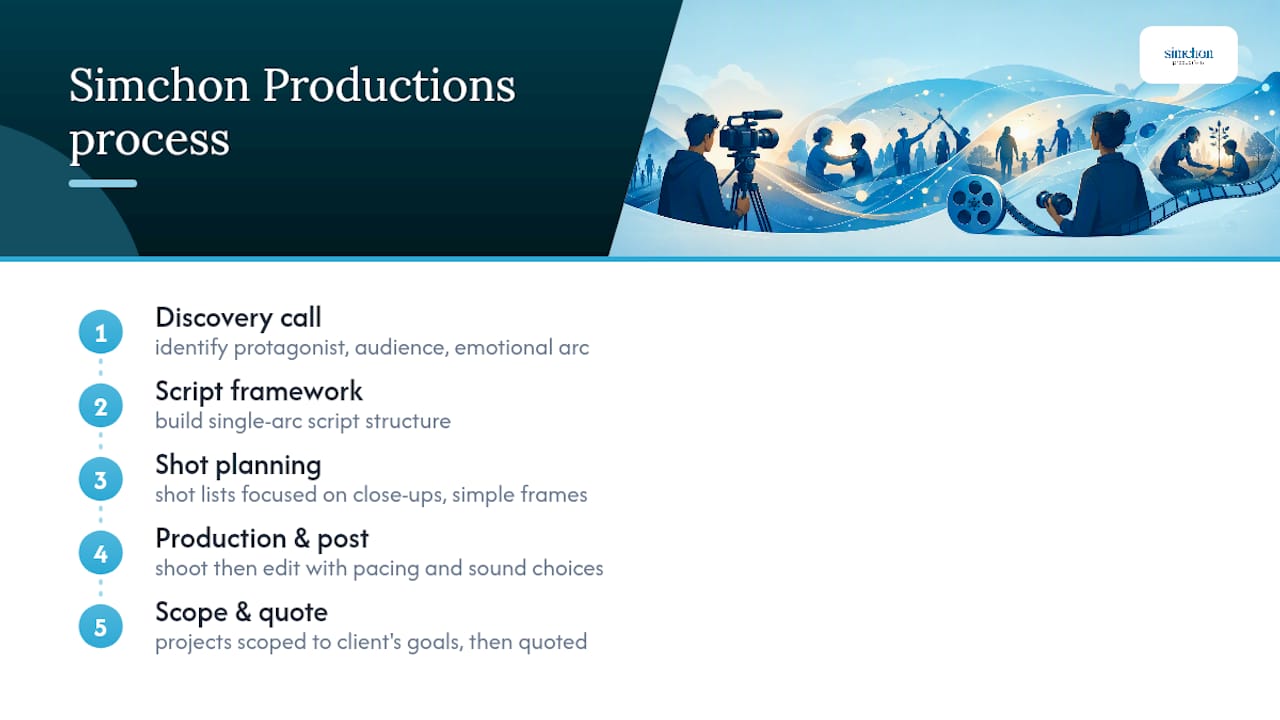
A typical project starts with a discovery call to identify the protagonist, the audience, and the single emotional arc the film needs to carry. From there, the team builds a script framework, plans shot lists around close-ups and simple frames, and handles post-production with the pacing and sound choices covered above. Projects range from short donor appeals to longer documentary-style institutional films, and each one gets scoped around the client’s actual goals rather than a fixed package.
Healthcare marketing teams working within compliance requirements can review examples in the patient storytelling guide before reaching out. To start a project, contact Simchon Productions directly to schedule a discovery call and get a scoped quote for your next film.
Where the research behind this article comes from
The claims in this article draw on peer-reviewed and large-sample research: the University Stories engagement study, the EEG-based emotional dynamics study, the visual complexity and attention study, and the auditory arousal and video engagement study. Readers building a research-backed production brief should consult these directly.
Sources
Emotional digital storytelling as a driver of social media engagement in higher education
Emotional dynamics and engagement in marketing videos (PMC article)
The dynamic effects of visual complexity and scene cuts on viewer attention
FAQ
What is a storytelling video?
A storytelling video presents a narrative, usually with a protagonist, conflict, and resolution, instead of a straightforward feature list or product demo. An emotional storytelling video adds a specific goal: making the viewer identify with the protagonist’s feelings, not just follow the plot.
What are the four types of storytelling?
Video storytelling generally splits into four working categories: brand narrative (company mission and values), testimonial or case study (a real person’s transformation), documentary-style (observational, unscripted), and campaign or event storytelling (built around a specific moment or cause). Simchon Productions works across all four for organizations, nonprofits, schools, and healthcare clients.
What are the five C’s of storytelling?
Definitions vary across marketing and film sources, but a common version includes character, conflict, cause, circumstances, and change, the elements that give a story shape and stakes. Not every framework uses identical terms, so treat this as a general guide rather than a fixed standard.
What is the best emotional story?
There is no single “best” emotional story format. The strongest ones share the same traits: a specific human protagonist, clear stakes, and a visible change by the end. A three-minute nonprofit mission film and a 60-second patient testimonial can both succeed if they follow that structure.
How long should an emotional storytelling video be?
Short-form emotional videos work best between 60 and 90 seconds for social platforms, while mid-form event or brand films run 2 to 5 minutes, and documentary-style institutional films can run longer when the story needs a mixed-emotion arc to sustain interest.