Filmmaker playbook for nonprofits: make 30–90s fundraising videos that pair story with one clear impact number, budget tiers, and ready script templates.

30–90s Fundraising Videos: Filmmaker Playbook for Nonprofits
A fundraising video strategy that works puts the donor at the center of the story, backs the claim with one clear impact figure, and ends with a CTA you can actually track. Keep it short, usually 30 to 90 seconds for social and email. Start today: draft a tight script or map out where each version of your video will live, because AFP’s storytelling guidance and the Give both point to the same gap: donors want proof, not polish.
TL;DR:
A fundraising video should have a clear, single-impact number placed after the emotional peak to enhance memorability and credibility.
Videos must be designed for sound-off viewing, with captions and visual storytelling to ensure accessibility and engagement.
The optimal video structure includes a hook within 10 seconds, stakes by 20 seconds, and a result before the call to action at around 90 seconds.
Production budget should align with campaign goals, ranging from $0 to over $20,000, depending on desired quality and scope, with time for approvals factored in.
Tracking meaningful metrics like view-through rates, click-throughs, and conversions is essential for evaluating actual donation impact, not just view counts.
Simchon ProductionsMake Your Nonprofit Story ResonateSimchon Productions creates cinematic nonprofit films with authentic storytelling and focused messaging designed to connect with your audience.Visit Simchon Productions
Table of Contents
What makes a fundraising video actually convert?
How do you write a fundraising video script fast?
Which production budget fits your fundraising goals?
Where should you publish each version of your video?
How do you know if your fundraising video is working?
What belongs on your fundraising video production checklist?
Why does cinematic, audience-first video move donors to give?
What should every nonprofit prioritize this year?
How can Simchon Productions help you build your strategy?
Where can you find more fundraising video research?
Sources
FAQ
What makes a fundraising video actually convert?
A fundraising video converts when it balances story and proof, hits the viewer fast, and asks for one clear action. I see nonprofits skip one of these three every week, and it costs them.
AFP’s guidance recommends a two-thirds narrative, one-third data mix. That means you spend most of your runtime on a person and their situation, then drop in a single, specific number to back up the emotion. Don’t scatter stats across the video. One number, placed right after the emotional peak, sticks better than five numbers spread thin.
Here’s the structure that works, mapped to time:
Hook (0 to 10 seconds): Show the protagonist’s face or situation immediately. No logo intros, no slow fades.
Stakes (by 20 seconds): Make clear what’s at risk if nothing changes.
Outcome (by 90 seconds): Show what changed because donors gave.
CTA (final 5 to 10 seconds): One ask, one link, one action.
This timing comes directly from AFP’s storytelling framework, and it holds up whether you’re cutting a 30-second Instagram Reel or a two-minute YouTube piece.
Accessibility matters as much as story. Design every frame to work with the sound off. Captions are not optional anymore. Establish your protagonist visually in the first several seconds so a scrolling viewer understands the story before they decide whether to turn on audio.

Your CTA has to be trackable, not just present. Use a unique UTM link for each channel, a short link for print or in-person asks, and a QR code for events. Embed the donate button directly below the video on your landing page instead of forcing a click-through.
Give.org’s 2026 Donor Trust Report found that 67.7% of U.S. adults say trust is essential before they give, but only 18.3% report high trust in charities. That gap is your opening. A video that shows real outcomes, not just good intentions, closes it faster than a brochure ever could.
How do you write a fundraising video script fast?
You write a fundraising video script fast by following a fixed time map and filling in six blanks: who, problem, intervention, result, donor role, and the ask. Skip the blank page. Use the structure.
Here’s the fill-in-the-blank framework:
Who: Name one person or one family. Not a category, not a statistic. A name.
Problem: State what they faced in one sentence, plain language, no jargon.
Intervention: Show what your organization did, specifically, not generally.
Result: Give one measurable outcome, a number, a milestone, a changed circumstance.
Donor role: Say plainly that donor support made the intervention possible.
Ask: One sentence, one action, no hedging.
For a 30-second cut, use only the hook and the ask, with one quick shot of the outcome in between. For 60 seconds, add the problem and intervention. For a 2-minute mission film, slow down and let the protagonist speak in their own words for at least 20 seconds before you cut to B-roll.
Before you shoot anything, get signed consent from every participant. Explain how the footage will be used, where it will be published, and how long you’ll keep using it. This protects the person on camera and protects your organization.
Pro Tip: Edit for silence first. Watch your rough cut with the sound off and see if the story still makes sense. If it doesn’t, the edit needs work before the voiceover does.

Which production budget fits your fundraising goals?
Your production budget should match your campaign’s stakes, not your organization’s size. A $500 phone shoot can outperform a $20,000 production if the story is strong and the edit is clean.
Phone or volunteer shoot ($0 to $500): Use a tripod, an external mic, and natural light. Capture one interview, some B-roll of your program in action, and add captions in a free editing app. Turnaround: 3 to 5 days.
Low-budget prosumer ($1,000 to $5,000): Hire a single shooter for one day, plus a freelance editor. Expect one polished 60 to 90 second video with clean audio and basic color correction. Turnaround: 1 to 2 weeks.
Mid-range ($5,000 to $25,000): Book a multi-day shoot, an experienced editor, and licensed music. Expect a primary film plus two or three shorter cutdowns for social. Turnaround: 3 to 5 weeks including approvals.
High-end cinematic (full agency production): Add a strategy session before anything is filmed, professional casting or subject selection, and a multi-day shoot with a dedicated director. This tier delivers a flagship film plus a full library of versioned assets for every channel. Turnaround: 6 to 10 weeks.
Whatever tier you choose, build in time for approvals. Board sign-off and legal review on donor testimonials often take longer than the edit itself.
Where should you publish each version of your video?
You should publish each version of your fundraising video where your audience already spends time, edited to match that platform’s habits. One master file, cut five ways, beats five separate shoots every time.
Email and donate-page embeds: Use a still thumbnail that shows a face, not a logo. Place the donate link directly below the player, not buried in a paragraph.
Social short-form (Reels, Shorts, TikTok): Cut vertical, hook in the first frame, and write the CTA as plain text on screen since many viewers scroll with sound off.
Long-form (YouTube, website): Write a full description with keywords, pin your donate link in the first line of the comments, and add timestamps for longer mission films.
Paid and CTV: Reserve a 30-second non-skippable cut for connected TV, since NonProfitPRO notes CTV works well for that format, and keep targeting simple: past donors, lookalike audiences, and your email list.
Sequencing matters. Use your acquisition edit, the emotional hook plus one ask, for cold audiences. Save your stewardship edit, the thank-you and impact update, for people who already gave. Reusing the same raw footage across both saves budget without repeating the same message.
Pro Tip: Serve your video to a prospect before a phone call or email ask. Industry commentary suggests video upstream of outbound contact can improve pickup and conversion, because the person already recognizes your organization when you reach out.
How do you know if your fundraising video is working?
You know your fundraising video is working when you can trace a donor from view to gift, not just count views. Set up tracking before launch, not after.
Track view-through rate and average watch time to see if viewers stay past the hook.
Track click-through rate to your donate page using a unique link for each placement.
Track donate-page conversion rate and average gift size to see if traffic turns into revenue.
Set up UTMs, a landing page funnel, and QR codes for events or print pieces that point back to video content.
Run one A/B test at a time: hook footage, video length, CTA wording, thumbnail image, or send time.
Give.org’s trust data shows only 18.3% of U.S. adults report high trust in charities, which means your first campaign should focus on proving impact clearly, not chasing viral reach. Treat your first video as a baseline. Your second and third videos, tested against that baseline, are where real gains show up.
What belongs on your fundraising video production checklist?
A fundraising video production checklist needs four parts before you ever pick up a camera: a message brief, a shot list, a release form process, and a delivery checklist.
Message brief: One page covering your case for support, the protagonist, and the single ask.
Interview questions: Five to seven questions that draw out specific moments, not general statements.
Shot list: Prioritize the protagonist interview first, then B-roll of your program, then supporting footage.
Release forms: Signed before filming, specifying usage and duration.
Delivery checklist: Captions, square and vertical crops, thumbnail images, UTM links, and embed code ready before launch day.
Production stage | Typical time needed |
|---|---|
Planning and script | 3 to 5 days |
Shoot day | 1 to 2 days |
Editing | 5 to 10 days |
Approvals | 3 to 7 days |
Distribution setup | 1 to 2 days |
Build this timeline backward from your campaign launch date so approvals never become the bottleneck.
Why does cinematic, audience-first video move donors to give?
Cinematic video moves donors when the messaging framework comes before the camera, not after. Simchon Productions builds every nonprofit film around a clear audience definition and a single focused message, then applies deliberate cinematography and post-production to carry that message with weight.
Authentic storytelling that hits the emotional core of the audience builds the trust that turns a viewer into a donor.
That approach mirrors what AFP’s storytelling guidance recommends: lead with story, support with proof. Whether an organization handles production in-house or brings in a partner, the deciding factor is always the same. A clear message, well framed, outperforms expensive equipment every time.
What should every nonprofit prioritize this year?
Three things matter more than anything else: a donor-centered story, a CTA you can actually track, and a habit of testing before you scale spend.
The mistakes I see most often are exploitative close-ups meant to shock rather than inform, big productions with no distribution plan behind them, and teams that skip versioning so one video gets forced onto every channel. Pick one video type, write a tight script this week, and run a single A/B test before your next campaign.
— Tzvi Simchon
How can Simchon Productions help you build your strategy?
This video production company turns the strategy in this guide into a finished film, matched to your budget tier and your timeline. Their services include brand films, donor films, nonprofit videos, event films, and documentary-style films, each built around an audience-first framework: define the viewer, focus the message, then shoot and edit to support it.
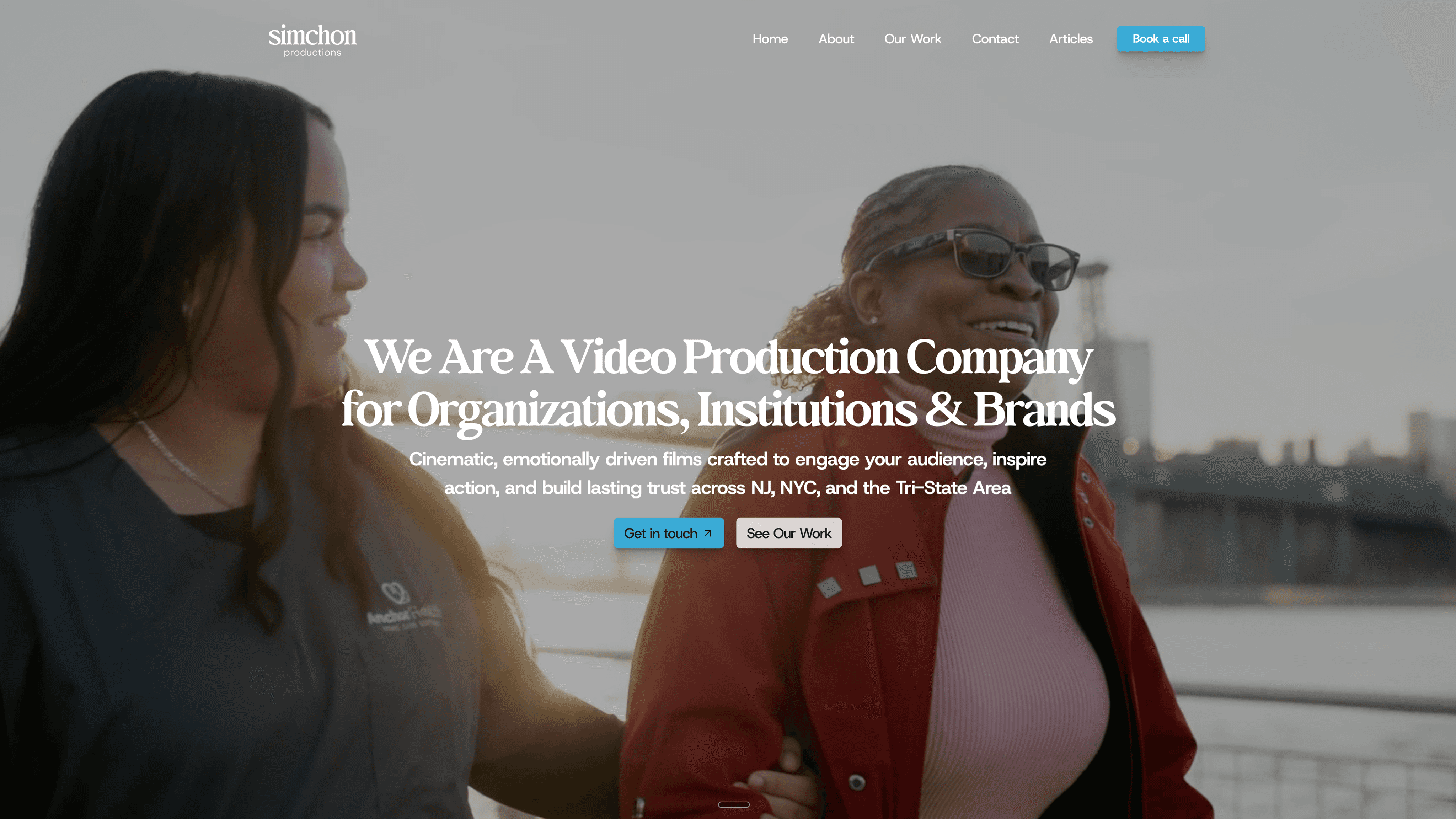
A typical engagement starts with a strategy session to define the protagonist and the ask, followed by shoot days, an edit pass, captioning, and delivery of versioned files for email, social, and donate pages. That structure covers common distribution needs, from a 30-second social cutdown to a longer mission film for websites.
If you’re weighing whether to shoot in-house or bring in a partner, start with a conversation about your goals and your timeline. Visit Simchon Productions to request a quote or review past work before your next campaign goes into production.
Where can you find more fundraising video research?
AFP’s storytelling guide lays out the narrative-to-data ratio and the timecoded story arc used throughout this guide.
NonProfitPRO’s video storytelling guide covers practical channel tactics, including CTV and testing video against static images.
Bloomerang’s donor thank-you video guide details timing and length for stewardship videos that support donor retention.
SignalEngine’s donor retention benchmarks offer a practical playbook for measuring retention after a campaign launches.
Sources
Storytelling for Donors: A Practical Guide for Fundraising | AFP Career Center
Donor Thank-You Videos: How to Make Them and Examples | Bloomerang
FAQ
What is the 80/20 rule in fundraising?
In fundraising, a large share of donations often comes from a small share of donors, which is why stewardship videos for major and repeat donors deserve as much attention as acquisition videos for new prospects. Applying this to video strategy means prioritizing personalized thank-you content for your top donors before scaling broad awareness campaigns.
What are some creative ideas for fundraising videos?
Strong fundraising video ideas include a single-protagonist mission film, a rapid-fire donor thank-you video sent within two weeks of a gift, and a behind-the-scenes look at how a donation gets used. Bloomerang recommends keeping thank-you videos to 30 to 90 seconds and sending them promptly, since timely thanks supports repeat giving.
What is the 3 to 1 rule for fundraising?
Definitions of the 3 to 1 rule vary across fundraising sources, so treat any specific ratio with caution unless it comes from a source covering your exact channel and audience. The more reliable principle, backed by AFP’s guidance, is a two-thirds narrative, one-third data balance within your video content itself.
What are the five P’s of fundraising?
The five P’s of fundraising are commonly described as purpose, people, plan, promotion, and persistence, though the exact list varies by source. For video specifically, the practical equivalents are a clear protagonist, a defined problem, a documented intervention, a measurable result, and a persistent, trackable ask.
How long should a fundraising video be?
A fundraising video for social media or email works best at 30 to 90 seconds, while a mission-driven film for your website can run up to two minutes. Bloomerang specifically recommends 30 to 90 seconds for donor thank-you videos, sent within two weeks of a gift for the best retention impact.