Learn what a public service announcement video is, how long it should run, how to plan and shoot one, and how to measure results, with real PSA examples.

Public Service Announcement Video: How to Make One That Works
A public service announcement video is a short, non-commercial film that raises awareness of an issue and asks viewers to take one clear action. The best ones run 30 to 60 seconds, open with a strong hook, and end with a single next step. This guide shows you how to plan, shoot, distribute, and measure one.
Simchon ProductionsMake Your PSA Message ResonateSimchon Productions creates cinematic films with authentic storytelling and focused messaging for organizations, institutions, and brands in the tri-state area.Explore video production
TL;DR
A PSA video serves the public interest. It does not sell a product. It points viewers to one action, such as visiting a website, calling, or booking an appointment.
Most video PSAs run 30 or 60 seconds. Fifteen seconds can work on social media.
Write a one-page creative brief first: goal, audience, tone, key message, call to action, and channels.
Effective PSAs use a hook, accurate facts, plain language, and a human story.
Plan distribution and measurement before you film, not after.
Table of Contents
What is a public service announcement video?
What makes a PSA video effective?
How long should a PSA video be?
How do you plan a PSA video, step by step?
What happens on the shoot and in the edit?
Which PSA topics work for healthcare, schools, and nonprofits?
How can Simchon Productions help with your PSA video?
How do you distribute a PSA video?
How do you know if your PSA video worked?
What is our view on PSA video?
FAQ
Sources
What is a public service announcement video?
A public service announcement (PSA) video is a short public-interest message that runs on broadcast, streaming, social, or other media. Its job is to raise awareness and motivate a defined action, such as visiting a resource, making an appointment, or changing a behavior.
The key word is “public.” A PSA speaks for a cause, a community, or a health issue. It does not promote a service for a fee. A hospital that tells parents to check car seats is running a PSA. A hospital that advertises its new surgery wing is running an ad.
That line matters for nonprofits, schools, and care providers. When a PSA feels like an ad, viewers tune out. When it feels like help, they listen.
What makes a PSA video effective?
An effective PSA grabs attention, explains one idea clearly, backs it with facts, and gives viewers a specific next step. The Community Tool Box says strong PSAs use simple, vivid language and a hook that earns attention without misleading, frightening, or stigmatizing people.
Penn State Media Commons lists four criteria:
Attract attention.
Communicate clearly.
Support the message with facts.
Help the audience sympathize with the people affected.
The American Council of the Blind adds that visuals can use live action, still images, animation, or graphics. The format is open. The message discipline is not.
Which PSA video examples are worth studying?
Three campaigns show different ways to build a PSA. Each one has published results.
Campaign | Creative approach | Reported result |
|---|---|---|
Love Has No Labels | Real people stood behind an X-ray screen. The reveal exposed implicit bias. | |
End Family Fire (2023) | Short scenes showed the consequences of unsecured guns. It ended with one instruction: store guns locked, unloaded, and away from ammunition. | More than half of aware gun-owning respondents reported safer-storage steps |
Tips From Former Smokers | Former smokers told their own stories on camera. | Exposure was associated with more quit attempts and higher 6-month quit intentions |
Look at what these three share. Each one used real people or real consequences. Each one asked for one thing. None of them tried to cover the whole issue in 30 seconds.
I see the same mistake all the time in organizational video. Teams try to say everything. A PSA that says everything gets remembered as nothing.
Why do tested messages matter?
The Office of Disease Prevention and Health Promotion says its Move Your Way materials were tested with intended audiences and offered in English and Spanish. Testing is not only for federal campaigns. Show a rough cut to five people who match your audience. Ask them what the video wants them to do. If they cannot answer in one sentence, the edit is not done.
How long should a PSA video be?
Most video PSAs run 30 or 60 seconds, and 15 seconds may suit social media, according to SAMHSA. Broadcast stations often expect those standard lengths. Social platforms reward a fast hook and a short run.
The format can be simple or elaborate. Texas DIR guidance says a PSA may be a single-actor message or a larger production with music, dramatic storylines, and effects. Budget and goal decide which one fits.
Here is a practical way to choose:
15 seconds: One fact and one action. Best for social feeds and reminders.
30 seconds: One short story beat, one fact, one action. The workhorse length.
60 seconds: A fuller story with a real person. Best when emotion carries the message.
A good habit is to cut a 60-second master and then pull 30-second and 15-second versions from it. Shoot with those cutdowns in mind. You will need clean frames and spare B-roll for each.
How do you plan a PSA video, step by step?
Start by deciding whether video is the right format, then define your topic, message, research, audience, distribution method, and hook. That is the order SAMHSA recommends before you outline, script, and storyboard.
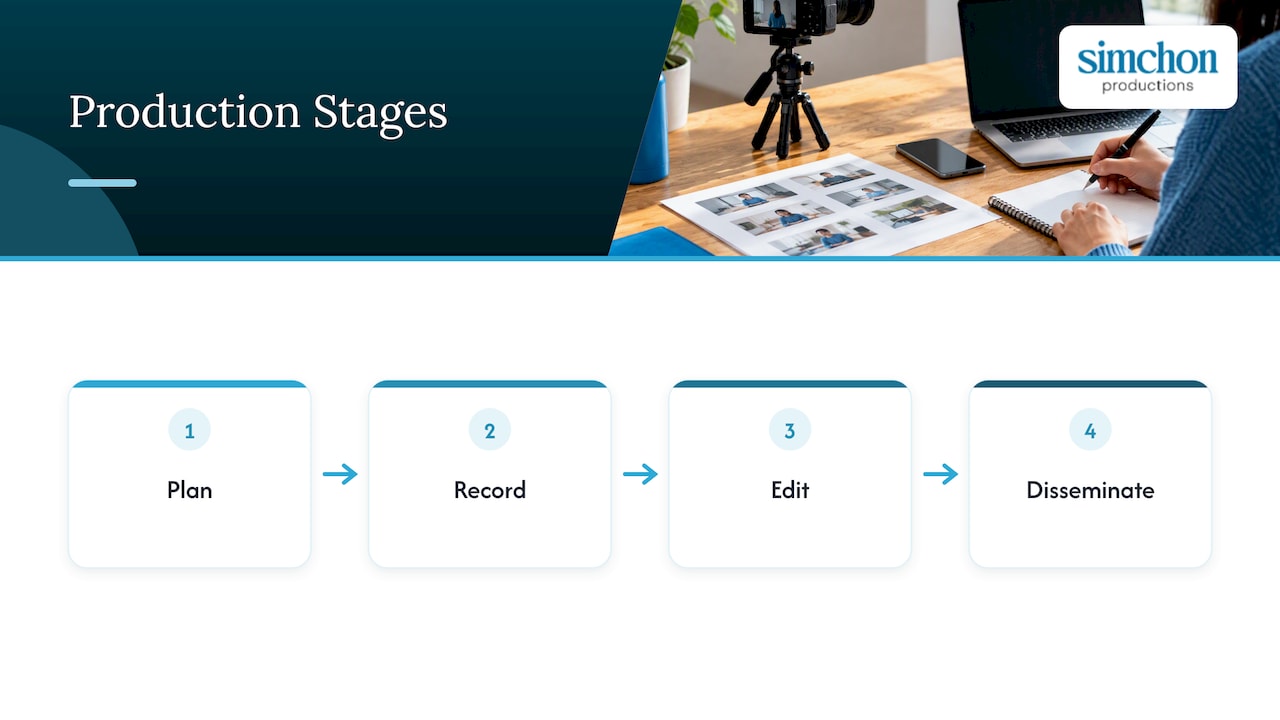
RTI International splits production into four stages: plan, record, edit, and disseminate. Use the same four stages whether you hire a crew or not.
What goes in a PSA creative brief?
RTI recommends a one-page creative brief that covers goal, audience, tone, key message, call to action, and channels. Here is how I would fill one out:
Goal: One measurable outcome. For example, more families booking a campus tour.
Audience: One group, described in plain terms. “Parents of rising 8th graders” beats “families.”
Tone: Warm, urgent, hopeful, or serious. Pick one.
Key message: One sentence a viewer could repeat to a friend.
Call to action: One step, with one URL, phone number, or location.
Channels: Where it will run, and in which lengths.
If you cannot fit the brief on one page, the PSA is trying to do too much.
What facts should the PSA answer?
The American Council of the Blind says a video PSA should answer who, what, when, where, and why. Its media materials should also list the organization’s name, contact information, run dates, length, and a short description of the message. Stations and partners need that sheet to say yes quickly.
How should the script sound?
Write for the ear. ODPHP’s user research found that audiences prefer informal, clear, concise, actionable content, with graphics that aid understanding and small-step instructions. Read every line out loud. If you stumble, the viewer will too.
A simple 30-second structure:
0 to 3 seconds: The hook. A face, a question, or a surprising image.
3 to 20 seconds: The story or the fact. One idea only.
20 to 30 seconds: The action. Say it, show it on screen, and say it again.
What happens on the shoot and in the edit?
A PSA shoot should capture real faces, clean audio, and plenty of B-roll, because the edit has to be tight. On a 30-second spot, every shot earns its place or gets cut.
Here is what a working filmmaker watches for:
Audio first. Viewers forgive a soft image faster than muddy sound. Use a lav mic or a boom, and record room tone.
Real people over actors, when the cause allows it. A person who lived the issue carries weight no script can match.
Release forms. Get signed releases from everyone on camera. For minors, get a parent or guardian signature. Patient, student, and resident privacy rules may add steps, so check them with your compliance lead before you film.
Captions. Many people watch with the sound off. Burn in captions and keep the call to action on screen for the last few seconds.
Multiple aspect ratios. Frame so you can deliver 16:9 for web and TV, and 9:16 or 1:1 for social.
In post-production, edit for emotion first and information second. Pick the music last, and keep it under the voice. Then test the final cut on a phone with the sound off and on.
Which PSA topics work for healthcare, schools, and nonprofits?
The best PSA topics are ones where your organization has real authority and the audience has a clear next step. Here are ideas by sector.
Senior care and healthcare:
Seasonal safety tips, such as hydration, fall prevention, or vaccine reminders.
A caregiver sharing what to look for when choosing care.
A short message that points families to a free resource line.
For more on how care providers plan film work, see our guides on the senior care video production process, the hospital video production process, and the healthcare agency video workflow.
Schools and universities:
Student mental health and where to find help.
Online safety for parents and teens.
A community awareness message tied to a school event.
Our K-12 video strategy guide covers how schools can fit this kind of film into a wider plan.
Nonprofits:
A cause-awareness spot built on one beneficiary’s story.
A volunteer call with one sign-up link.
A seasonal need, such as food or coat drives, with a clear drop-off point.
Our post on mission story video best practices shows how to find the story that carries a cause.
How can Simchon Productions help with your PSA video?
We produce cinematic, story-driven films for healthcare providers, senior living communities, private schools, universities, and nonprofits across New Jersey and the NYC tri-state area. A PSA fits inside that work, because every film we make starts with a defined audience and one focused message.
If you have a cause, a campaign, or a community message that needs to land, we can help you shape the brief, film it, and edit it for the channels you plan to use. Projects are quoted by scope, so there is no standard price list. Tell us what you want viewers to do, and we will tell you how we would film it. Start at Simchon Productions.
How do you distribute a PSA video?
Share the PSA online, through social media, at community events, and through partner organizations, and submit it to TV stations in their preferred format. That is the distribution path SAMHSA outlines.
Build a distribution list before you film. A simple version looks like this:
Your own channels: Website, email list, social accounts, and in-person screens.
Partners: Local health departments, school districts, chambers of commerce, faith groups, and sister nonprofits. Send them a short kit with the video files, captions, and a one-paragraph description.
Local media: Call the station’s public affairs contact and ask for its file format and length requirements before you export.
Paid boosts: Optional. Even a small budget can put a social cut in front of the right zip codes.
The Community Tool Box adds a useful caution. PSAs rarely create major policy or community change alone, especially when they rely on donated placement. They work best alongside broader communication and community engagement. Treat the PSA as one strong piece of a larger plan.
How do you know if your PSA video worked?
You measure the action you asked for, plus reach and awareness, using tracking you set up before launch. Views alone do not tell you whether anyone did anything.
Large campaigns show what a full evaluation can look like:
CDC reports more than 4.5 billion impressions, more than 6.8 million website clicks, and 42 million video views for its Stop Overdose campaigns from 2016 through June 2024. Exposure was associated with better naloxone and fentanyl knowledge.
CDC’s evaluation of the 2014 Tips From Former Smokers campaign estimated 1.83 million additional quit attempts tied to exposure.
The Ad Council used post-event surveys for a buzzed driving program. Among more than 5,000 concertgoers, 74% of drinkers reported taking safe transportation home.
You do not need a federal budget. You can copy the logic at small scale. CDC assessed reach, reactions, beliefs, policy support, and actions in one evaluation, and the results differed by outcome and survey wave. That is a good reminder to track more than one number.
For a local PSA, try this:
Reach: Views, completion rate, and shares by channel.
Action: Clicks to your landing page, calls, form fills, or sign-ups. Give the PSA its own URL or phone extension so you can count them.
Awareness: A two-question survey at an event or in your newsletter. Ask if people saw the video and what it asked them to do.
What is our view on PSA video?
We have filmed in nursing homes, classrooms, and nonprofit offices, and the PSAs that work share one trait: the team knew exactly who they were talking to before the camera came out.
Many organizations start with the topic. We start with the person watching. A parent scrolling at night, an adult child worried about a mother, a donor deciding where to give. Once that person is clear, the message gets shorter, and the film gets stronger.
We also believe a PSA should look like it cares. Cinematic quality is the floor, not the deciding factor. Good lighting, clean sound, and a careful edit tell viewers that the cause deserves their attention. Then a real face and one honest sentence do the rest.
That is why we build every film on an audience framework and focused messaging, then protect the emotional core through post-production. For a PSA, that approach keeps 30 seconds from turning into noise.
Tzvi Simchon
FAQ
What does PSA stand for in video?
PSA stands for public service announcement. In video, it means a short, non-commercial message made to raise awareness or change a behavior on a public-interest issue. It usually ends with one clear action for the viewer.
How do I make a PSA video?
Decide that video is the right format, then write a one-page creative brief with your goal, audience, tone, message, and call to action. Script and storyboard it, then film, edit, and distribute. Follow the plan, record, edit, and disseminate stages, and test a rough cut with a few people from your audience.
What makes a good PSA idea?
A good idea is one issue, one audience, and one action. It often rests on a real person’s story or a vivid consequence, and it avoids scaring or shaming viewers. If you can state the message in one sentence, the idea is ready to script.
How much does it cost to produce a PSA video?
Cost depends on scope: crew size, locations, talent, music, and how many versions you need. Texas DIR guidance notes PSAs are generally inexpensive when airtime is donated, but production still has costs. Our projects are quoted per engagement, so we scope your film before giving a number.
Where can a PSA video run?
It can run on your website, social channels, email, community events, partner organizations, and local TV stations that accept PSAs. Ask each outlet for its preferred length and file format first. Make a 30-second and a 15-second cut so you are ready for both.
Sources
Chapter 6, Section 7: Preparing Public Service Announcements, Community Tool Box
Evaluation of the National Tips From Former Smokers Campaign, CDC
The PSA Handbook for ACB Affiliates and Chapters, American Council of the Blind
How to Create DIY Video and Audio Materials, RTI International
Appendix C: Original User Research, Health Literacy Online, ODPHP